US moves to double its number of outbound students by 2018

The number of US post-secondary students studying abroad has roughly doubled in each of the past two decades, growing from 71,000 in 1989/90 to 144,000 in 1999/2000 and again to 283,000 students by 2011/12. The most recent figures, from the Institute of International Education’s (IIE) , indicate that 289,408 American students studied abroad for academic credit in 2012/13. Growth, however, has slowed in recent years with the total number of US students abroad increasing only 2% between 2011/12 and 2012/13. Also of note: that 2012/13 total represents only about 9% of all American undergraduate students today. These are some of the factors that led the IIE to establish an ambitious goal to double the number of American students abroad, in both credit and non-credit programmes, to 600,000 within five years (that is, as of the 2019 edition of Open Doors which will be based on 2017/18 data). The IIE’s initiative was launched in early 2014 with an initial investment of US$2 million, a call to action to partners and stakeholders in the US and abroad, and a plan to expand study abroad scholarships for US college and high school students. Allan E Goodman, the President and CEO of IIE, says of the rationale for the programme, “Studying abroad must be viewed as an essential component of a college degree and critical to preparing future leaders. Globalisation has changed the way the world works, and employers are increasingly looking for workers who have international skills and expertise.” In November 2014, IIE announced for Generation Study Abroad, including 298 US colleges and universities from 48 states, 67 international universities and organisations, 16 education associations, and 13 US and foreign government agencies (the US Department of State among them). These partner organisations have engaged with Generation Study Abroad in a variety of ways, including the following:
- The Council on International Educational Exchange (CIEE) has established a new US$20 million scholarship fund to support American students in their studies abroad.
- The State University of New York (SUNY) has pledged to increase study abroad participation by 25% across its 64 campuses, and to work to expand the international internship opportunities available to SUNY students.
- The University of Western Australia, one of five Australian universities partnered in Generation Study Abroad, has pledged scholarship support of up to US$70,000 in 2015, and is moving to introduce a new fee structure for US students that enroll outside of bilateral exchange agreements.
IIE has also announced a number of next steps for the initiative for 2015, including a Study Abroad Fund that will provide incentive grants to further boost study abroad programmes at US institutions, a virtual study abroad fair planned for February 2015, and a first-ever in Washington, DC in October. The importance of these measures as a mechanism for the coordinated expansion of study abroad nationwide is underscored by the following observation from Janice Mulholland, a US-based education manager with the British Council: “The US education system is highly decentralised. This means there’s little national coordination on most higher education policy issues, including those that affect student mobility. The Department of Education does have a hand in study abroad, but mostly indirectly through its federal financial aid programmes, which students can use to study abroad. The Department of State also plays a role in supporting student mobility through its grant programmes such as and initiatives like 100,000 Strong. This is a direct contrast to the British higher education structure and policy environment. In the UK, the government has set a national goal for 20% of UK students to study abroad.” Editor's note: Despite original proposals to cut Fulbright funding in the 2015 federal budget, last month President Obama restored Fulbright funding at its previous 2014 levels and also increased it by US$1.8 million to a final amount of over US$236 million.
US students abroad today
Decentralised system or no, it is fair to say that the prospect of another 300,000 internationally mobile US students in the next few years has captured the attention of institutions and partners around the world. While time will tell how fast and far the number of American students abroad will grow, it will also be interesting to watch how the participation of a large field of Generation Study Abroad partners may influence US study abroad trends, particularly with respect to destination and term of study.
It happens that the broad patterns of US outbound mobility have been reasonably stable over the past several years. NAFSA, for example, has summarised the last five years of Open Doors data to provide the following distribution of US students abroad by global region.
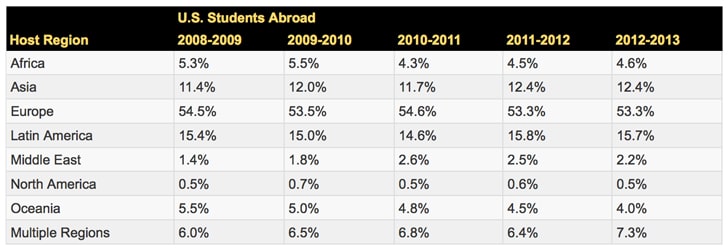
 Open Doors 2014 Report on US students studying abroad. Source: IIE