
New degree system drives rising enrolment and quality in Niger

West African countries are continuing to implement the bachelor-master-doctorate system, or LMD – with University World News reporting that . Now the system is standard for West Africa’s largest country, which has a population of 15 million people and is mostly Saharan desert. Last May, Niger’s cabinet adopted a decree establishing the LMD system as compulsory for higher education institutions. This followed adoption of the system in October 2009 by Abdou Moumouni University, the country’s largest and oldest university. With the decree, Niger officially complied with a 2007 West African Economic and Monetary Union directive, in terms of which member states must adopt the LMD system. But the directive demands more: member states must also comply with international quality standards for issuing the three different types of degrees: the licence (three-year bachelor), masters (two years) and PhD (three years). Before implementation of the LMD system, it took four to five years to complete a bachelor degree in Niger. The government’s concerns are now centred on the quality of higher education and research. The introduction of the LMD system in higher education institutions in this Sahel state is also designed to improve access to quality education. “Once established, this system will enable higher education and scientific research to adapt to development needs and to ensure – like in the Anglo-Saxon countries from which it came – training that will lead directly to [economic growth],” said Dr Mahaman Laouali Danda, Niger’s minister of higher education.
Lack of resources
Monitoring progress is difficult due to a lack of resources and a dearth of accurate statistics. “The government is trying to implement the LMD, but for now the means are not following,” said Dr Amadou Diallo Bounty, a professor in the faculty of humanities at Abdou Moumouni University. Niger was once a French colony and France is helping fund the reforms. It has earmarked a budget of EUR1.2 million (US$1.57 million) to help Abdou Moumouni University implement the LMD system in full, while directly assisting teachers, researchers and students. French ambassador to Niger Alain Holeville said support for higher education was a priority of the French government. “This project is proof that France is on the side of youth, and that investing in higher education is an investment in the future,” he said. Bounty pointed out that Niger’s work was not being done in isolation. The country belongs to NEHEWA – the Network for Excellence in Higher Education in West Africa – which involves many universities. NEHEWA promotes a new policy of academic cooperation in the region and aims to modernise university education and boost the mobility and employability of students and graduates. The Network strives to identify the best strategies to finance higher education, which means identifying and assessing ways to make the LMD system more accessible financially and improving its implementation. Adopting the LMD system across the region should help align curricula and make studies more credible worldwide. Niger is a member of the Economic Community of West African States, which has charged member states with common goals including higher education development. And the West African Economic and Monetary Union has a programme, supported by the African Development Bank, to assist member states including Niger in reforming higher education and adopting the LMD system.
Tertiary education in Niger is growing
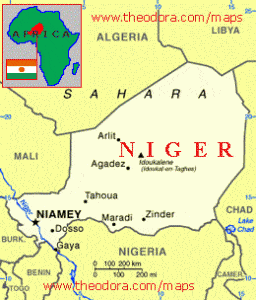
Meanwhile, tertiary education has been growing in Niger. In 2010, a transitional military regime launched three new universities to ease the pressure on Abdou Moumouni University, which was the only public academic institution. The government, replaced by an elected administration in April 2011, adopted three draft ordinances for establishing universities in Maradi, Zinder and Tahoua. The initiative aims to ‘decongest’ Abdou Moumouni, according to University of Tahoua President Ambouta Karimou. “Our university is still a young institution that has not yet many years of experience in the system of LMD,” he said. They are also short of money: “The budgets allocated to us are not based on the specific needs of our institution. So it is clear that our needs are not fully covered. As we are now in our third year, we just released our first masters courses without being able to gauge the level of effectiveness.” The private sector has also been growing. The l’Université Canadienne du Niger, or UNICAN, was the first private university to be established, founded by President Dr Ismaël Camara in 2002 following formal approval from the Ministry of Higher Education. The Islamic University of Niger – officially called Oum Al-Qura University of Niger – based in Say, was established in November 1986, with its faculty provided by members of the Organisation of Islamic Cooperation. Another private institution, the University of Maradi, was launched in 2004 in southern Niger. “These projects aim to strengthen the capacity of higher education and research to ensure better development of the country,” said a Niger government communiqué. Meanwhile, Abdou Moumouni University remains dominant, enrolling between 15,000 and 19,000 students, according to the government, but with a budget of less than XAF5 billion (US$10 million). As for Tahoua, Maradi and Zinder; they currently provide technology and science courses only, and have fewer than 5,000 students each. Source:







