
Social media as a marketing tool – who does it best?

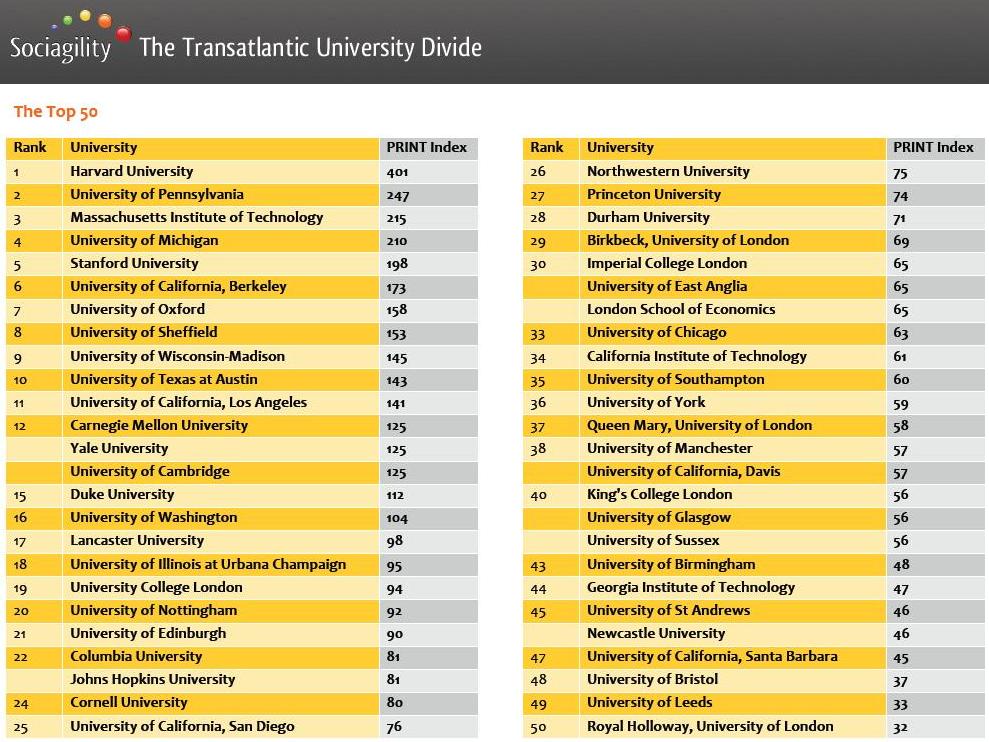
Changes in UK higher education sector funding means that even the most venerable institutions are having to compete more aggressively for sources of revenue. This competition is especially evident in the race to attract the very best national ‘AAB’ students and for international students. But how should universities market themselves to these potential students? And does this actually matter in the fight for reputation, recruitment and revenue? If it does, can UK universities learn any lessons from their US counterparts? As outlined in a recently released report, , the social media consultancy Sociagility used its PRINT™ social media performance measurement system to compare 50 leading UK and US universities from the 2011-2012 Times Higher Education World University Rankings. By analysing the relative effectiveness of institutions in the two markets, they were able to identify what, if any, lessons could be learned from the leaders.
Finding the audience – does social media matter?
If being competitive in student recruitment matters then what matters to 16–24 year olds is also very important. Online engagement is second nature to this group and social networking is the number one activity. Clearly all the traditional methods of marketing to this group are still important but social media can provide an opportunity to create a competitive edge:
- to allow prospective students to engage on a more personal and informal basis;
- to see what the campus experience is really like;
- to interrogate current and past students about teaching, accommodation, lifestyle and job prospects.
And for international students with less opportunity to visit a campus, the online recruitment experience is crucial and social media increasingly important. The PRINT™ scores are based on site traffic, followers, views and engagement - as well as receptiveness to listening to comments, interaction, network reach and trust. Sociagility's results show remarkably close correlation with THE's World University Ranking scores, both the overall and the reputation index, demonstrating that these are not chance effects. It must be acknowledged that many of the US institutions dominating the rankings are very large and very well funded compared to their UK counterparts, and that sheer size and volume of activity may boost some individual attribute scores, like popularity and network reach.
What are US universities doing right?
Most of the leadership in social performance is in the US, and this has implications for reputation and recruitment. In general it seems that not only have US universities been devoting more time and effort, over longer, than most UK institutions, they have also committed management support and dedicated resources across faculties and departments, not just a couple of people centrally. Representatives of some of the US universities analysed also said that they feel comfortable that their reporting structures are clear, with single or joint reporting lines to well-established communications departments, which in turn are part of established marketing functions. The top US universities interviewed were not resting on their laurels but investing further in better content, social media specialists, additional listening capability and measurement systems. As one commentator put it: “We need to ensure better value not just more volume.”
What can UK universities do better?
- Get the basics right One very simple step that every university can take right now is to ensure that its primary social media accounts are clearly signposted on the home page of its website. The number of UK universities that have not done so is astounding.
- Develop a clear strategy The high performing universities in the UK and US spoken to all had a formal social media strategy in place. Elements included: • clearly defined objectives that linked to university success; • senior management support and leadership for all the university’s social media efforts; • consistent approaches across all schools and departments; • central guidance and policies to encourage and empower disparate teams; • dedicated social media resources both centrally and in key individual departments.
- Choose the right channels Social media success is not about using every channel, but about using the right channels (Harvard, for example, did not record the highest Twitter or YouTube channel scores). UK universities can consult and conduct their own audience research in order to determine the best social media channels to reach the right audiences, with the right messaging.
- Focus on the right things Although certain kinds of activity may ‘feel’ right, they won’t always contribute towards strategic objectives or deliver any kind of competitive advantage.
- Benchmark and measure The emphasis on meaningful social media measurement (i.e. not fans and followers) must increase, as every marketing activity comes under scrutiny in order to balance the books.
Source: Sociagility







