
Foreign applications to Hong Kong universities up sharply this year

A surge in 2012-2013 applications to Hong Kong institutions is another sign that the country is making headway in establishing itself as an education hub. Since the government began new policies in 2007, more scholarships have been provided for international students and immigration policies have been liberalised. Its reputation has been growing stronger as the country revamps its universities’ curricula, expands university facilities, and attracts American and other foreign higher-education institutions. But has it progressed beyond its status as a regional education hub to more of a global study destination? takes a closer look...
More international students knocking on Hong Kong's door
The New York Timesrecently announced that universities in Hong Kong have seen a dramatic increase in the number of foreign applications for 2012–2013. The University of Hong Kong is reporting a 42% increase compared to 2011–2012. The Chinese University of Hong Kong is up 50%, and the Hong Kong University of Science and Technology is reporting 55% growth over the same period. University enrolment statistics in Hong Kong reflect country of origin across three broad categories: local, foreign, and Mainland Chinese. And reports suggest that the Special Administrative Region’s eight publicly funded universities are seeing comparable growth (up 53%) in the numbers of applications from Mainland China as well.
Building reputation
Needless to say, these are substantial gains and they call to mind the government’s policy, first announced in 2007, of establishing Hong Kong as a regional education hub. In the five years since, much progress has been made:
- scholarship funding for foreign students has been increased;
- quota limits on international students have doubled (from 10% to 20%);
- visa regulations have been relaxed (foreigners can now stay on in Hong Kong to work for a year after graduation);
- the region’s public universities are in the midst of a major redesign that will see a shift away from the British-inspired three-year degree programmes to American-style four-year degrees.
Most recently, the Hong Kong Education Bureau is offering six parcels of cheap land, and other incentives, to attract foreign institutions to establish branch campuses in Hong Kong. The World Bank reports that there were five foreign branch campuses operating in Hong Kong in 2010. With that in mind, these latest initiatives stand to result in a significant jump in the number and profile of foreign institutions operating in Hong Kong, not to mention the ballooning capital investment in education in the territory. So if all these growth indicators are pointing so sharply upward — 42%, 50%, and more from one year to the next — can we now conclude that Hong Kong has arrived as an international study destination, or as an important regional hub for education in Asia?
Looking at the numbers
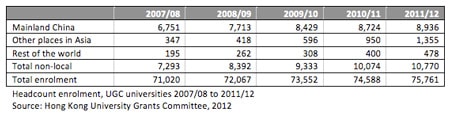
A closer look at the statistics from the University Grants Committee — a government administrative and advisory body for the territory’s eight publicly funded universities — reveals that while some year-over-year growth measures are indeed impressive, overall foreign student enrolment has grown steadily, but more modestly overall, since 2007.
The UGC reports that non-local students, that is students from outside the Hong Kong Special Administrative Region, accounted for 10.27% of total enrolment in 2007–2008 and 14.22% in 2011–2012. Overall, non-local enrolment in the eight UGC universities grew by 48% over the same period.
UGC figures also indicate that the bulk — nearly 63% — of this growth has come from an increase in enrolments from Mainland China. Most of the remainder originates from students from elsewhere in Asia, with minimal growth in the numbers of inbound students from other global regions.
“We have a number of excellent universities in Hong Kong, so international students and parents are now beginning to realise the opportunities for higher education here. Many students, particularly those from Asian countries, are choosing to stay in Asia because of the enhanced job opportunities after graduation predicted from the economic growth forecasts.”
The enrolment composition that we see in Hong Kong reflects a broader global trend of international students staying within their home regions to a greater extent than they have in the past, and that is perhaps the most significant aspect of some of the recent enrolment growth reports. While the SAR may not yet be ready to take its place as a global study destination, it is certainly drawing more students from within Asia. As the government policy changes of recent years — affecting everything from visa regulations to government investment to scholarship support and even curriculum design — continue to take hold, it seems clear that Hong Kong will further emerge as an important regional destination for students in Asia and especially for those in the key Mainland Chinese market. Sources: , The Chronicle of Higher Education,







