
International students generate CDN$8 billion for Canadian economy

has released a report showing that international students contributed more than CDN$8 billion to the Canadian economy in 2010, up from CDN$6.5 billion in 2008. Ed Fast, Minister of International Trade and Minister for the Asia-Pacific Gateway, proudly announced:
“The Harper government is committed to continuing to attract the best and brightest students to Canada.”
“This study reaffirms our government’s commitment to international education. That is one of the reasons we are committed to refreshing our government’s Global Commerce Strategy and to developing a comprehensive plan to entrench educational links between Canada and international institutions for Canada’s long-term prosperity.”
The report found there were 218,000 full-time international students in Canada in 2010, up from 178,000 in 2008 and more than double the number of students in 1999.
In total, the annual expenditure of CDN$8 billion by international students translated to estimates of almost CDN$4.9 billion worth of contribution to GDP, supported 86,570 jobs, and generated CDN$455 million of government tax revenue. Foreign students are now worth more than Canada’s exports in unwrought aluminium or aerospace products.
“I am delighted that Canada is a destination that is growing in attraction for international students,” said Minister Fast while visiting the University of British Columbia. “The presence of international students and researchers taking advantage of Canada’s world-class facilities creates jobs and economic growth, and contributes to our people-to-people ties with other countries and, in particular, emerging markets.”
“Outstanding international students and researchers not only enrich our campuses but make Canada more competitive by sharing knowledge and expertise both during their time at university and afterwards,” said Prof. Stephen Toope, President and Vice-Chancellor of the University of British Columbia.
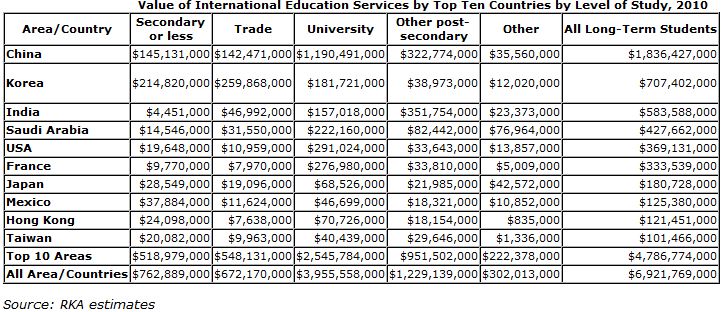
- The economic benefit of international students studying in Canada is substantial. Total expenditure of long-term international students in Canada amounted an estimated CDN$6.9 billion in 2010. This translates to almost CDN$4.2 billion in GDP contribution to the Canadian economy, and represents about 7% of the GDP contributed by the overall education services sector in the Canadian economy.
- International education services serving these long-term students contributed to 70,240 jobs in the labour market. This represents about 5.7% of the total number of jobs in the overall education services sector in Canada.
- Those international students in short-term language training programmes in Canada were estimated to have contributed an additional CDN$788 million per year in total spending to the Canadian economy. This is equivalent to about CDN$455 million in GDP, 10,780 jobs, and CDN$48 million in government revenue.
- In addition to capturing the economic impact that has resulted from students’ spending on tuition, fees and basic living expenses, an estimated CDN$336 million per year can be attributed to additional tourism related activities, enjoyed by the international students and their family and friends.
- Governments also benefit from international education services as the total amount of net indirect taxes collected in 2010 was estimated to be CDN$455 million (including tax revenue generated from serving long term and short term international students, as well as from tourism activities). Out of this amount, an estimated CDN$180.6 million were tax contributions to the federal government, and CDN$273.9 million was contributed to provincial and territorial government tax revenue.
- It is important to note that over 50% of foreign students are from Asian countries (primarily China, India, South Korea and Japan).
A commitment to refresh Canada’s Global Commerce Strategy was announced in Economic Action Plan 2012. A more powerful international education strategy will help strengthen Canada’s engagement with emerging economies and ensure greater collaboration between Canada and institutions while boosting the country’s economic prosperity. The full report can be found , and more details on Canada's international education and youth efforts are . In addition, our video with Languages Canada Executive Director Gonzalo Peralta explains what Canada is doing to ramp up its marketing efforts around the world. Watch the video interview here. Source:
Most Recent
-
Canadian immigration officials have made several updates to compliance guidance for study permits and post-graduate work permits Read More

-
Italy announces its “biggest language training and international mobility programme ever� Read More
-
Why sharper English-language guidance is becoming an agent’s sharpest tool for student success Read More







