NACAC removes ban on commissioned agents in international student recruitment

The National Association for College Admission Counselling () held its national conference in Toronto this past week. On Saturday, the NACAC Assembly debated - and passed with a 152-47 vote - a motion to change the association’s ethical standards to permit the use of commissioned agents in international recruitment. The motion was closely based on a related recommendation from the final report of the Commission on International Student Recruitment that was released last June. The motion’s passage will now result in an amendment to Section I.A.3 of NACAC’s Statement of Principles of Good Practice to stipulate that member institutions will:
“not offer or accept any reward or remuneration from a secondary school, college, university, agency or organisation for placement or recruitment of students in the US. Members who choose to use incentive-based agents when recruiting students outside the US will ensure accountability, transparency and integrity.”
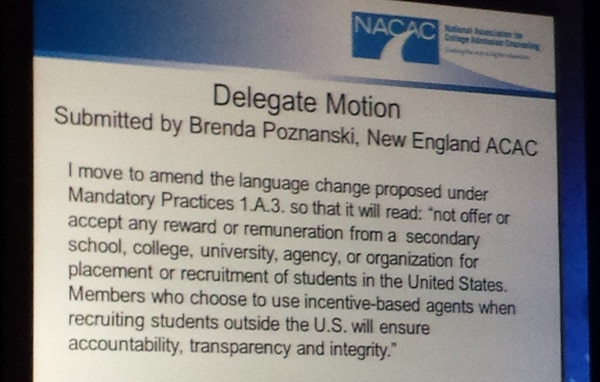
Previous to this amendment, Section I.A.3 read simply, “not offer or accept any reward or remuneration from a secondary school, college, university, agency, or organisation for placement or recruitment of students.”
An important step forward
The question as to whether this stipulation applied to international recruitment - and, in effect, whether it then represented a ban on the use of commissioned agents in recruiting students outside the US - was raised in 2011. This triggered a years-long debate within and around NACAC that led to the formation of the Commission on International Student Recruitment, the Commission’s report earlier this year, and, ultimately, the vote this past weekend on the motion to amend NACAC’s Principles of Good Practice. “The Assembly’s vote is an important step forward that will enable us to continue to protect the rights of students while resolving questions about the propriety of using commissioned agents in international recruitment,” said Jim Rawlins, NACAC president. “I commend the Assembly for addressing this difficult issue in a comprehensive and collegial manner and for taking into account the many points of view on this issue.”
The new requirements will take effect after a one-year moratorium during which NACAC’s Admission Practices and International Advisory Committees will continue to interpret and refine the implications of the Assembly’s vote for US colleges and universities that recruit students from countries outside the US. In particular, the International Advisory Committee will now move forward to develop a best practices guide for working with commissioned agents in international recruitment, with the expectation that the forthcoming guide will “serve as a template for colleges, universities, and secondary schools when establishing and maintaining relationships with incentive-based agents and agencies.”
It is expected that the Committee’s guide will be presented at the 2014 NACAC Assembly. Coming back for a moment to the vote this past weekend, a report from Inside Higher Ed provides a concise : “The question of whether abusive practices are more likely to happen when agents are paid on a per-student basis has been at the heart of the debate. Some argue that the fact that an agent has a financial interest in a student landing at a particular institution could lead the agent to put his or her own interests - rather than the student's - first. "There are concerns about a lack of transparency - does a student even know that the agent has a financial stake in the universities he or she recommends - and disagreement about the acceptability of "double-dipping," in which agents collect fees from both the student and the institution. "Finally, some who oppose the use of agents argue that many universities view them as a shortcut to increasing international enrolments, and tuition revenue, without making the necessary investments to support international students when they actually show up on campus. "Those supporting the use of commissioned agents, on the other hand, argue that it can in fact be done ethically and responsibly, and that contracting with individual agents around the world is the most feasible way for many institutions to expand their global reach. They also point out that for universities in Australia, Canada and the United Kingdom, the practice has long been common and largely uncontroversial.”
Statements of support
The American International Recruitment Council (), a non-profit industry association of accredited US higher education institutions and AIRC-accredited international recruitment agencies, was quick to commend the vote in an official statement over the weekend. “AIRC commends the decision by the NACAC Assembly to adopt new language in the association’s Statement of Principles of Good Practice following the recommendations of the NACAC Commission on International Recruitment. AIRC strongly supports the Commission’s call for accountability, transparency and integrity by institutions engaging in agency based recruitment… AIRC stands ready to work with institutions seeking to understand the implications of adding an agency-based recruitment component to their recruitment practice and supports NACAC’s continued attention to this process.” ºÚÁϹÙÍø is also on the record as supporting the recommendations of the Commission on International Student Recruitment and is also an advocate for strong professional practice standards for institutions and agents alike. In the wake of the strong vote of support at the NACAC Assembly, ºÚÁϹÙÍø CEO Markus Badde added:
“We congratulate the Assembly for its adoption of the motion to amend NACAC’s Statement of Principles of Good Practice. And we particularly support the association’s emphasis on accountability, transparency, and integrity. These values are closely aligned with the standards of practice that we promote at ºÚÁϹÙÍø through our quality control systems, training and certification services, and professional development programmes. This is an exciting moment for our industry, one where we can now move past the question as to whether working with commissioned agents is ethical or not, and on to the more substantive issues that will actually impact on the quality of educator-agent relationships and on the quality of service for students and their families. ºÚÁϹÙÍø heartily endorses the development of such standards and will be pleased to support the ongoing work of the NACAC committees in any way that we can.”
Most Recent
-
Japan: Greater availability of in-country English programmes is exerting some downward pressure on outbound mobility Read More

-
UK: Sponsored study visa issuances down, rejection rates up, and more Read More
-
Beyond borders: Why student support matters more than ever in transnational education Read More