UK moves to simplify visas for Chinese visitors

The British government announced steps last week to make it - news that was welcomed across the global education and travel industry but especially in the UK, where some reports bemoan millions of pounds in lost revenues arising from Chinese frustration with British visa processing. This latest announcement follows a number of changes to the UK’s immigration rules, which took effect at the beginning of this month, in its effort to make the country more attractive. The UK’s Chancellor of the Exchequer, George Osborne, announced three new visa measures targeting Chinese tourists and business travellers at the beginning of his five-day trade mission to China in mid-October. The announced changes are said to be in effect by summer 2014:
- Selected Chinese tour operators will be able to use the “Schengen” form, a single application accepted by 22 out of the 28 EU member states as well as Iceland, Liechtenstein, Norway, and Switzerland, to apply for their groups to visit the UK as well. Currently, Chinese tourists have to fill out a separate application for the UK, an extra step critics have said has dissuaded Chinese tourists from visiting the UK when they travel to the EU. Mr Osborne also noted that there is a goal to expand the single-application process to Chinese business travellers as well as tourists.
- A 24-hour “super priority” visa service will be made available to Chinese nationals.
- The UK will expand its VIP mobile visa service – currently available only in Shanghai and Beijing – to major cities across China. This would see teams go out to applicants to collect their forms and biometric data. As New Europe says, “Not only will [Chinese] no longer have to submit a second application, but they won’t even have to get up from their desks.”
In the course of his announcement, Mr Osborne commented to an audience of Chinese students at the top-ranked Peking University:
"I don't want Britain to resent China's success; I want us to celebrate it. I don't want us to try to resist your economic progress; I want Britain to share it... Let me make this clear to you and to the whole of China, there is no limit to the number of Chinese who could study in Britain. There is no limit to the number of Chinese tourists who can visit. No limit on the amount of business we can do together.”
Some observers anticipate the improved visa processing for Chinese visitors may lead to increased enrolment in short-term courses in the UK, and could even make the UK a more attractive destination for longer-term study to the extent that improved visa conditions make it easier for family members of foreign students to visit Britain. Chinese students make up the largest group of foreign nationals in UK schools and universities. The UK Council for International Student Affairs reports there were 78,715 Chinese students enrolled in the UK in 2011/12, with Indian students the next largest national group: 29,900 students in 2011/12, although this did represent Britain's first-ever drop of international students from India (a dramatic 23.5% decline).
Opportunity lost?
In 2012, Britain issued 210,000 visas to Chinese citizens and these tourists are estimated to have contributed £300 million to the British economy. Yet many believe that Britain has lost millions of pounds annually as a result of outdated and unwelcoming visa policies toward Chinese tourists. For its part, a statement from the UK government notes that, “The UK already offers a competitive service to Chinese visa applicants,” and reports that its China services include:
- 12 Visa Application Centres across China, more than any other country outside Asia.
- An optional five-day priority visa service for eligible tourists, business visitors and skilled workers.
- Guides on the visa application process in Chinese for business visitors, independent travellers and Approved Destination Status travellers.
- A Prime Time service in six Visa Application Centres, offering extended opening hours for those who need the convenience of an appointment outside of usual business hours.
The British government reports as well that, “96% of Chinese visa applications to the UK are approved and (non-settlement) visas were processed, on average, in less than seven days in the first half of 2013.”
Opportunity found
According to a release from China outbound travel specialist China Edge Ltd.:
“Chinese are now the largest consumers of luxury in the world, but over 60% of their spending happens outside China - and the UK has an opportunity to capture a larger share of the market. The average Chinese visitor to the UK is reported to spend around £8,000, so a significant increase in visitor numbers could represent a windfall for well-prepared British brands.”
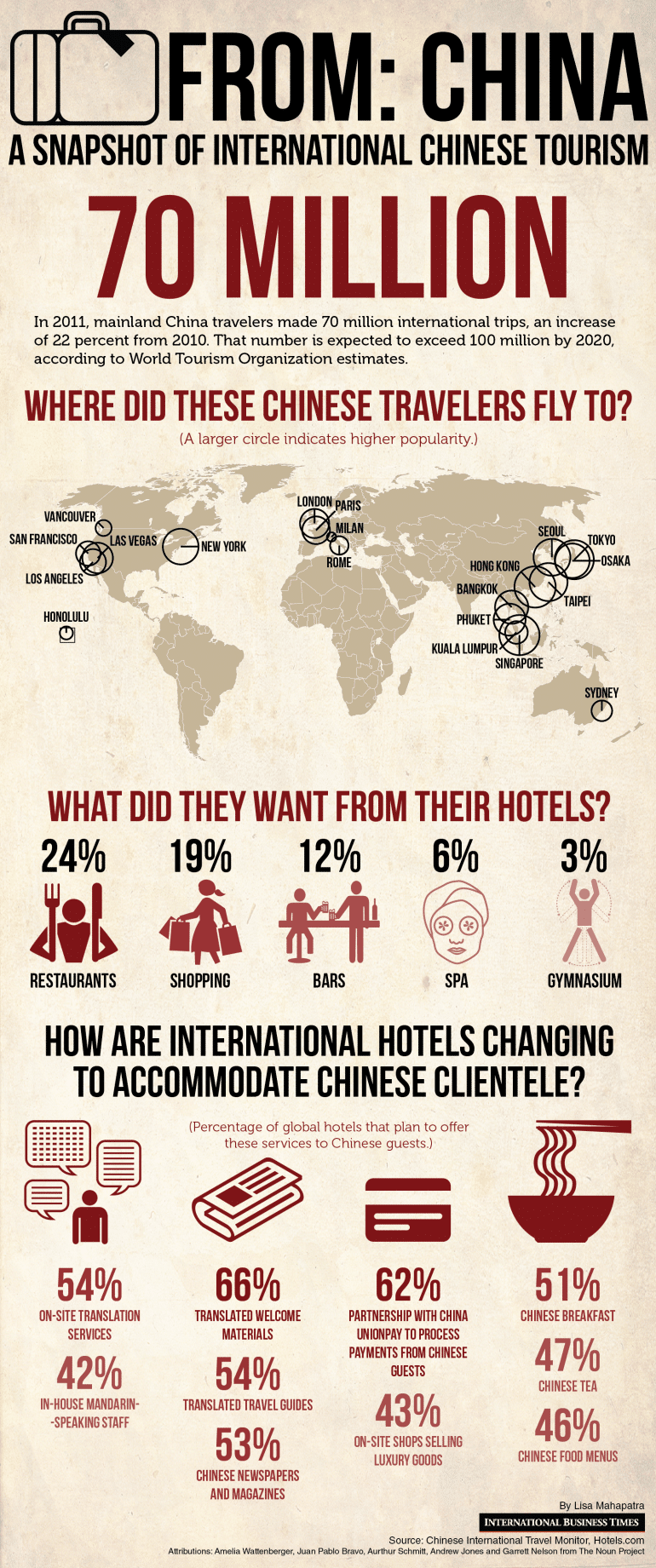
Jeremy Gordon of China Edge advised UK businesses to get more sophisticated in their marketing to wealthy Chinese visitors: “There is much more that British luxury brands can do to effectively target, engage and serve the global Chinese consumer. Brands should review their strategy and the relevance of their offering for Chinese visitors, build engagement with outbound tour operators and through Chinese social media, and also enhance in-store services and training.” For tips and best practices on how to apply this to the education sector, see our related article "Chinese students drawn to elite education brands." The opportunity is indeed huge, as illustrated in the infographic below. According to the World Tourism Organization, there will be 100 million outbound Chinese tourists in 2020. The Chinese market research firm Daxue Consulting :
- The Annual Report of China Outbound Tourism Development 2009–2012, reports that 70.25 million Chinese tourists travelled abroad just in 2011, with a year-on-year growth of 22%.
- According to the number of tourists, China’s outbound tourism market has been the largest market on the planet, 1.2 times and 3.5 times the US market and the Japanese market, respectively.
With its new measures for streamlining visitor visas, the UK is now moving to strengthen its position in this key global market and to increase its share of the exploding demand for outbound travel among Chinese students and families.