
Is that funny? Using humour in international recruitment marketing

We could have spent April 1 – otherwise known as in many parts of the world – trying to convince you that the liberal use of purple on your website is the key to search optimisation, or breaking the news that US President Barack Obama is leaving politics to take up international student recruitment full time.
But instead, we’ll retain our usual laser-like focus and gravitas today because it is high time we tackled a pressing issue of concern to many education marketers: is there a place for humour in international student recruitment?

Humour (like great marketing) often relies on cultural references or other shared understanding that can break down across borders and cultures. Watch for this when incorporating humour into your marketing, especially for campaigns or materials that are going to be used in multiple countries. Adapt where you think you may need to, or fall back to more culturally neutral marketing messages when in doubt.
The key here, as in most aspects of marketing, is to be true to your school. Don’t use humour at the expense of your brand or if there isn’t a good fit with the rest of the story you are trying to tell through your marketing effort. Some brands – some industries for that matter – lend themselves more to the use of humour than others. At the same time, if you are in a marketplace, such as education, where humour is less often used, there can be an opportunity to set your institution or school apart by tapping the funny bone of prospective students. Similarly, if you are trying to position against more established or higher profile brands, then humour can be a device that helps you break through in a highly competitive space. The University of Lincoln vs. Swans While your brand contains many of the answers as to how far you should go with humour, knowing your audience is also key. What will they find funny in the first place and how will your use of humour influence their impressions of your institution or school? If in doubt about any of your marketing materials or a new campaign, test it with colleagues, partners, agents, or alumni. These key stakeholders will often be your best sources of local knowledge, and can also serve as an important testing ground or advance filter for how humour will play in the wider market. Humour, after all, can be a tricky business and a delicate balancing act at the best of times, as anyone that has ever attempted a vaguely risky joke at a dinner party can attest. Indeed, what makes something funny is an age-old question that many have tried to answer. Tracy Playle is the founder of the UK-based education marketing consultancy Pickle Jar Communications. In a 2013 blog post, she describes University of Colorado professor Peter McGraw’s “benign violation” theory of how comedy works:
“In essence, in order for us to find something funny, we must at one and the same time be able to have a degree of empathy and understanding of what we are hearing or watching, and for a violation to also take place of that. Laughter can be seen as our way of showing others that the violation that takes place through the joke (or otherwise) is actually okay, that actually the violation is really benign and therefore something that we can laugh at."
"But, for humour to occur it must have both elements. McGraw’s simple venn diagram explains this well. Humour occurs at the intersection of the benign and the violation…Humour fails when content is either too benign (“meh”), or when it is too much of a violation (“that is way out of line”).”
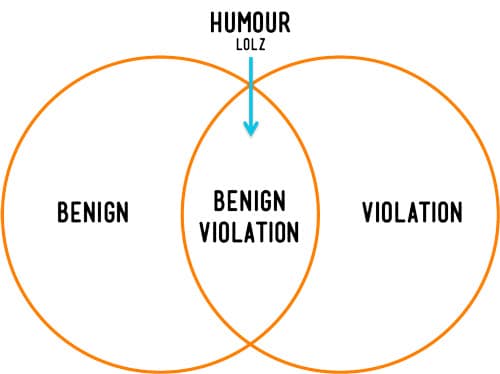
"That said, the humor needs to be authentic to your brand and speak directly to your audience. Students are quick to filter out messaging and creative that is trying too hard to be 'cool.'"
As the Chegg survey illustrates, the line between advertising and entertainment is getting blurrier all the time. Particularly for younger demographics – the high school or post-secondary-age groups that are key to most recruiters – humour can be the key in engaging prospects and getting them to opt in to learn more about your programmes and services. For some institutional brands, social media channels – where the institutional voice is often more informal and audiences are often more open to entertaining content – can be a more comfortable place for experimenting with comedy. There are a number of great examples that combine education marketing with humour in social media and we leave you with one such clip from the University of Nebraska, which illustrates that it is possible to be funny, reserved, and “on brand” all at once. A sample clip from the widely viewed , featuring University of Nebraska Chancellor Harvey Perlman







