Ϲ

Market intelligence for international student recruitment from Ϲ

Ϲ

5th Sep 2014

10 websites in China your admissions department should know

The following is a guest post by Michael Waxman-Lenz, CEO and co-founder of International Education Advantage (), and Jiangyinan Zhai, a graduate student of integrated marketing at New York University. For additional background on key online marketing channels in China, please see our earlier post “Making sense of China’s social and mobile web.”

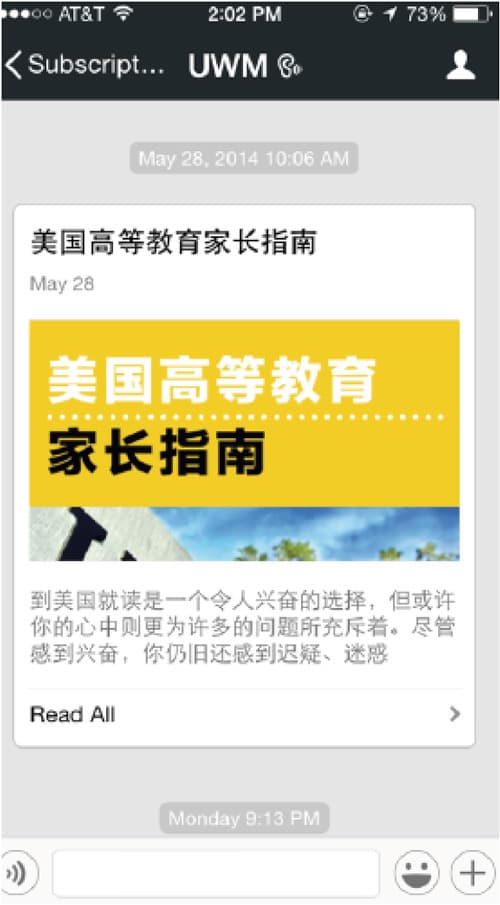
Is your admissions department challenged with social media and digital media management? It’s no wonder with new sites, platforms, and new channels coming up all the time. Now you enter the Chinese market with your recruiting activities: in addition to a plethora of Western platforms, the digital environment in China poses an even greater challenge with its own set of social media and search engines. We would like to give you a number of practical pointers to enhance your knowledge and your management of the digital footprint of your university or school in China. As you know, the Chinese government blocks many Western social media platforms such as Facebook, Twitter, and YouTube so that only domestic services – such as Youku, Sina Weibo, Renren, and WeChat – are left for you to work with. Beyond the big social networks in China, which are better known, we will introduce you to a number of specialised websites used by prospective students to research and learn about studying outside China. It’s good to be digitally ambitious, and you may want to be present in one or more of the big social media platforms that are specific to China, such as WeChat, QQ, or Sina Weibo. Though as it is with all Western social media platforms, it is good practice to only start your presence if you can maintain regular current content delivery and engagement. So don’t take on too many platforms at the same time. Many universities use student assistance to support these efforts. This can be helpful but be aware that you need to control the registration and the login information so that you don’t lose access when your student worker is moving on. We like WeChat in particular as a fast-growing and easy-to-maintain social media platform, and we’ve included an example below of a WeChat microsite for the . a-screen-capture-of-a-wechat-landing-page-for-the-university-of-wisconsin-milwaukee A screen capture of a WeChat landing page for the University of Wisconsin-Milwaukee. Prospective students can request information via a small menu within the app. The key is to think of the prospective Chinese student as a mobile consumer first. WeChat offers you the ability to have small micro-blogs and messages; students can request the content on demand by selecting a simple number from a menu. WeChat is a great example of a product with a “mobile first” approach, and you want targeted and relevant content that can be easily accessed via a mobile handset.
Study abroad websites in China

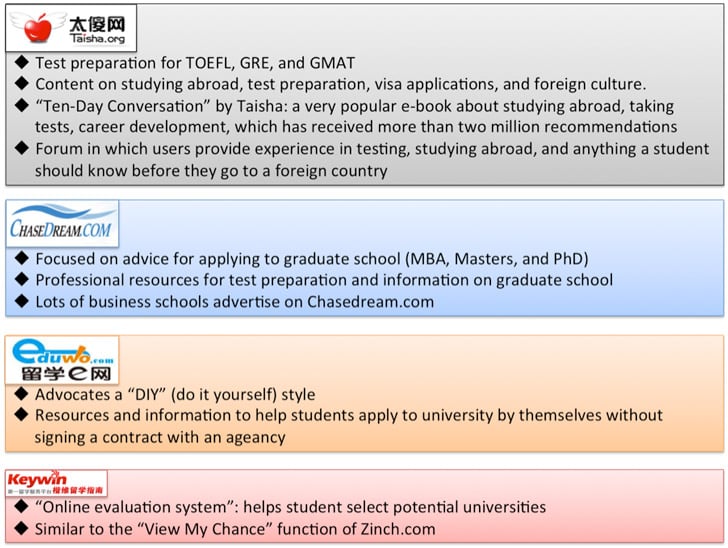
Now let’s introduce you to a number of websites that are created for students to find information about studying in Western countries or outside China. We carried out research to identify 10 leading websites in China for prospective students. The following chart highlights a few of the biggest, such as Taisha and , and the information they offer. During our research, we noted with interest that some of these websites are also connected or have their own student counseling businesses. leading-websites-in-china-for-prospective-students As a university marketer, you probably wonder whether you could advertise your own brand and programmes to prospective students. We found in our research that it was more difficult than you would expect. Only one of the websites provided pricing information to us, which we have included in the following summary of our research findings. from
Search engine results in China

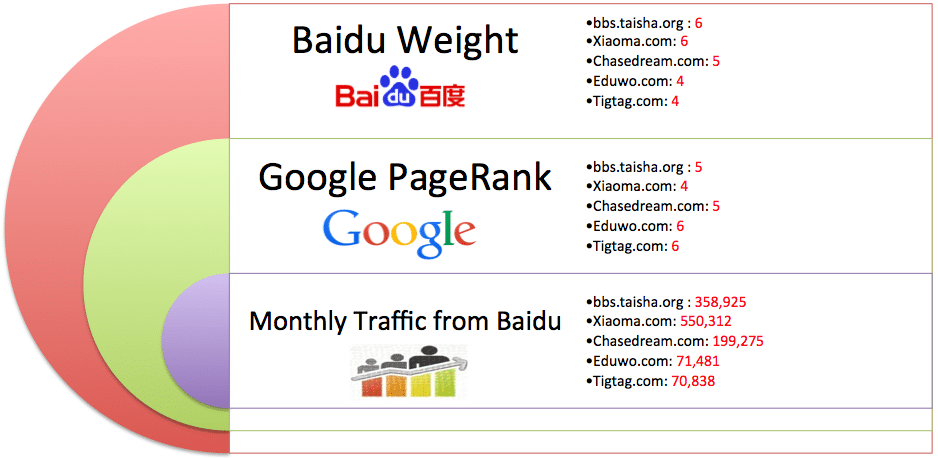
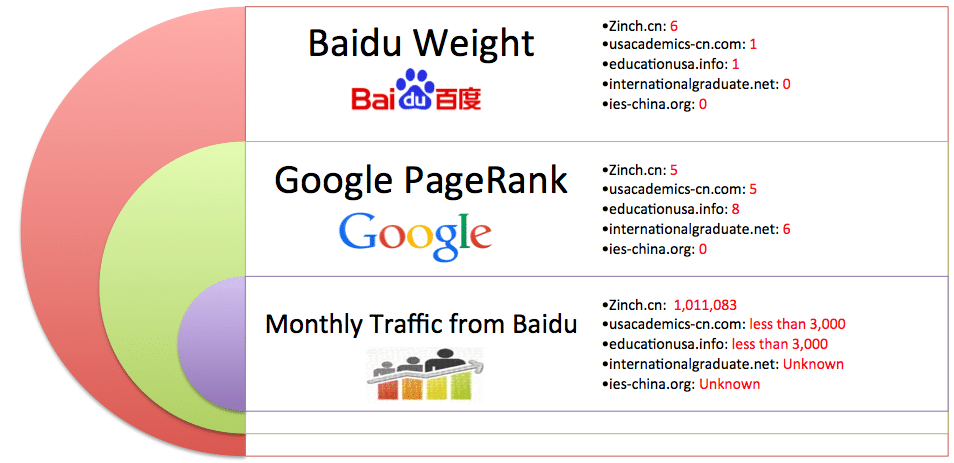
Lastly, let’s address one other challenge in managing your digital footprint in China: identifying the websites that matter in terms of reach and audience. We found one service call SEOChinaz, which provides an indication on the level of traffic and relevance in the search engine world in China. The following figures draw on SEOChinaz, Baidu, and Google data to provide an overview of relative rankings and reach of selected study abroad websites. The figures provide a Baidu weight as well as a Google PageRank for each website. Baidu weight is a ranking scheme – ranging from zero to ten – that reflects the search optimisation and reach of the site. The Google PageRank is derived from an algorithm that measures the number and quality of inbound links to a website. The figures also provide a monthly traffic estimate for each website as reported by SEOChinaz. As the first figure illustrates below, Zinch (now called Chegg in the US) is well-known to many US admissions departments and ranks high in terms of Baidu weight, while ies-china.org does not even register. Please note, however, that such rankings need to be monitored constantly since search engines, such as Baidu, can and do regularly change their algorithms and ranking methodologies. baidu-weights-google-rankings-and-monthly-traffic-estimates-for-selected-study-abroad-websites Baidu weights, Google rankings, and monthly traffic estimates for selected study abroad websites. We did the same analysis for the leading Chinese study abroad websites mentioned earlier. As the following figure indicates, Taisha and Xioma receive the most traffic with more than 300,000 and 500,000 visits per month, respectively. baidu weights-google-rankings-and-monthly-traffic-estimates-for-leading-study-abroad-websites-identified-in-intead-research Baidu weights, Google rankings, and monthly traffic estimates for leading study abroad websites identified in Intead research. It is also noteworthy that all of these websites rank highly on Baidu – much higher than many of the Western lead generation services. This means that a Chinese student searching for information on studying abroad will find these websites much more easily. At the end of the day, remember that your digital footprint in China is a combination of all of the different web channels you use. These include your own university or school website certainly, but also the social and mobile channels in which you are active, and the extent to which they all are optimised for search, especially searches conducted by both parents and students in Mandarin.
Most Recent

  • A common challenge: Strengthening student confidence in the ROI of study abroad Read More
  • New international student permit approvals for Canada fell below COVID levels in 2025 Read More
  • UK Home Office publishes updated visa sponsor guidance for “agents and third parties” Read More

Most Popular

  • Which countries will contribute the most to global student mobility in 2030? Read More
  • Research shows link between study abroad and poverty alleviation  Read More
  • Beyond the Big Four: How demand for study abroad is shifting to destinations in Asia and Europe Read More

Because you found this article interesting

New international student permit approvals for Canada fell below COVID levels in 2025 Canada approved only 75,372 new study permits in 2025. This represents a -64% drop year-over-year, and an -18%...
Read more
UK Home Office publishes updated visa sponsor guidance for “agents and third parties” The UK government has expanded its regulatory oversight for British institutions’ engagement with education agents. The existing structure...
Read more
Visa rejections climb in the US for international students from key markets including India A new report from Shorelight called Beyond the Interview: A Decade of Student Visa Denials
and What Comes Next,...
Read more
Supply and demand for international higher education increasingly aligned in Asia A new report from Studyportals and the British Council, “Asia, Latin America, and MENA in global education,” demonstrates...
Read more
Canadian immigration officials move to ease rules around student work permits Immigration, Refugees and Citizenship Canada (IRCC) has introduced a package of amendments to the current rules around student...
Read more
Australia: Student visa refusal rates reach record high amid weakening demand from China Australian universities have so far faced fewer challenges than English-language training (ELICOS) and vocational education providers in the...
Read more
What international students need to know about study and work visas in the United States The current political climate in the United State has spurred a flurry of proposals and rules affecting the...
Read more
Study finds strong agent interest in partnering with Japanese universities For many years, institutions in the Big Four (Australia, Canada, UK, and US) have partnered with educational agents...
Read more
What are you looking for?
Quick Links