Ϲ

Market intelligence for international student recruitment from Ϲ

Ϲ

9th Oct 2014

Part 2: Keyword research: Building your toolkit

Editor’s note: Today’s post is the second in a two-part series on keyword research. Part 1 focuses on a topic mapping and brainstorming process designed to generate a wide-ranging field of keywords. The following post demonstrates how to identify and focus on the best-performing keywords through competitor research and keyword tools.

If you have followed the brainstorming steps outlined in Part 1 of this series, you are now looking at a very full page (maybe pages) of keywords and search queries. But now what? The next step is to narrow that large field of keywords into a smaller, more focused set that you can use to guide your search optimisation efforts as well as your online advertising campaigns. As we noted in Part 1, the goal throughout is to find the keywords and search terms that are most relevant and most commonly used in searches that could apply to your institution or school. More to the point, the object of this exercise is to find the keyword terms that can help make your institution or brand more visible to the prospective students for whom your programmes, services, and location are most relevant and appealing. For the purposes of today’s article, we are going to assume that you already have a fairly clear picture of the prospective students you are trying to reach. Needless to say, understanding who that student is – their circumstances, motivations, and decision-making process – is a critical foundation for any aspect of your marketing and recruitment, including keyword research. For more on developing that deep understanding and profile of your prospective student, please see our recent post, “The art of listening: Better results start with understanding your customer.” We’re going to assume as well that you already have an equally clear picture of who your competition is. In the context of keyword research, this competitive set can include both direct and indirect competitors. It will particularly include those institutions that are ranking near or above you in search results for the keywords that are most relevant to your institution or brand. With those two assumptions regarding customers and competitors firmly in hand, let’s now take a look at a couple of strategies that you can employ to zero in on the keywords that will be most important to your online marketing efforts. The first thing we suggest is that you take a close look at what your competitors are doing: what keywords are they targeting and how are they performing in terms of search. Next, we will suggest a series of tools, most of which are freely available, that you can use to sharpen your keyword focus further.

Where do you rank?

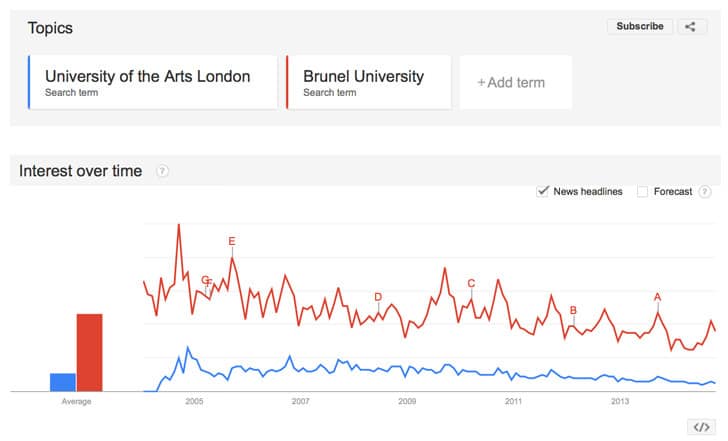
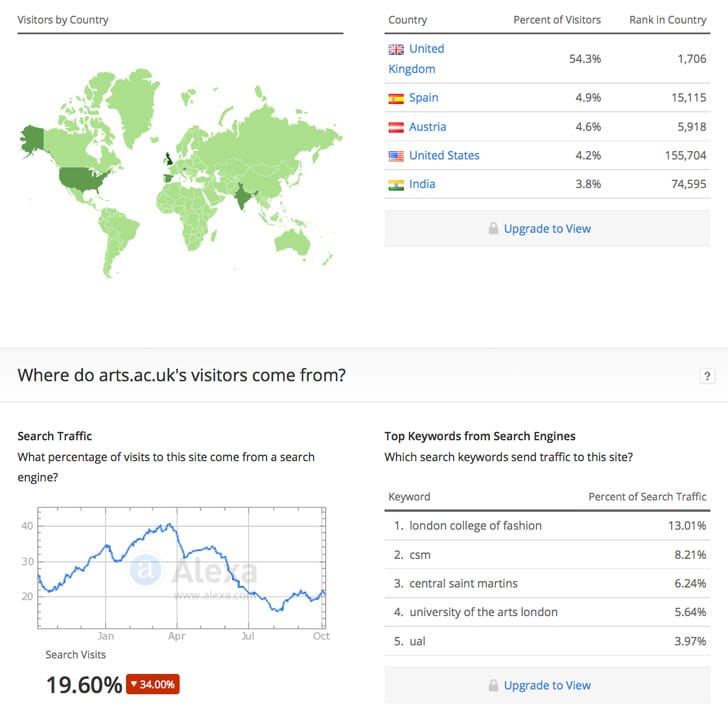
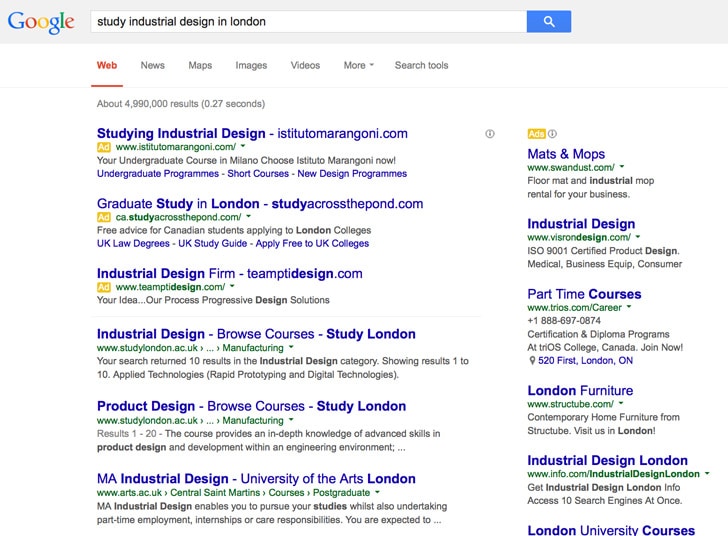
You can test your definition of your competitive set by running a number of sample search queries using the keywords from your brainstorming work. Where do you rank in the organic search results for those terms? What other institutions or schools currently rank higher than you? search-results-for-study-industrial-design-in-london-query Search results for a ‘study industrial design in London’ query. Note the paid ad results at the top of the page and in the right-hand column. These reflect advertisers that have targeted some or all of the keywords in the search query. Note as well the organic search results that appear in the main column. These are the top-ranked results for this search query and an important reference point for you in benchmarking your own performance against this query. Use the observations from your test queries to refine your sense of your competitive set and to identify the most important competitors for your institution or brand. Writing on the Hubspot blog, SEO specialist Rebecca Churt adds, “Now that you have a more comprehensive list of your true competitors, it's time to . Are they selling the same vision? What are their products and/or services? Are their buyer personas like yours? Are they addressing similar personas in a different way than you?” There are a number of tools you can use to take a closer look at your competitors’ online marketing strategies. Here are a few that we think are especially interesting. . This nifty tool from Google provides a rich view of search performance over time. Run searches in Google Trends for branded keywords (i.e., the name of your institution or school) for both yourself and your competitors. This will give you some good insights into how you are performing with respect to searches relative to your competition. You’ll remember that University of the Arts London (UAL) was one of the top search results for our earlier “study industrial design in london” query. In the example shown below, we have compared the search performance for UAL against Brunel University, another top-ranked result from that earlier search. Google Trends allows you to map performance in this way, but also to see how search interest varies by global region as well as the most commonly used search queries through which users find their way to the UAL website. a-google-trends-result-for-the-terms-university-of-the-arts-london-and-brunel-university A Google Trends result for the terms “University of the Arts London” and “Brunel University.” Rather than absolute search volumes, the graph reflects how many searches have been done for a particular term, relative to the total number of searches done on Google over time. . Alexa audits and publicly reports on traffic to websites. It provides estimates for traffic volumes and sources as well as some indicators regarding important keywords. To stick with the University of the Arts London example from earlier, here is a screen capture of part of the Alexa estimates for the UAL website. alexa-estimates-for-the-ual-website SEMrush. SEMrush is an SEO tool focused on competitive research. It is a paid service but offers some views of its data for free. You can use it to generate rich reports for both organic and paid keywords targeted by your competitors (with accompanying search volumes and advertising cost estimates for each).
Filling out the toolbox

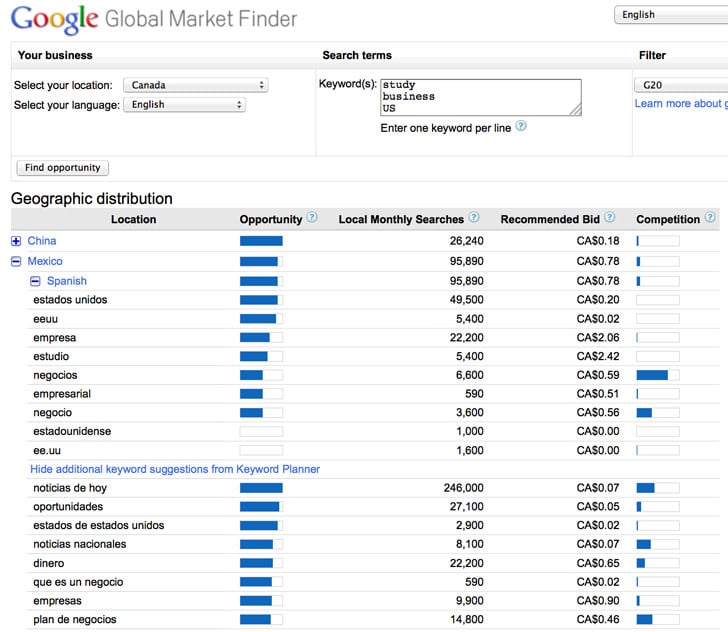
Whereas the applications we’ve noted above are largely concerned with competitor research, there are a number of additional tools that you can use to further your keyword research. Here is a quick survey of some of the most commonly used and best-rated tools in this space, all of which are freely available. . This is the primary Google tool for keyword planning. Like a number of analytics and data tools from Google, it comes with a bit of a learning curve and will take some time (and trial and error) to learn to use properly. You will also need a Google AdWords account in order to use Keyword Planner. However, it remains one of the best-rated tools for keyword research and the following tutorial will help you get up to speed quickly. . This is an interesting new spin on established Google keyword tools, and one of particular interest to international recruiters. It allows you to browse keyword trends by country, showing you the corresponding search terms used in the languages of each country, as well as search volumes and advertising costs for each. translated-keywords-and-search-volumes-for-markets-around-the-world Google Global Market Finder in action, showing translated keywords and search volumes for markets around the world Keyword Tool. This is a simple but effective keyword tool that draws on Google Suggest data (the suggested search queries that appear below your search bar as you are typing a query into Google) to map related “helper” keywords and queries.
What’s next?

By using the range of competitive research and keyword tools that we’ve outlined here, you will be better able to zero in on the most-relevant and best-performing keywords for your institution or brand. Even with all of the changes in search in recent years, keywords still play an important role and you will want to use them widely and well in the content and structure of your website as well as in your paid online advertising campaigns. As with any other aspect of online marketing, the key is to test, measure, and improve over time:

  • If you revise your web content to incorporate new keywords that you have identified, track your search performance carefully so that you can observe the effects and adapt further as needed;
  • If you run advertising campaigns with your new keywords, track those results carefully too and repeat or revise your advertising efforts based on the actual campaign data.

We will pursue both of these topics further in subsequent posts. For the moment, fire up those new keyword tools and zero in on the key terms for your international recruitment efforts!

Most Recent

  • Recruiting under Canada’s international student cap: Six strategic enrolment gaps that matter Read More
  • Ϲ Podcast: Beyond the brochure: What employability really looks like for students Read More
  • Taiwan’s international enrolment up by 17% in 2025/26 Read More

Most Popular

  • Which countries will contribute the most to global student mobility in 2030? Read More
  • Research shows link between study abroad and poverty alleviation  Read More
  • Beyond the Big Four: How demand for study abroad is shifting to destinations in Asia and Europe Read More

Because you found this article interesting

Recruiting under Canada’s international student cap: Six strategic enrolment gaps that matter Recruitment teams across Canada are working harder than they have in years and still missing their targets. The...
Read more
Taiwan’s international enrolment up by 17% in 2025/26 Taiwan’s foreign enrolment grew to 140,420 in 2025/26 – a +17% increase from the previous year and an...
Read more
The questions families are actually asking: Inside the student advising conversation in 2026 Five years ago, a typical counselling session began with a list. A student would come in with the...
Read more
US coalition files lawsuit to challenge rule ending Duration of Status admissions for international students A consortium of prominent education organisations and unions has announced that it has mounted a legal challenge to...
Read more
Global agent survey reveals international students’ top concerns are visa uncertainty and affordability The 2026 Navitas Agent Perception Survey report sheds light on many characteristics of international students’ mindset and behaviours...
Read more
TrustEd Ireland quality mark rollout continues with awards to first group of English-language schools Quality and Qualifications Ireland (QQI), the national agency responsible for the quality assurance of tertiary education and training,...
Read more
Canada’s language training sector in “state of crisis” after further enrolment declines in 2025 Languages Canada reports that the findings in its 2025 Annual Survey Report “make it unmistakably clear that the...
Read more
UK Home Office revokes Bloomsbury Institute’s student sponsor licence In a moment where every UK institution is especially focused on compliance requirements, the Home Office confirmed in...
Read more
What are you looking for?
Quick Links