UK students more interested in study abroad

The number of British students studying abroad is growing, and it looks like that will continue, with a new British Council survey showing that just over a third of UK university students are interested in study abroad. The Higher Education Statistics Agency (HESA) reports that 28,640 students went abroad in 2013/14. This was a record-high level of outbound mobility for the UK, and represents a 58% increase over the 18,105 students who went abroad the previous year. There are, however, two important qualifiers attached to this impressive growth:
- HESA has changed its methodology for counting study abroad activity. In 2012/13, British institutions were asked to report on "exchange programmes" undertaken by their students. In 2013/14, they were asked to report more broadly on "mobility periods." The difference is important as it would lead, for example, to shorter-term studies (e.g., four weeks or less) or volunteer assignments abroad being included in the count where they would not have been in the past.
- The HESA figure for 2013/14 includes UK-domiciled as well as other EU and non-EU students (that is, foreign students studying in the UK who went abroad to a third country). Setting aside the 6,540 non-UK-domiciled students for the moment, that leaves 22,100 UK-domiciled students who went abroad last year.
The more detailed information on study abroad now collected by HESA also points out that the vast majority of UK-domiciled students abroad (83%) are enrolled in study programmes, as opposed to work or volunteer assignments overseas. An even larger majority (96%) are undergraduate students. Regardless of methodology changes, it seems clear that the number of British students abroad has climbed steadily over the past several years. An independent analysis from Kingston University’s Joan-Anton Carbonell points to an increase of 8,000 students (roughly 40% of the estimated 20,064 students abroad in her latest tally) over the six years up to 2012/13. UK participation in the Erasmus mobility programme has also grown steadily, with 15,566 students abroad on Erasmus study and work placements in 2013/14. This represents an increase of 6.8% over the previous year and growth of 115% since 2007. Needless to say, even with that growth there remains a significant gap between the 493,570 foreign students that the UK hosted in 2013/14 and the number of students it sent abroad that year. "The idea that the internationalisation of higher education is simply comprised of student recruitment is not only outdated, but also ultimately is incorrect," says the British Council. "Outward student mobility is essential at the individual level for growth personally and among one’s peers, at the institutional level for diversification and knowledge sharing, and at the national level as an investment in human capital and long-term relationship building." Indeed, a 2013 report found that more than half of UK employers were unhappy with the foreign language abilities of UK graduates and 47% were concerned about graduates’ cultural awareness. This persistent and considerable gap between inbound and outbound has led the British government to establish a UK Strategy for Outbound Mobility, a national effort to improve awareness of and access to international study opportunities. "Outward mobility is on the rise, however there is still more to be done," said Vivienne Stern, Director of the UK Higher Education International Unit.
"If we want to encourage our students to spend time abroad whilst at university we need to better understand their motivations and what dissuades many others from taking advantage of opportunities."
Broadening Horizons
A new report from the British Council - - aims to do just that. It draws on a 2015 survey of 2,856 full-time, UK-domiciled university students (most between 16 and 30 years old) for a series of important insights. The survey found, for example, that 34% of respondents were interested in study abroad. This compares to the 50% of American students who expressed interest in a parallel survey and, more directly, to the 20% of British students who expressed interest in an earlier study in 2013. Those respondents to the 2015 survey who wanted to go abroad also preferred to go for longer periods: 47% stated they would want to study for a year, and 26% wanted to pursue a full degree outside of the UK. A strong majority (59%) were interested in studies at the undergraduate level. The US remains a top choice for British students, with 40% of respondents indicating the US as their preferred destination. Interestingly, however, 42% of respondents to the 2015 survey who wanted to go abroad also expressed interest in going to non-English-speaking countries (an increase of 4% compared to a previous survey from 2014). and the UK remains in turn the leading destination of American students abroad. Broadening Horizons adds, "According to UNESCO… the top destination for UK students is the US, followed by France, Ireland, Germany and Australia… [However,] according to the UK Higher Education International Unit, 70% of UK undergraduate student mobility takes place in Europe, with 25% of students studying in France, 17% in Spain and 9% in Germany; 12% of UK students study in the US, making it the number three destination for undergraduate study abroad."
Motivations and concerns
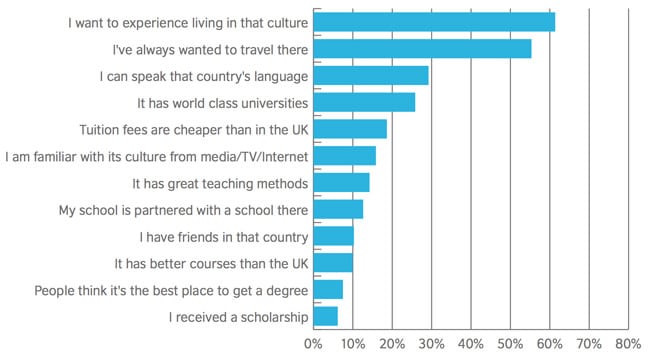
The survey found that the cultural experience of studying abroad was a significantly stronger driver for UK students than were academic or employability-related factors. As the following chart illustrates, the most important factors in selecting a study destination included wanting to experience the culture (61%) and wanting to travel there (55%).