Lessons from Silicon Valley: Growth hacking and international recruitment

Do you need a growth hacker on your marketing and recruitment team? Growth hacking is an idea – and perhaps as much a new perspective on marketing as anything else – that has gained currency in the tech start-up community in recent years. "" says entrepreneur and marketer Andrew Chen, "one who looks at the traditional question of ‘How do I get customers for my product?’ and answers with A/B tests, landing pages, viral factor, email deliverability, and . On top of this, they layer the discipline of direct marketing, with its emphasis on quantitative measurement, scenario modeling via spreadsheets, and a lot of database queries." As this range of activity suggests, the strict definition of growth hacking is a bit fluid. Here though is a quick sketch of some of the more central concepts in this emerging area of marketing practice.
Put aside the old tools
Finely chiselled press releases? Expensive launch events? Page upon page of expensive advertising? Not for growth hackers. The Silicon Valley marketing toolbox is all about online tools and social channels. More to the point, it is about the deployment of those still-new tools to carefully target prospective customers, test extensively, measure results, and then construct a scalable marketing programme that can reach new prospects in a highly efficient and effective way. In one famous early example of growth hacking from 1996, the founders of the world’s first free web mail, Hotmail, were faced with the challenge of finding a way to build the user base for their new service. Traditional marketing methods – billboards, radio ads, and other forms of paid advertising - were a poor fit for a service that was, after all, free. Their solution? The founders added a small message at the bottom of every email sent on the system: "P.S.: I love you. Get your free email at Hotmail," with a link, of course, to a page where new users could sign up. That was it. And the rest, as they say, is history. Ten million users and a year or so later, Hotmail was sold to Microsoft for US$400 million. You don’t have to be a technical genius to add a persistent web link at the bottom of an email message. But it helps to have that part of your brain turned on that understands and how people use it. To that end, one of the larger implications of a growth hacking approach is that the still often separate domains of marketing and technology need to be mashed together. For some organisations, this could mean that a growth effort is led by the sort of hybrid marketer-coder that Andrew Chen describes above. For others, this might mean building a team of two or more specialists that work together to pursue a blend of marketing and technical strategies.
Focus on growth
"" says startup specialist Sean Ellis, and indeed the central principle of growth hacking is dramatic and rapid growth.
There are a number of examples of brands that have grown through such techniques, including those, such as , , and Instagram, that have amassed both large audiences and worldwide profiles in the process.
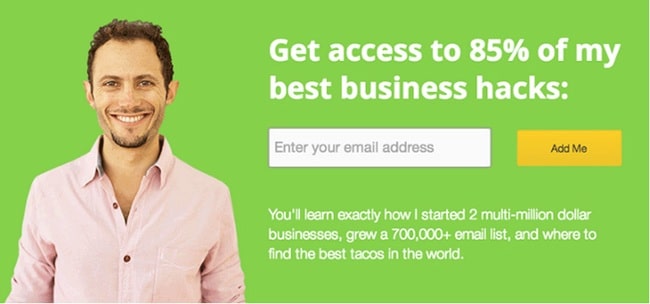
The user population and growth stats of such brands can be a little staggering. But the personal website of AppSumo.com chief Noah Kagan provides a more relatable example of growth marketing techniques. In a 2014 post, he describes to drive opt-ins towards a goal of tripling his base of readers by 300% within a year.
One of the important lessons he offers is to organise the growth effort around a single goal. "Focus on moving one metric at a time," he says. "This simplifies every single decision you make and helps prioritise which actions to take…Instead of trying to increase on-page time, improve SEO, get guest bloggers, grow social media followers, and get more YouTube followers, I focused solely on email subscribers.
For most of us, it’s too easy to set five or six goals and then when we don’t reach them, we have an excuse: ‘Well, we were trying to reach all of these other goals and we got distracted.’ Instead, you should commit to just one goal for a 30-day period and track it daily. You’ll be much more likely to achieve what you want."
Keep it fresh
Part of the fluidity in growth marketing concepts arises from the fact that practitioners are constantly trying new strategies, and, just as quickly, setting aside “older” techniques that have lost their edge with prospective customers. It’s generally held in online marketing that a given tactic will become less effective over time. Take online banner ads, for example. When the first banner ads debuted on Hotmail in 1994, they generated a click-through rate (CTR) of 78%. As of 2011, the CTR for display ads on Facebook was passing through .05% and many sites report lower rates today. In others words, adds Andrew Chen, "First it works, and then it doesn’t…Over time, all marketing strategies result in [poor] click-through rates." Think about your own experience as an Internet user: the first time you encounter something – be it a new approach to web design or a new type of promotional offer – that can be a very compelling thing. But the Internet also teaches us all to be impatient, and it has a strong bias towards novelty. One of the effects of this is that once you see that same strategy repeated a few times the “new” comes off of it fairly quickly. This is a challenge for any marketer, but there is also an opportunity lurking there. The flipside of the “first it works, then it doesn’t” problem is that if you are first-to-market with a new approach or new strategy, you can realise some really big gains. Mr Chen offers the example of Airbnb’s integration with Craigslist as one case where a growth marketing mindset opened up a new marketing channel. Simply put, Airbnb figured out a way to build usage by making it easy for its hosts to publish their listings within Craiglist’s online classified advertisements: "They’ve picked a platform with tens of millions of users where relatively few automated tools exist, and have created a great experience to share your Airbnb listing. It’s integrated simply and deeply into [Airbnb.com], and is one of the most impressive ad-hoc integrations I’ve seen in years. Certainly a traditional marketer would not have come up with this, or known it was even possible – instead it’d take a marketing-minded engineer to dissect the product and build an integration this smooth."
The point here is not the technical difficulty involved but the importance of doing something new, and something that can be easily repeated and therefore scaled quickly.
Let’s take this back to international recruitment again: what opportunities do you see for combining marketing thinking with technical innovation in your recruitment effort? Our post from yesterday suggests one possibility. A recent Hobsons survey found that a majority of prospective international students, once admitted, would like to hear from their host institutions weekly in the period from admission to course start. Our guess is that not many institutions are doing this now and that there is an opportunity here to drive greater student engagement (and reduce attrition through those latter stages in the admissions pipeline) with targeted, automated email communications to admitted students. Growth hack, ahoy! For further inspiration, please see our recent posts on unconventional marketing techniques and customer experience design.