
Shifting demographics reshaping German demand for language study abroad

A recent survey by the German agency association FDSV (Fachverband Deutscher Sprachreise-Veranstalter) has found that the number of Germans going abroad for language study declined slightly last year (a 1.4% decrease between 2013 and 2014). An online survey by FDSV gathered responses from 26 agencies (both members and non-members), who collectively sent 46,358 language students abroad in 2014. The survey was part of undertaken with the University of Heilbronn that included 96 language travel companies (77 language travel operators and 19 travel agents). Behind the slight decline in the number of German language students abroad, however, is a more balanced picture of demand across various age groups in Germany, as well as signs of market growth. The average amount Germans spent on a language holiday in 2014 was €1,308 (US$1,382), an increase of 8.6% over 2013. The market was valued at €186 million (US$196 million) in 2014, with an estimated 160,000 students going abroad that year.
One age group pushed the overall decline
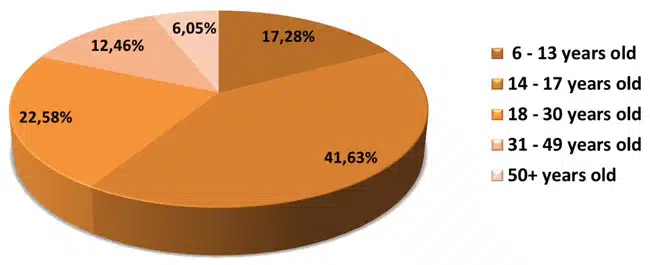
The main factor in the decrease in the number of Germans going abroad to learn a language in 2014 was the 14-17-year-old demographic: while these young Germans accounted for 53.2% of language travel trips in 2013, they represented 41.6% of bookings for 2014.
English remains the most popular language choice
The vast majority of German language students abroad are studying English (84%), and younger students compose most of the bookings for the language (90.6% for those 17 years and younger versus 70.5% of those 18 years and older). Spanish is the next most popular language, but in this case it is German adults who are more interested in learning Spanish (13.5% versus 1.9% of younger students). The same trend is evident for French (7.6% versus 3.8% of youth) as well as Italian (4.4% versus less than 1%).
The UK is the leading destination
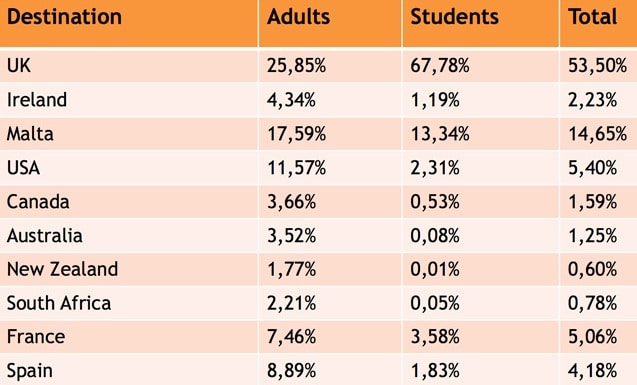
More than half of the 160,000 German language students making up the base of the FDSV–University of Heilbronn (53.5%) went to the UK for their courses in 2014, with younger students driving this figure (67.8% versus 25.9% of adults). Interestingly, the next-most popular destinations - Malta (14.7%), the US (5.4%), France (5.1%), and Spain (4.2%) saw more adult students than younger ones.
Length of stay
When German students travel farther from home to study English, they tend to stay longer than when they go to the UK. On average, students spent two weeks in the UK versus 4.3 in Australia and 5.2 in New Zealand; Germans also spend more time learning languages in Asia than the overall average. Meanwhile, when German students (especially young ones) go to nearby German-speaking countries, they are most likely to stay for just a week. The FDSV attributes these brief stays to the "short and uncomplicated journeys" enabled by the proximity of these countries to Germany. Across all destinations, the average length of stay for German language travellers is two weeks. The average length of stay in the UK and the US decreased slightly in 2014: from two weeks to 1.8 weeks in the UK, and from 4.8 weeks to 3.7 weeks in the US.
Satisfaction is high
Only 1.9% of all Germans who travelled in 2014 to learn a language expressed complaints about their experiences, which the FDSV considers low "especially when one considers the complex travel services" involved in making study abroad trips. They noted that student satisfaction also involves having a "positive experience of accommodation in private houses as well as satisfaction with the language teaching and teachers." Julia Richter, from FDSV, says that while the traditional format of 20 lessons for a language course combined with accommodation in a host family’s home is still the first choice for students as well as for adults, English boarding schools are becoming a more important option as well, especially for younger students.
Looking ahead
The FDSV survey found market growth in the 31-49 age group (+2.6% over 2013) and the 50+ one (+1.3% over 2013), and FDSV considers both promising demographic groups for foreign language schools, saying:
"The demand for individual language learners and language travel special formats … steadily increases."
Catering to these mature groups comes with challenges and opportunities; comfortable - and for some wealthier students, luxury - accommodation and recreational activities such as theatre, art galleries, etc. become more important with students’ more advanced age.







