Ϲ

Market intelligence for international student recruitment from Ϲ

Ϲ

18th Jan 2017

Australia on track for 12% growth in 2016

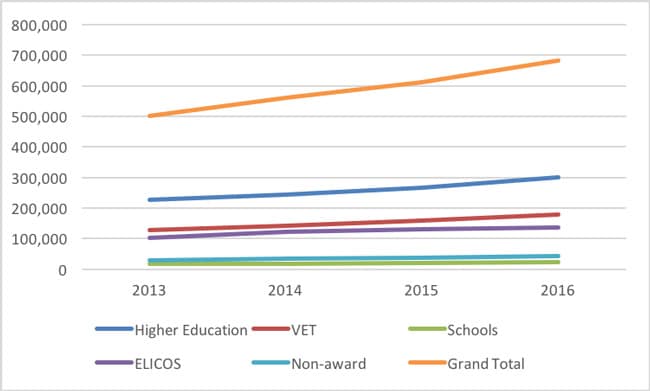
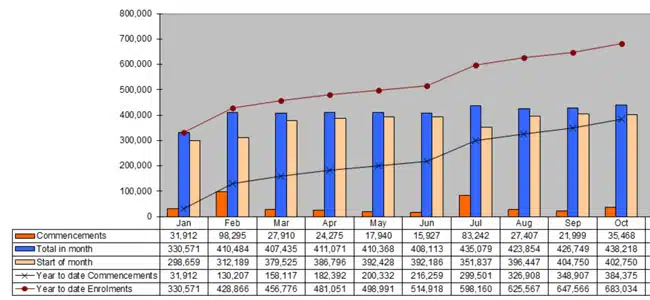
The latest data release from the Australian Department of Education and Training (DET) reveals that the country’s international education sector is tracking toward another year of strong growth for 2016. The department reports that year-to-date October 2016, , compared to the same period for 2015, and that commencements have increased by 11%. As is always the case with DET data, there is a necessary caution here in that the statistics are tracking total course enrolments based on reporting from institutions and also from the Department of Immigration and Border Protection (DIBP). This method results in an enrolment count that is considerably higher than the actual head count or FTE enrolments for a given period. As DET explains: "International student enrolment data generally does not represent the number of overseas students in Australia or the number of student visas issued in different countries. Instead data counts actual course enrolments. The exception is the data at the beginning of a month which represents a close approximation to the number of students enrolled on that day.” This approach gives rise to cases where students could be counted more than once if, for example, they enroll twice during the same reporting period (e.g., in an English language programme initially and then a degree programme after). Keeping in mind the department’s suggestion that start-of-month enrolment values provide a closer approximation of actual student numbers, the following chart tracks total enrolments, commencements, and start-of-month numbers through October 2016. foreign-enrolment-in-australian-education-all-sectors-year-to-date-october-2016 Foreign enrolment in Australian education, all sectors, year-to-date October 2016. Source: Australian Department of Education and Training DET reports that all education sectors have seen growth through October 2016, particularly higher education institutions (+13%) and vocational programmes (+12%) - which together accounted for 70% of all international enrolment YTD October 2016. More broadly, all sectors have seen growth from 2013 on, and total enrolment in Australia has grown by 36% YTD October 2016 compared to the same period four years earlier. australian-enrolment-growth-by-education-sector Australian enrolment growth by education sector (and total), YTD October 2013 to YTD October 2016. Source: Australian Department of Education and Training
Sending countries

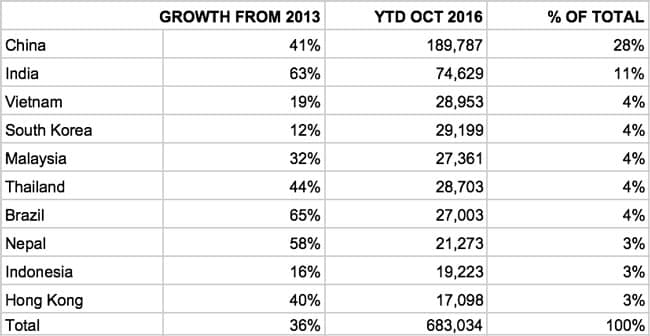
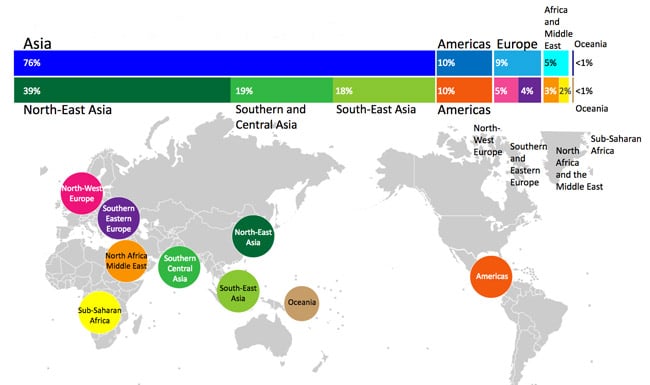
As the following chart illustrates, roughly three in four foreign students in Australia come from Asia. proportion-of-ydt-october0-2016-enrolment-by-world-region Proportion of YTD October 2016 enrolment by world region. Source: Australian Department of Education and Training Not surprisingly, nine of Australia’s top ten sending markets are also found in Asia, Brazil being the one exception. And those top ten countries accounted for nearly seven in ten international students in Australia in 2016. China is far and away the largest sender with 28% of all enrolments YTD October 2016. Taking a broader view, the fastest-growing markets over the four years from from 2013 to 2016 were India (+63%), Brazil (+65), and Nepal (+58). top-ten-sending-countries-for-for-ytd-october-2016 Top ten sending countries for YTD October 2016, with growth indicated for each since YTD October 2013, and percentage of total enrolment for 2016. Source: Australian Department of Education and Training For additional background on recent developments in international education in Australia, please see:
Most Recent

  • Australia moves to reduce net migration with new restrictions on student family members and “visa hopping” Read More
  • How can we tell the story of international education? Read More
  • UK: August’s sponsored study visa applications drop to lowest level since 2022 Read More

Most Popular

  • Which countries will contribute the most to global student mobility in 2030? Read More
  • Research shows link between study abroad and poverty alleviation  Read More
  • Beyond the Big Four: How demand for study abroad is shifting to destinations in Asia and Europe Read More

Because you found this article interesting

Australia moves to reduce net migration with new restrictions on student family members and “visa hopping” In a speech at the National Press Club on 17 September, Australian Home Affairs and Immigration Minister Tony...
Read more
UK: August’s sponsored study visa applications drop to lowest level since 2022 Newly released UK Home Office data shows that sponsored student visa application volumes are down significantly through August...
Read more
US court grants preliminary injunction to block rule that would have ended Duration of Status admissions for international students Last month, a consortium of prominent education organisations and unions launched a legal challenge to the Department of...
Read more
For the first time, the Australian government has exercised its powers to cancel an entire course In late 2025, the Australian Parliament passed a package of legislative amendments extending new oversight and regulatory powers...
Read more
Netherlands: Government-commissioned research finds that international students contribute much more than the public cost of hosting them The Dutch government’s economic policy analysis bureau, CPB, has conducted research that shows that international students represent a...
Read more
Korean government introduces new quality controls for universities and agents South Korea met its goal of hosting 300,000 international students by 2027 in mid-2025, two years early, and...
Read more
Australia: Decline in international higher education commencements projected for 2026 Australian universities should not expect an increase in foreign students on their campuses anytime soon, according to Keri...
Read more
The outlook for Indian student mobility through 2030 A new report from QS highlights how Indian demand for study abroad is expected to continue to shift...
Read more
What are you looking for?
Quick Links