Ϲ

Market intelligence for international student recruitment from Ϲ

Ϲ

22nd Mar 2017

Japan’s employment outlook helping to drive foreign enrolment growth

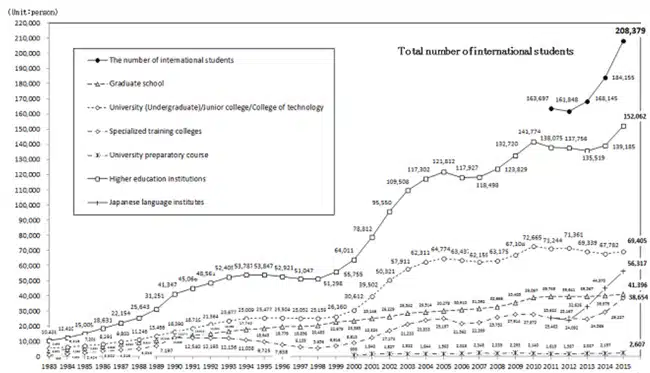
For some time now, Japan has held to an ambitious goal to host 300,000 foreign students by 2020. It looked for a number of years, however, like that target would remain out of reach. But the country’s foreign enrolment growth has begun to gain more momentum over the last two years and, it now appears, could be on pace to reach that 300,000-student plateau by the end of the decade. Year-over-year growth took a big step in 2014, with total student numbers up nearly 10% over the year before. And the latest figures from the (JASSO) show even greater growth in 2015, with a 13.2% increase compared to 2014. Japan hosted nearly 210,000 students in 2015 and if that growth continues at roughly the same rate through 2020, the 300,000-student target will certainly be within reach. Total foreign enrolment in Japan and enrolment by level of study, 1983–2015. Source: JASSO Virtually all international students in Japan (93%) come from other Asian countries, and nearly half (45%) arrive from China. In keeping with a strategy to focus on ASEAN markets, Vietnam has also been an important driver of growth in recent years, with Vietnamese enrolment in Japan increasing by nearly 50% between 2014 and 2015 alone. In fact, Vietnam is now the number two sending market for Japan with nearly 40,000 students enrolled in 2015. Roughly seven in ten (73%) foreign students are enrolled in some level of higher education in Japan, with the balance studying in Japanese language institutes.
Playing the employment card

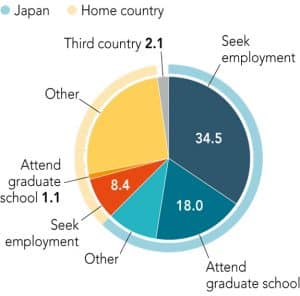
Japan’s recent progress in growing its international enrolment is bound to get a boost from new measures to boost employment outcomes for foreign graduates. “Japan is hiring foreign talent and it is now a top priority that international students attending Japanese universities stay on in the country, with the government offering new incentives such as subsidised company internships, help with finding jobs on graduation, stepped-up Japanese language courses and more streamlined processes for work visas after graduation,” notes a report from . Many of these new supports arise from the latest iteration of the , which was announced in June 2016. One of its goals: to raise the employment rate of foreign graduates from the current 30% to 50% by 2020. That ambition lines up well with the post-graduation plans of many foreign students. A 2014 JASSO survey of nearly 12,000 foreign students found that more than a third intended to stay in Japan after their studies to find work. Post-study plans of foreign students in Japan, 2014. Source: JASSO More recent surveys suggest that the percentage of graduates who intend to stay and work has climbed considerably higher over the last couple of years. Indeed, new government data finds that a record number of foreign graduates – nearly 16,000 – . This drive to employ foreign graduates partly relates to Japan’s international recruitment goals, but, more broadly, it reflects a reality of the Japanese labour market in that there are simply more jobs than there are graduates. Thanks in part to a low birth rate and a strengthening economy, Japan has one of the lowest unemployment rates among the world’s developed economies. As of January 2017, there were roughly 1.5 jobs in Japan for every applicant, meaning that foreign graduates are increasingly in demand as a new source of talent. “Big companies are waking up to another untapped source of recruits: foreign students at Japanese universities,” reports . “A job fair for overseas students held at Pasona's Tokyo headquarters on March 10 attracted 32 companies - including all the country's major banks. Trading company Itochu Corp. and synthetic fiber-maker Toray Industries were also represented.” The active recruitment of foreign graduates by such high-profile employers, the strong job market for university graduates, and the expanding range of career support services and supportive policies for international students all represent a powerful boost to Japan’s attractiveness as a study destination. The early indications are that foreign enrolment in the country continued to grow through the latter part of 2015 and through 2016. Given the prominence of employment prospects in the study abroad choices of international students, all of these developments are likely to play a significant role in Japan’s continuing drive to host 300,000 students by decade’s end.
Most Recent

  • Canadian immigration officials have made several updates to compliance guidance for study permits and post-graduate work permits Read More
  • Italy announces its “biggest language training and international mobility programme ever” Read More
  • Why sharper English-language guidance is becoming an agent’s sharpest tool for student success Read More

Most Popular

  • Which countries will contribute the most to global student mobility in 2030? Read More
  • Research shows link between study abroad and poverty alleviation  Read More
  • Beyond the Big Four: How demand for study abroad is shifting to destinations in Asia and Europe Read More

Because you found this article interesting

Canadian immigration officials have made several updates to compliance guidance for study permits and post-graduate work permits Over the past four to six weeks, Immigration, Refugees and Citizenship Canada (IRCC) has updated several of its...
Read more
Italy announces its “biggest language training and international mobility programme ever” The Italian government is about to operationalise the largest language learning and mobility scholarship programme in the country’s...
Read more
Why sharper English-language guidance is becoming an agent’s sharpest tool for student success Most agents ELSAA speaks with are deeply committed to their students’ success – that isn’t in question. What...
Read more
Updated: US Department of Homeland Security publishes rule to end Duration of Status for international students Updated: 22 July 2026 As expected by US international education experts, the Department of Homeland Security (DHS) has...
Read more
Joint sector alert sends a clear compliance message to Australian higher education and VET providers There are two national quality-assurance regulators for tertiary education in Australia. TEQSA (Tertiary Education Quality and Standards Agency)...
Read more
Academic support and learning resources in TNE: Delivering student success across borders In my previous article in this series, I argued that if transnational education (TNE) is to fulfil its...
Read more
England: Government “remains of the view” that the International Student Levy should go ahead; implementation planned for August 2028 The UK first indicated it would explore “a levy on higher education provider income from international students” in...
Read more
Decline in Indian demand a major factor in softer outlook for foreign enrolment in US higher education in 2026/27 The Institute of International Education (IIE) does a twice-yearly snapshot survey of US institutions that required reading in...
Read more
What are you looking for?
Quick Links


