
Australian legislation to tighten regulations for VET providers and agent reporting

The Australian government has introduced new amendments to , elements of which will affect both foreign students and education agents.
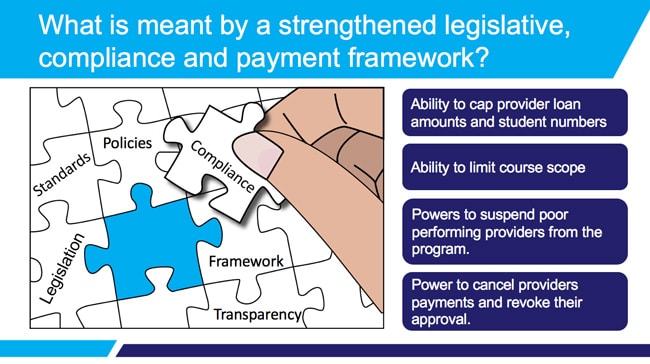
Introduced on 1 June 2017, the Education Legislation Amendment (Provider Integrity and Other Measures) Bill 2017 aims to amend the Education Services for Overseas Students Act 2000 and the Tertiary Education Quality and Standards Agency Act 2011. The overall effect will be to strengthen the for higher education providers in Australia.
These measures are clearly aimed at large operators in the vocational education and training (VET) sector. There have been growing concerns in Australia in recent years around aggressive recruiting by private VET providers in conjunction with generous loan programmes for domestic VET students. Some of the largest private providers in Australian VET have attracted hundreds of millions of dollars in loan support but with the vast majority of students failing to complete their intended programmes.
Australia moved late last year to reform VET loan programmes. A new programme was launched on 1 January 2017 that capped loan amounts, and gave the government new powers to suspend or terminate the loan eligibility of poor-performing providers.
Managing ownership risk
With its new legislative amendments, the government is also clearly aiming to curb the entry of suspect VET providers into the higher education space, and also to secure new powers to deal with poorly performing providers. As a recent report in The Australian illustrates, there is in fact across the two sectors. “As VET providers look for alternatives to their trouble-plagued sector,” notes the paper, “they comprise most applicants for initial registration from the higher education regulator, the Tertiary Education Quality and Standards Agency (TEQSA).” “Given that half the providers within higher education are now dual-sector, it’s a risk to which TEQSA is very alert,” said TEQSA Chief Executive Anthony McClaran. “When we’re considering the overall risk to a higher education provider, we also take into account any knock-on risks from their position in the VET sector.” The Australian further explains that TEQSA’s risk framework includes two criteria related to providers’ financial viability, and that the agency has “significantly expanded” its attention on financial risk “because of these cross-links to other parts of the wider education sector”. In a related statement, Minister for Education and Training Simon Birmingham characterised the legislative amendments as a, “pre-emptive strike” against the bad actors that the government has moved to exclude from public loan programmes. “We want to ensure that dodgy vocational education providers cannot transition their operations into the higher education and international education sectors,” added the minister. “The Bill will ensure we further strengthen the already-high standards in place to assess applications and ensure ongoing compliance by those seeking to enter the higher education sector and the international education sector.”
No opt out for agents
In a departure from a previously announced plan for a new system of agent performance reporting, the 1 June legislative amendments make no mention of anticipated “opt out” provisions for agents. It now appears that all agent-related performance data will have to be shared within a new tracking system. “There is no doubt that education agents play a significant role in the recruitment of international students in Australia,” said International Education Association of Australia CEO Phil Honeywood. “Although the majority of agents are entirely scrupulous in their recruitment of international students, it is always the unfortunate few who can tarnish both Australia’s and their own professional reputation.” “Reporting on agent performance, and publishing data as appropriate, will promote greater transparency and accountability in educator-agent relationships and the wider sector.” For additional background, please see:







