
Internationalisation and focus on student recruitment increasing among US colleges

The latest edition of a major tracking study finds that internationalisation efforts are accelerating among US colleges, with a greater emphasis on international student recruitment and revenue generation than in previous years. Released today, is the fourth edition of a comprehensive study carried out every five years by the American Council on Education (ACE). This year’s mapping survey was sent to chief academic officers, provosts, senior international officers, institutional researchers, and presidents of US colleges between February and October 2016. ACE subsequently received 1,164 completed surveys for an overall response rate of just under 40% – meaning the 2017 mapping effort set new records both for total number of responses and also response rate. “Comprehensive data on the institutionalised practice and policy of internationalisation – which Mapping provides – uncovers the realities of how internationalisation is playing out on campuses and gives a detailed picture of how trends progress over time,” said ACE President Molly Corbett Broad. “Most vitally, I think it helps institutions ask – and answer – ‘Where do we go from here?’”
Key findings
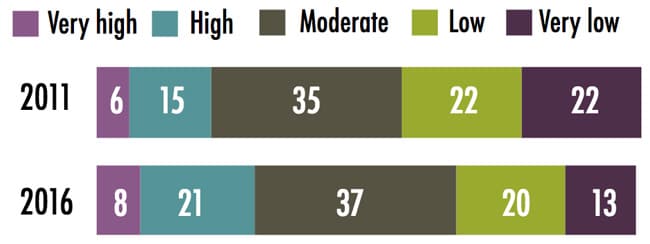
The top-level finding for 2017 is that US institutions are expanding their internationalisation efforts. As the following chart reflects, nearly 30% of respondents report “very high” or “high” levels of international activity within their respective institutions, as opposed to the 21% who indicated the same during ACE’s last mapping effort in 2011.
Setting up shop
ACE also notes that more US colleges are now relying on a single international office on campus to drive internationalisation efforts. There was a 22% increase in the 2016 survey (compared to 2011) of colleges reporting that internationalisation is led by a dedicated international office. Slightly more than half of responding colleges (53%) now also have a full-time management staffing position overseeing international within the institution – this marks a 13% increase in such staffing provisions since 2011.
Resourcing recruiting
Nearly half of respondents (48%) to the 2016 survey said that they had an international recruiting plan in place, with eight in ten of those incorporating hard targets with respect to student numbers. Nearly 60% also included specific geographic targets, with the top three priority markets noted as China, India, and Vietnam. US colleges are also reporting increased spending on international recruitment travel this year (again, relative to 2011), and an expanded use of technology for international recruiting. (This latter point refers to technology tools beyond institutional website and email, such as virtual college fairs and social channels.) This year’s survey also highlights a dramatic increase in the use of education agents among US colleges. Echoing findings from other recent studies of agent usage in the US, ACE observes, “A markedly higher percentage of institutions are engaging overseas student recruiters (agents) than in 2011...the percentage of institutions providing funding for recruiting agents more than doubled between 2011 and 2016.” In 2011, 17% of ACE respondents indicated that they were engaged with education agents. That figure increased to 45% in the 2016 survey. The mapping survey takes a much broader, and very detailed, view of internationalisation within US colleges, including the role of faculty, strategies for internationalising the curriculum, and the level of support services available to international students. The complete report is available online for further reference, and ACE has also provided an interactive assessment tool that US institutions can use to benchmark their internationalisation efforts. For additional background, please see:
- “US: The link between public funding and international student recruitment”
- “Are you receiving me? Leading destinations aim to send more students abroad”
- “Study finds growing use of agents among US universities”
- “Coming to America: The need for greater diversification in international enrolment”
- “The development of international strategies in US higher education”







