Contrasting EU and non-EU trends for British higher education

The global strength of the British education brand is showing this year with record-high application volumes and acceptances for non-European Union students in 2017.
However, the latest data release from the Universities and Colleges Admissions Service (UCAS) paints a mixed picture in also highlighting a drop in EU and domestic enrolments in British higher education.
UCAS is starting to roll out its full-year data for 2017 and the , published earlier this week, will rekindle concerns around the impact of the ongoing Brexit process.
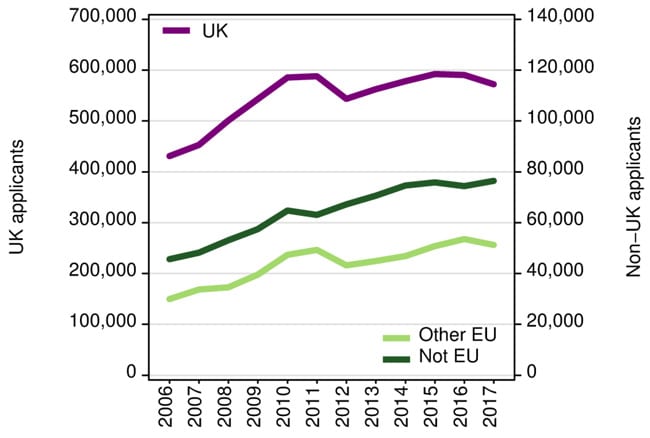
In terms of application volumes for the year, UCAS reports a 3.1% decline in applicants from the UK (this works out to 18,220 fewer applications compared to 2016). Of particular note to international educators, applicants from the EU also declined by 4.4% year-over-year (the equivalent of 2,375 applications). This, UCAS points out, eroded much of the growth in EU application volumes recorded in 2016. Perhaps more notably, it reverses a growth trend that has persisted since 2012, which was the last year in which EU numbers fell off. “Between 2012 and 2016, the number of EU applicants increased by between 4% and 8% each year,” says UCAS. “Had that trend continued into 2017, applicants from the EU would have been around 10% higher than observed.”
But as the following chart illustrates, applications from outside the EU increased by 2.8%, or 2,090 applicants, in 2017. This marks a new record-high for application volumes for non-EU students, and reverses a dip in volume from this important group in 2016.
Acceptances on trend
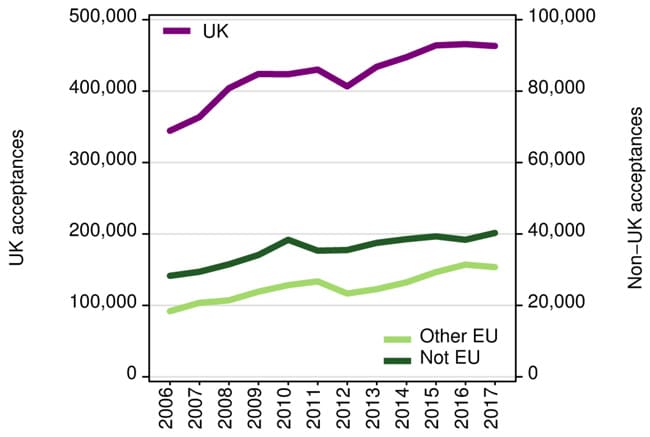
The number of acceptances granted by British universities followed a similar pattern in 2017: UK and EU numbers were down against an increase in acceptances for non-EU applicants.
The number of acceptances granted to British prospects fell by .5% this year, and by 2.1% for EU students from outside the UK. As with the trend for application volumes, this decline in EU acceptances reversed a four-year growth trend dating back to 2012.
Also following the non-EU trend line, acceptances to prospects from outside the EU rose by 5% (or roughly 2,000 students) compared to 2016. This growth effectively offsets (and then some) a 2.3% decline in non-EU acceptances in the previous year, and establishes a new record level for non-EU admissions.
Most Recent
-
Japan: Greater availability of in-country English programmes is exerting some downward pressure on outbound mobility Read More

-
UK: Sponsored study visa issuances down, rejection rates up, and more Read More
-
Beyond borders: Why student support matters more than ever in transnational education Read More