
Malta’s ELT student numbers jump by 14%

English Language Teaching (ELT) schools in Malta hosted more than 87,000 international students in 2017 according to Malta’s National Statistics Office (NSO), representing the first year of significant growth after a marginal increase last year and a slight decline in 2015. The year-over-year growth registered in 2017 was 13.6%, much more robust than 2016’s uptick of only 1.6% over 2015. Malta’s international ELT students represented close to 4% of Malta’s total tourists in 2017. Women made up 60% of their numbers. General English courses were by far the most popular choice in Malta in 2017, accounting for nearly three quarters (71.5%) of ELT enrolments. Intensive English courses enrolled another 16.5% of the total international ELT student population.
Top 10 senders change slightly
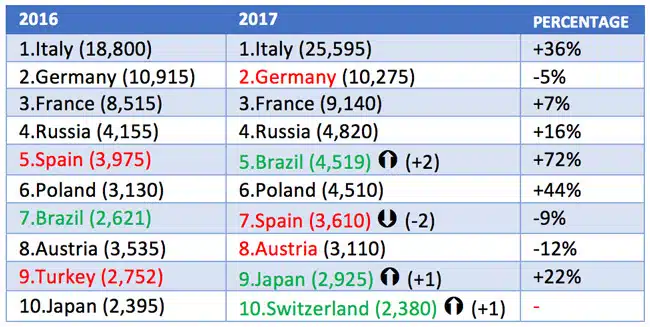
Italians continue to be the largest proportion of Malta’s ELT international students, making up 29.5% of the total (25,595 students) and with a 36% increase over 2016. Germany is the next-largest sending market (composing 12% of the total), but it sent a few less students in 2017 (10,275, down -5%). The third-largest sending market (9,140 students, or 10.5%) is France, and numbers from France were up 7.5% over 2016.
Russian student numbers in Malta’s ELT schools grew again in 2017 to 4,820, making it the second year of growth after a steep decline from 2013 through 2016. The most notable increases, however, came from Brazil (which sent 4,520 students, a 72.5% increase over 2016) and Poland (4,510 students, an increase of 44% over 2016). Brazil vaulted from ninth place into the Top 5 sending markets as a result, just edging out Poland and displacing Spain.
In 2017, the bottom half of the Top 10 source markets for Malta’s ELT schools were Spain (3,610 students, down 9% compared to 2016), Austria (3,110 students, down 12%), Japan (2,924, down 22%), and Switzerland 2,380, up 22%).
In 2016, Turkey was among the Top 10, but it contributed 15.5% fewer students in 2017, allowing Switzerland to replace it.
More than half of ELT students in Malta are under the age of 18
Students under the age of 15 make up 32% of international students in Malta’s ELT sector, and their numbers have grown by 63% since 2014. Students aged 16–17 and 18–25 are the next largest groups, making up 19% and 21% respectively. By contrast, those aged 50 or older represented only 7% of international students in the country’s ELT sector in 2017.
Students’ average stay is just under three weeks
When we last looked at Malta’s ELT numbers, total student-weeks had declined for the second consecutive year. In 2017, they increased from 229,000 to 244,200 weeks (growth of 6.6% over the year before), with women accounting for many more weeks than men (144,450 versus 99,750, respectively). However, the average length of stay fell to 2.8 weeks from 3 weeks in 2016. As in 2016, it is likely that shorter student stays are related to the increasing proportion of young students in ELT schools. Younger students are more likely to come in summer months than older ones, and stay for less time. Average stays also vary by nationality. The NSO notes that,
“With an average of 12.2 weeks, students from Colombia recorded the highest average duration. These were followed by South Korean and Turkish students with an average duration of 9.3 and 7.2 weeks respectively.”
Summer months are the busiest
A quarter of Maltese ELT enrolments for 2017 can be traced to students who arrived in July (21,570 arrivals). Another 11% came in August, and 10% came in March. June and July are notable for the significant influx of students aged 15 and under: these youngsters represent 44% of the total international student population studying in the country’s ELT schools during this period, in comparison to the 32% they represent on average throughout the year. By contrast, December and January are the most popular months for students aged 18–25. This age group accounts for 33% of the overall ELT population in December and 37% in January (their normal representation in the total is 21%). For additional background, please see:
Most Recent
-
Canadian immigration officials have made several updates to compliance guidance for study permits and post-graduate work permits Read More

-
Italy announces its “biggest language training and international mobility programme ever� Read More
-
Why sharper English-language guidance is becoming an agent’s sharpest tool for student success Read More







