Ϲ

Market intelligence for international student recruitment from Ϲ

Ϲ

23rd May 2018

British ELT rebounded in 2017

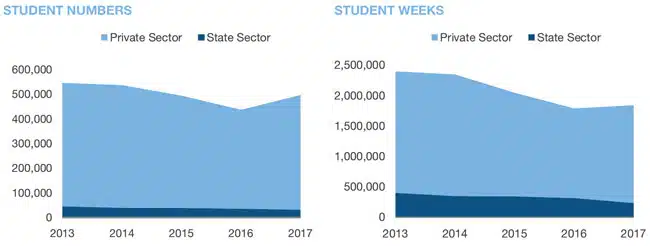
Whether measured by total number of students or by student weeks, the volume of programming delivered by English UK’s 400+ member English Language Teaching (ELT) centres fell for three straight years up to 2016. But all that changed last year, with , and 5% growth in student weeks. Total student numbers reached just over 497,000 for the year, with those students booking nearly 1.9 million weeks of ELT studies. “We’re delighted that for many of our members, their hard work and innovation has paid off,” said English UK Chief Executive Sarah Cooper. “They have taken advantage of the favourable exchange rate and built on that to attract students from growth and new markets.” While that is very strong year-over-year growth indeed, the following charts reflect that total programme volumes remain below recent-year highs from 2013. Total enrolment by number of students (left) and student weeks, 2013–2017. Source: English UK
Six in ten from EU

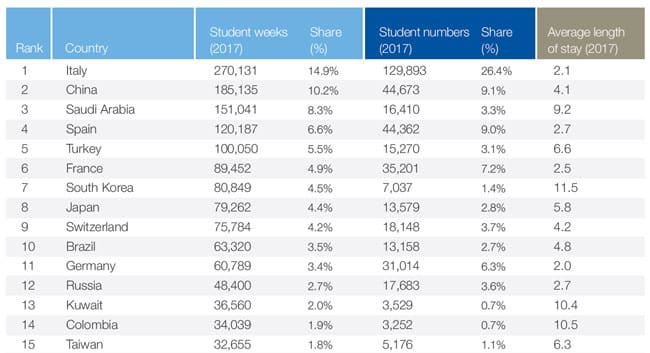
Nearly 60% of all ELT students in the UK come from the European Union, and from Italy, Spain, France, and Germany in particular. Owing to the longer stay of non-EU students, however, roughly two thirds of all student weeks for 2017 were attributed to students from outside the European Union. In 2017, the average stay for non-EU students, at 5.5 weeks, was more than twice that of the average 2.3-week stay for those from within the EU. Top 15 sending markets for British ELT in 2017 by student numbers and student weeks. Source: English UK In terms of year-over-year enrolment gains, the fastest-growing sending markets were Italy (+29), China (+37%), Brazil, (+53%), Russia (+63%), Colombia (+22%), and Taiwan (+27%). Italy was the big gainer for 2017, not only in its absolute growth from the year before but in the fact that that increase builds on its already large base as the leading source market for British ELT. Italian student weeks rose from 224,000 in 2016 to 270,000 last year, which alone accounts for about half of the total year-over-year growth in student weeks. "Seeing some key source markets growing this year is a very positive development for the UK,” says Patrik Pavlacic, head of research at StudentMarketing which analyses the English UK data. “It’s not only traditional markets but also markets in Latin America and Asia where we saw the UK being under-represented.”
Junior growth strong again

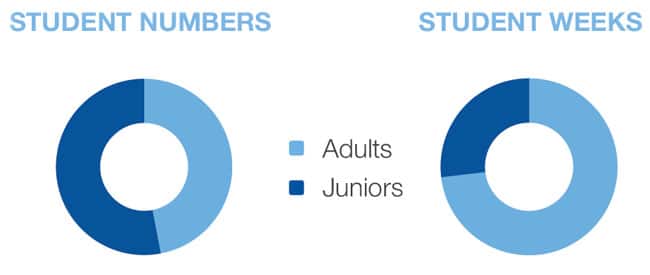
“2017 reinforced the UK as the most popular destination in the world for junior English language students,” adds a foreword to the 2017 enrolment report. “The 27% [year-over-year] growth in junior student numbers seen in the private sector is a testament to the UK’s attractiveness for this age band.” In total, students under the age of 18 accounted for just over half (53%) of all British ELT enrolments last year, but only a little more than a quarter of all student weeks (27%). English UK notes as well that within its membership, “Junior students dominated the private sector membership (55%) whereas state sector centres were predominantly attended by adult students (90%).” Share of enrolment (left) and student weeks for adult and junior students, 2017. Source: English UK
Advocating for EU mobility post-Brexit

English UK announced as well last week , and to try to ensure that EU student mobility can be maintained after the UK leaves the European Union. “We are extremely concerned about the consequences if students from the EU find barriers to entering the UK after Brexit,” said Ms Cooper. “We need to ensure that as many MPs as possible are aware of the economic and employment hit their constituencies and the wider UK may take if the needs of these largely short-term students – here for an average of under four weeks - aren’t taken into consideration.” Even before 2017’s strong growth, English UK estimates the direct turnover of the sector at £3.1 billion (US$4.2 billion) as of 2016, and that British ELT centres support 37,500 direct and indirect job. “What the figures don’t show – but other evidence does – are the other huge benefits these students bring to the UK,” adds Ms Cooper. “A summer holiday here to learn English can lead to a student choosing a university and perhaps a postgraduate course here, and a lifetime of affinity to the UK once they return home. After Brexit, this is exactly the kind of international relationship we need to build.” For additional background, please see:

Most Recent

  • Survey of 67,000 prospective students highlights gaps between interest and enrolment for study abroad Read More
  • Bipartisan congressional group calls on US administration to preserve Duration of Status for international student visas Read More
  • US ELT weeks fell by nearly -8% in 2025 Read More

Most Popular

  • Which countries will contribute the most to global student mobility in 2030? Read More
  • Research shows link between study abroad and poverty alleviation  Read More
  • Beyond the Big Four: How demand for study abroad is shifting to destinations in Asia and Europe Read More

Because you found this article interesting

Bipartisan congressional group calls on US administration to preserve Duration of Status for international student visas There was something different about this year’s annual NAFSA conference. The experience was wonderfully familiar in many ways,...
Read more
US ELT weeks fell by nearly -8% in 2025 In 2024, a slow recovery from plummeting international enrolments in the COVID-19 pandemic was underway for US Intensive...
Read more
Report: International students already studying in the UK or offshore through TNE represent an increasingly important recruitment opportunity Tighter compliance thresholds for UK universities recruiting international students – and the associated “Red, Amber, Green” scheme developed...
Read more
Japan: Greater availability of in-country English programmes is exerting some downward pressure on outbound mobility Nearly 170,000 Japanese students studied abroad using one of 41 service providers in Japan in 2025, with the...
Read more
UK: Sponsored study visa issuances down, rejection rates up, and more If you are an international student prospect, where you live in the world increasingly determines where you can...
Read more
New data provides early signals that Canada’s popularity as a study destination is on the rise Demand for study in Canada appears to be on the rebound, according to search data from two major...
Read more
UK universities bracing for a further decline in international enrolments Last year, the number of foreign students in UK higher education declined by -6%, according to data from...
Read more
Australia orders a year-long pause on new VET and ELICOS provider registrations In a legislative instrument dated 18 May 2025, Australia’s Assistant Minister for International Education Julian Hill has ordered...
Read more
What are you looking for?
Quick Links


