Ϲ

Market intelligence for international student recruitment from Ϲ

Ϲ

22nd Aug 2018

Global study highlights a jump in online bookings for under-30 travellers

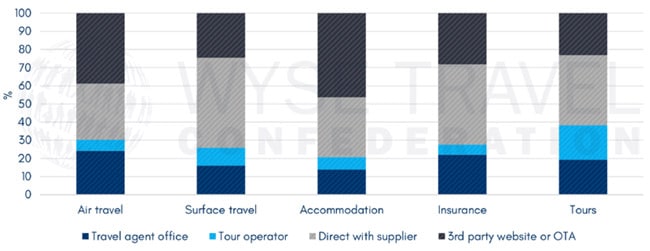
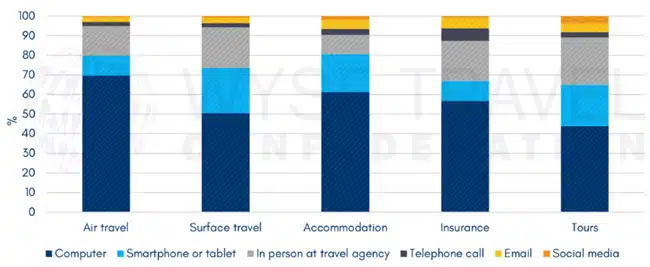
Every five years, the WYSE Travel Confederation puts its New Horizons Survey in the field to monitor key trends in the under-30 travel market. The latest findings – drawing on 57,000 survey responses from young travellers around the world – were published earlier this month in . As always, the report is wide ranging and comprehensive, and this year’s edition updates and expands on a number of important findings from earlier years. One area of note is the increasing role of online booking services for millennial and Generation Z travellers. The report’s overall observation in this respect is that travel is being made more accessible by the incredible volume of travel information now available online, and by the growing range of online booking options as well. As of 2007, around 50% of millennial travel bookings were made online, and most often via a desktop computer. In the 2017 survey, respondents reported that 80% of their travel bookings were made online. And, as the following chart illustrates, an increasing share of these transactions are being carried out on mobile devices. booking-medium-reported-by-youth-travellers-in-2017-new-horizons-survey Booking medium reported by youth travellers in 2017 New Horizons survey. Source: WYSE Travel Confederation Similarly, the survey finds a pronounced shift in booking channel over the past decade. In the late 2000s, more than seven in ten of all youth travel bookings were arranged in physical travel agent offices. In 2017, a majority of bookings were made online, whether direct with suppliers or via third-party sites or online travel agencies (OTAs). The most commonly used OTAs among survey respondents were Expedia, STA Travel, Skyscanner, and StudentUniverse. booking-channel-reported-by-youth-travellers-in-2017-new-horizons-survey Booking channel, including physical travel offices and online travel agencies, or OTAs, reported by youth travellers in 2017 New Horizons survey. Source: WYSE Travel Confederation New Horizons also clearly indicates that youth travellers are planning their trips with a much greater range of information sources and information channels than was the case a decade ago. The number of sources reported by survey respondents has increased from an average of four in 2007 to nearly 11 in 2017. “Friends and family were still the most important information source for young travellers in 2017, but the importance of social media and comparison or referral websites grew significantly in 2017 compared with 2012,” notes the study report. “Sources that have become less important over the past five years include tour operator brochures, printed guidebooks, tourist offices and travel agents. Not surprisingly, more information is being gathered online at the cost of face-to-face interaction or printed sources.”
Travel for study and work

The report carries some important implications for destination marketers and recruiters alike, especially so given both the scale of the youth travel segment and its natural overlaps with study abroad markets. The UN World Tourism Organization estimates that youth travel accounted for 23% of all international arrivals in 2017, or just over 300 million trips, with the value of the youth travel market estimated at more than US$280 billion. Although nearly four in ten (38%) of all youth bookings are still for holiday travel, WYSE is tracking an increasing proportion of what might be classed as “purposeful travel” within the youth segment, from 53% of all trips in 2012 to 62% in 2017. And study figures prominently within that field of the 60%+ of youth bookings for purposeful travel, with 23% indicating that they travelled abroad for language study, another 14% reporting non-language study as the purpose of their trip, and 13% indicating that they went abroad for international work experience. For additional background, please see:

Most Recent

  • Supply and demand for international higher education increasingly aligned in Asia Read More
  • Canadian immigration officials move to ease rules around student work permits Read More
  • Australia: Student visa refusal rates reach record high amid weakening demand from China Read More

Most Popular

  • Which countries will contribute the most to global student mobility in 2030? Read More
  • Research shows link between study abroad and poverty alleviation  Read More
  • Beyond the Big Four: How demand for study abroad is shifting to destinations in Asia and Europe Read More

Because you found this article interesting

Supply and demand for international higher education increasingly aligned in Asia A new report from Studyportals and the British Council, “Asia, Latin America, and MENA in global education,” demonstrates...
Read more
Canadian immigration officials move to ease rules around student work permits Immigration, Refugees and Citizenship Canada (IRCC) has introduced a package of amendments to the current rules around student...
Read more
Australia: Student visa refusal rates reach record high amid weakening demand from China Australian universities have so far faced fewer challenges than English-language training (ELICOS) and vocational education providers in the...
Read more
What international students need to know about study and work visas in the United States The current political climate in the United State has spurred a flurry of proposals and rules affecting the...
Read more
Study finds strong agent interest in partnering with Japanese universities For many years, institutions in the Big Four (Australia, Canada, UK, and US) have partnered with educational agents...
Read more
Canada’s language training sector reinvents pathway programme model in response to policy settings In 2019, pathway programmes – joint offerings that link language study with academic programmes – accounted for nearly...
Read more
Study highlights poor outcomes for graduates of Indian higher education Across economies advanced and developing, young degree-holders are finding it more difficult than in the past to secure...
Read more
Canada: Government audit finds impact of international student cap far greater than expected The Office of the Auditor General of Canada (OAG) has released a report that analyses the effect of...
Read more
What are you looking for?
Quick Links