Ϲ

Market intelligence for international student recruitment from Ϲ

Ϲ

5th Sep 2018

Annual survey finds continued growth in international schools

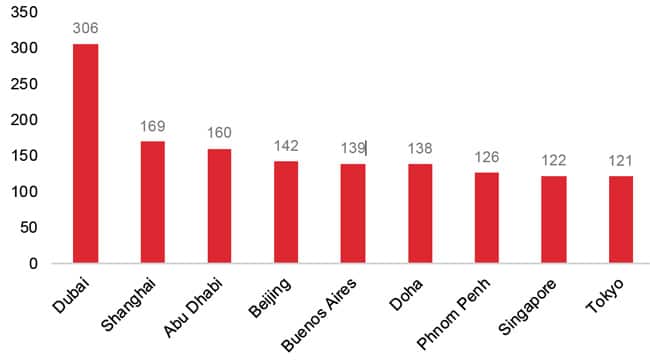
The latest edition of an annual global study reveals ongoing growth in the international schools sector, both in terms of the number of schools and with respect to enrolment. The 2018 Global Report on the International Schools Market from ISC Research counts a total of 9,605 English-medium international schools worldwide. This represents a year-over-year increase of 6.3%, and contributes to a compound annual growth rate of nearly 6% over the last five years. ISC defines the segment as follows, “These schools, for children aged between 3 and 18, offer an international curriculum or a curriculum other than the country’s national curriculum (often the National Curriculum of England or an American style of curriculum). Most are entirely English-speaking, others are bilingual with English as one of the main languages of learning.” The locations with the greatest number of international schools are summarised in the chart below, with Dubai and its 306 leading the way (followed at some distance by Shanghai, Abu Dhabi, and Beijing – each with between 140 and 170 schools). the-nine-leading-global-centres-by-number-of-international-schools-hosted-2017-18 The nine leading global centres by number of international schools hosted, 2017/18. Source: ISC Research Looking ahead, ISC is already tracking another 104 new school openings planned for the 2018/19 school year.
Enrolment growth

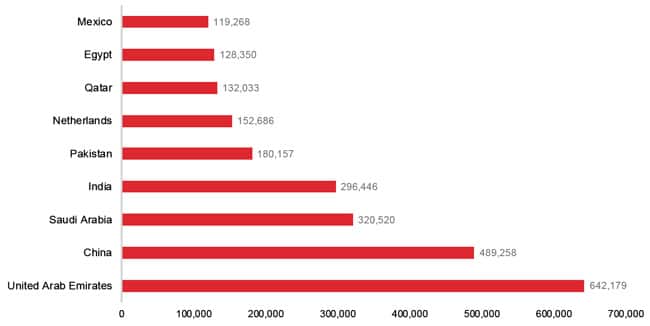
Along with an expanding field of school choice, the number of students enrolled in international schools has also continued to grow this year. ISC reports 7% growth in enrolment year-over-year, taking the total student population to 5.1 million worldwide (on a compound annual growth rate of just under 7% over the past five years). As the following chart reflects, roughly a third of this total enrolment is concentrated in four markets: the UAE, China, Saudi Arabia, and India. leading-international-school-locations-by-enrolment-2017-18 Leading international school locations by enrolment, 2017/18. Source: ISC Research This volume of enrolment translates to roughly US$49 billion in direct tuition revenues and supports a global workforce of 467,000 teaching staff. “This continuing demand for international education reflects a trend that we are seeing in a vast number of countries,” says ISC Schools Director Richard Gaskell. “It is fuelled by increased wealth and parents’ aspirations to prepare their children in the best possible way to study at universities overseas, and for careers that can take them around the world. There is a very high level of investment interest in international education in many countries and we expect this trend to continue as economies improve.” Looking ahead, ISC projects continued strong growth for the sector over the next decade, with all top-level indicators – including number of schools, enrolment, revenue, and employment – all expected to exhibit significant further growth through 2028. By that point, the research consultancy forecasts the total number of schools worldwide will exceed 16,000, global enrolment will approach ten million students, and combined sector revenues will reach US$95 billion.
Indicator for global mobility

The significance of this continuing rapid expansion of international schools extends well beyond the sector itself. As ISC puts it, “Approximately 20% of [international school] students are the children of expatriate families who are seeking a school offering the language of learning and curriculum from their home country. However, the vast majority of international school students today are the children of local families choosing, what they consider to be, the best possible education close to home to prepare their child for university overseas and global careers.” Thus, the growing population of students in the sector also represents an important – and expanding – pool of well-qualified applicants for higher education institutions abroad. For additional background, please see:

Most Recent

  • UK Home Office publishes updated visa sponsor guidance for “agents and third parties” Read More
  • Visa rejections climb in the US for international students from key markets including India Read More
  • Supply and demand for international higher education increasingly aligned in Asia Read More

Most Popular

  • Which countries will contribute the most to global student mobility in 2030? Read More
  • Research shows link between study abroad and poverty alleviation  Read More
  • Beyond the Big Four: How demand for study abroad is shifting to destinations in Asia and Europe Read More

Because you found this article interesting

UK Home Office publishes updated visa sponsor guidance for “agents and third parties” The UK government has expanded its regulatory oversight for British institutions’ engagement with education agents. The existing structure...
Read more
Visa rejections climb in the US for international students from key markets including India A new report from Shorelight called Beyond the Interview: A Decade of Student Visa Denials
and What Comes Next,...
Read more
Supply and demand for international higher education increasingly aligned in Asia A new report from Studyportals and the British Council, “Asia, Latin America, and MENA in global education,” demonstrates...
Read more
Canadian immigration officials move to ease rules around student work permits Immigration, Refugees and Citizenship Canada (IRCC) has introduced a package of amendments to the current rules around student...
Read more
Australia: Student visa refusal rates reach record high amid weakening demand from China Australian universities have so far faced fewer challenges than English-language training (ELICOS) and vocational education providers in the...
Read more
What international students need to know about study and work visas in the United States The current political climate in the United State has spurred a flurry of proposals and rules affecting the...
Read more
Study finds strong agent interest in partnering with Japanese universities For many years, institutions in the Big Four (Australia, Canada, UK, and US) have partnered with educational agents...
Read more
Canada’s language training sector reinvents pathway programme model in response to policy settings In 2019, pathway programmes – joint offerings that link language study with academic programmes – accounted for nearly...
Read more
What are you looking for?
Quick Links


