Ϲ

Market intelligence for international student recruitment from Ϲ

Ϲ

11th Sep 2018

Study explores adoption of online learning and its relationship to student mobility

“Online learning – the use of the Internet to provide or augment formal education – has grown up. Still viewed as novel or innovative in some quarters, online learning can now look back on an almost thirty-year history.” This statement opens an important new study from the Observatory on Borderless Higher Education (OBHE), and it kicks off a wide-ranging survey of the scale and shape of online learning in key markets around the world. In Whatever Happened to the Promise of Online Learning? The State of Global Online Higher Education, the OBHE sets out case studies for 12 selected countries and regions, and finds widely varying rates of adoption and experiences of online learning across this sample:

  • China
  • Egypt
  • England and Scotland
  • India
  • Malaysia
  • Mexico
  • Saudi Arabia
  • South Korea
  • Spain
  • Sub-Saharan Africa (excluding South Africa)
  • United Arab Emirates
  • United State of America

The study places these markets into one of five descriptive categories as follows:

  • “Distance, Not Online.” These markets have a large distance learning sector but one that makes little use of of online learning (e.g. Egypt, India).
  • “Online Learning as Marginal.” These education systems are characterised by strong growth in enrolment on campus, but with very modest use of online learning (e.g. Saudi Arabia, UAE and Sub-Saharan Africa).
  • “Blurred Growth.” The OBHE considers that these countries have a muddled online learning context, with elements of distance learning, that nevertheless is growing more quickly than conventional delivery modes (e.g. Mexico, Spain).
  • “Clear Online Growth.” As distinct from “Blurred Growth” markets, these countries feature a clearly defined online learning sector that is growing more quickly than campus-based programming (e.g. United States).
  • “Peaked/Decline.” Countries belonging to this final group have seen their online enrolment flatten or even decline in recent years (e.g. England, South Korea).

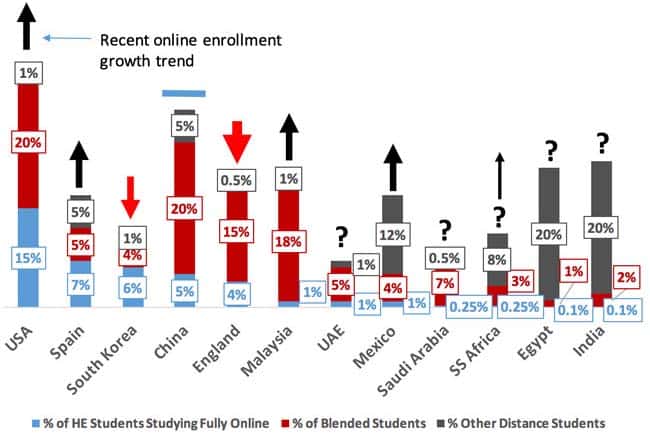
Keeping those broad categorisations in mind, the following chart provides a summary of the market share of online learning, and recent growth trends, for the 12 case study countries and regions. estimated-mated-share-of-fully-online-blended-and-other-distance-students-in-domestic-higher-education Estimated share of fully online, blended, and other distance students in domestic higher education, with recent-year growth trends illustrated, for case study markets, 2016. Source: OBHE One of the questions that the study aims to explore is why online learning has grown in some markets, but not in others. In the two markets where online and distance learning are more established – the US and China – the OBHE sees some common factors at work. This essentially boils down to a systemic commitment to online learning as a means of serving student populations that might otherwise have difficulty accessing higher education, whether because of geography, affordability, or lifestyle factors (i.e., family or career commitments). "It is striking that online learning is the subject of so much hype and speculation around the world but there is so little objective, comparative analysis of how the delivery mode is actually playing out in different countries,” said report author and OBHE Director Richard Garrett. “Our hope is that this report – and the supporting case studies – help address this gap."
The connection to international mobility

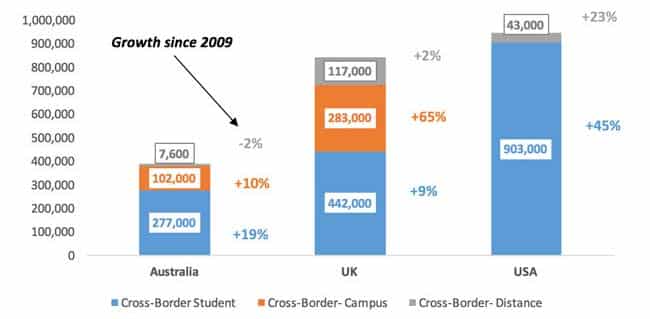
Of particular relevance to international recruiters, the study also considers the extent of online provision across borders – that is, the scale of “virtual international mobility” where students pursue online programmes offered by an institution overseas. “[One] strand of dotcom-era enthusiasm for online learning was the notion that the technology would disrupt national higher education systems, prompting large virtual student flows across country borders,” says the study report. “Champions foresaw in online learning a way to dramatically increase access to high quality programming, addressing absolute capacity limitations in some countries and quality or cost restrictions in others.” Even acknowledging that data on cross-border enrolments is limited in many markets, the OBHE finds little evidence of growth in this area. Looking back over a decade or more, total growth in international mobility has been significant, and the volume and variety of transnational education has also expanded considerably via more conventional modes such as international branch campuses and joint or dual degree programmes. In the following chart, we see this pattern playing out through the examples of Australia, the UK, and the US as it tracks the volume of higher education provision for inbound cross-border students, those enrolled in campus-based TNE initiatives, and those following distance or online programmes that reach across borders. The overall growth rate since 2009 is also shown for each delivery mode. international-student-enrolment-for-2016-in-australia-the-uk-and-the-us-by-mode-of-delivery International student enrolment for 2016 in Australia, the UK, and the US by mode of delivery. Source: OBHE In the final analysis, the report anticipates a continued variability by market going forward in terms of the pace of adoption and nature of online learning provision. The OBHE projects continued growth in the sector, buoyed in large part by the strong underlying global demand for higher education. Its view of the sector’s outlook, however, is more tempered than the revolutionary forecasts offered in the past by other observers. “For many institutions and students, a blend of online and in-person study may be the best way forward,” notes the report. “Blended learning means that online learning complements rather than competes with the traditional campus, supports learners, faculty and staff where they live (in urban areas at least), and affords creative combinations of individualised and group, online and in-person learning. This vision of online higher education aligns online and campus development. Until online learning can embody at scale the best of one-to-one and small group interaction, most students will need more than online alone.” For additional background, please see:
Most Recent

  • Canadian immigration officials have made several updates to compliance guidance for study permits and post-graduate work permits Read More
  • Italy announces its “biggest language training and international mobility programme ever” Read More
  • Why sharper English-language guidance is becoming an agent’s sharpest tool for student success Read More

Most Popular

  • Which countries will contribute the most to global student mobility in 2030? Read More
  • Research shows link between study abroad and poverty alleviation  Read More
  • Beyond the Big Four: How demand for study abroad is shifting to destinations in Asia and Europe Read More

Because you found this article interesting

Canadian immigration officials have made several updates to compliance guidance for study permits and post-graduate work permits Over the past four to six weeks, Immigration, Refugees and Citizenship Canada (IRCC) has updated several of its...
Read more
Italy announces its “biggest language training and international mobility programme ever” The Italian government is about to operationalise the largest language learning and mobility scholarship programme in the country’s...
Read more
Why sharper English-language guidance is becoming an agent’s sharpest tool for student success Most agents ELSAA speaks with are deeply committed to their students’ success – that isn’t in question. What...
Read more
Updated: US Department of Homeland Security publishes rule to end Duration of Status for international students Updated: 22 July 2026 As expected by US international education experts, the Department of Homeland Security (DHS) has...
Read more
Joint sector alert sends a clear compliance message to Australian higher education and VET providers There are two national quality-assurance regulators for tertiary education in Australia. TEQSA (Tertiary Education Quality and Standards Agency)...
Read more
Academic support and learning resources in TNE: Delivering student success across borders In my previous article in this series, I argued that if transnational education (TNE) is to fulfil its...
Read more
England: Government “remains of the view” that the International Student Levy should go ahead; implementation planned for August 2028 The UK first indicated it would explore “a levy on higher education provider income from international students” in...
Read more
Decline in Indian demand a major factor in softer outlook for foreign enrolment in US higher education in 2026/27 The Institute of International Education (IIE) does a twice-yearly snapshot survey of US institutions that required reading in...
Read more
What are you looking for?
Quick Links


