
How accommodation features and amenities affect student decision making

- Recent student surveys on accommodation preferences put the emphasis on public transit access, cost, and safety in student decision making around housing
- The surveys point to opportunities for housing providers to step up security provisions and to offer more common spaces and related services within student housing facilities
When students consider where to study, of course they think about quality of education, about post-study employment opportunities, and about making connections for life. But they also think about practicalities – and so do their parents. Where will they live? How much will it cost? Is there transit nearby? What security measures are in place at the accommodation they will call their home for the length of their study? These non-academic factors are very influential for students weighing the pros and cons of studying at one institution versus another – perhaps especially so when the availability and cost of student accommodation is an increasingly pressing issue in several destinations. Global investment in purpose-built student housing reached a record-high US$16 billion in 2016, more than double the figure in 2014, underscoring the importance of housing. When it comes to accommodation, students don't just have one question about accommodation; they have dozens, and the answer to each matters a great deal. Institutions, schools, and PBSA (purpose-built student accommodation) providers are now able to access a steady stream of global research to help them anticipate students’ and parents’ questions and to design student housing to include popular amenities and features.
Students’ preferences in six countries
A six-country study conducted among 4,000 university students by Sodexo UK – the University Lifestyle Survey – found that the top non-academic factor influencing students’ choice of university was the availability of good transit links (41%), followed by the cost of accommodation (30%). When students were asked about facilities in general, the availability of good IT and study facilities was important to (38%), and nearly as many (32%) cited good social facilities. The most common services that students had in their housing were wifi (76%), a laundrette (62%), and security (58%). The prevalence of wifi is a good match for students’ preferences, as is security (see this related article for more on the high priority students place on safety when making study abroad decisions). But the Sodexo UK survey found that, “Social space and sports facilities were a lot less common – only a third (32%) had social space (i.e., a café or bar) and only 29% had a gym.” These low percentages, when considered alongside the relatively high demand for social spaces among surveyed students, suggest potential for competitive differentiation and for design strategies.
The importance of amenities in student accommodation
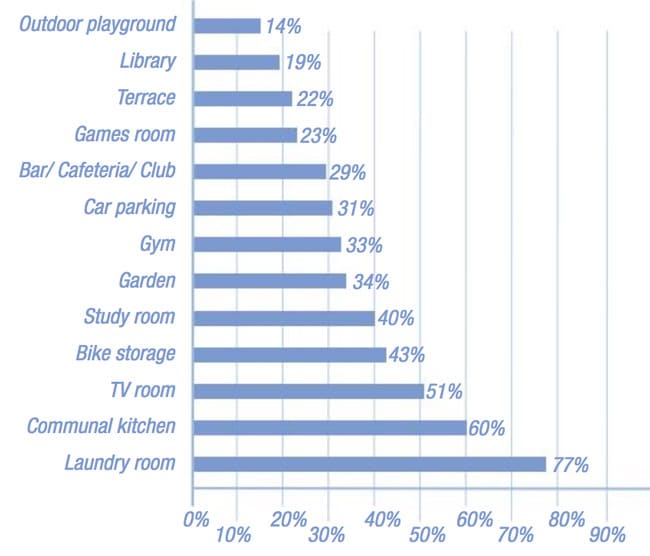
In other research news, StudentMarketing has conducted a study across 15 European cities and among more than 1,000 PBSAs to determine which student accommodation amenities are most common. As they note,
“With an additional 335,000 internationally mobile degree students in Europe by 2020, and continuing growth in the number of incoming students on short-term programmes such as Erasmus+ and US study abroad, the need to know what these students want in their ‘home away from home’ is critical to occupancy. Are investors and PBSA operators prepared for their needs, now and in the future?”
More than half of the PBSAs across the cities had a laundry room, a communal kitchen, and a TV room. These amenities are, of course, nothing new, and would be expected by the vast majority of students travelling far from home to study and live. What’s interesting is that less than half of the PBSAs had a bike room, study room, gym, garden, or bar or cafeteria for socialising. Again, PBSAs offering one or more of these amenities stand to gain an important edge in their marketing.
Easing parents’ fears
Crucially, only half of PBSAs surveyed by StudentMarketing (51% to be precise) provided access control systems and identifiable security measures, a small percentage given that, as the StudentMarketing report authors note, “security and safety are now coming to the fore in Europe, with parents wanting their children to feel safe in the current precarious geopolitical era.” They add,
“There is clearly an opportunity for PBSAs to either upgrade or incorporate tangible security features in their developments to attract occupants through their parents.”
Staying in step
The report’s other recommendations for new PBSA developments to respond to today’s generation of students are:
- The incorporation of social spaces (e.g., bars, cafeterias, club rooms) – only 29% of the PBSAs they surveyed had these, and the Sodexo UK research referenced earlier in this article also highlights this as a market opportunity;
- The inclusion of gyms and outdoor areas for a generation of students that is famously active; less than a third of the PBSAs surveyed had these.
For additional background, please see:







