Australia to publish agent performance data this year

Australia is moving forward with plans to publish detailed agent performance data later this year. Last October, at the 2018 Australian International Education Conference, Minister for Education Dan Tehan reaffirmed the government’s commitment to publish performance data for education agents. And most recently, the Department of Education and Training (DET) has set out further details in a policy paper released earlier this month. The paper highlights the key role that agents play in international student recruitment to Australia, and calls for stakeholder feedback on the planned reporting scheme. DET is open to feedback via a dedicated submissions page until 5:00 pm, Friday, 8 February 2019.
Transparency is the goal
The policy paper points to updated Australian legislation from 2017 as the foundation for expanded reporting on agent performance: “The ESOS Act [Education Services for Overseas Students] permits the Government to give information about education agents’ performance to providers, and publish information about education agents’ performance. This may be done for the purposes of promoting compliance with the ESOS legislative framework and student visa conditions.” The department has been piloting reporting models since 2017, and, as of May 2018, has been providing detailed reports to providers on the performance of agents with which they have a formal agreement. These reports are based on information collected within Australia’s (Provider Registration and International Student Management System). This data was contributed to PRISMS on a voluntary basis until last year, at which point it became mandatory (as of 1 January 2018) for Australian educators to report into the system. The performance data reflected in PRISMS revolves around a number of student enrolment and visa outcomes. More specifically, the system tracks whether a student went on to:
- successfully complete their enrolment;
- transfer to another provider;
- notify early cessation of their studies;
- have their studies terminated for non-payment of fees or disciplinary reasons;
- be reported for unsatisfactory course progress or course attendance;
- defer or suspend their studies; or
- not complete for any other reason.
In terms of visa status, PRISM also tracks whether:
- a student visa application was granted;
- a student visa application was refused;
- a student visa application was withdrawn;
- a student visa application was invalid; or
- a student visa was cancelled.
To this point, performance reports have been provided only to individual providers and have covered only the agents with which the provider has a formal agreement. The DET policy paper outlines the next phases in this reporting effort, starting with the publication of comparative data in the first half of 2019. These reports will allow providers to benchmark the performance of their agents against that of all other agents tracked in the system, broken down by sending market and educational sector. And then later this year – by “mid-2019” – the department intends to publish “performance data for all agents on a public website,” with the goal of allowing providers and students to easily access data for all agents tracked in the system. This public data will also allow, for the first time, agents to benchmark their performance against other agencies.
A key recruitment channel
The DET paper also clearly highlights the critical role that education agents play in Australian recruitment.
“Education agents are an integral part of Australia’s international education system,” notes the DET paper. “They represent education providers to students and advise prospective students on courses of study available to them in all education sectors…The vast majority of agents achieve good outcomes by recruiting high-quality, genuine students who complete their courses and abide by their visa conditions.”
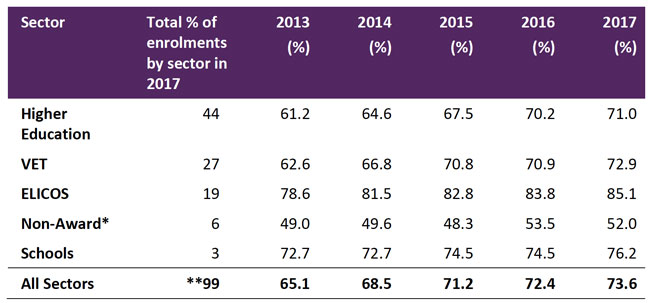
The following table summarises the proportion of foreign students referred by agents, by educator sector, between 2013 and 2017. It reflects that agents have played an increased role in all sectors in Australia over this period, and that overall the proportion of international students referred by agents has increased from 65.1% in 2013 to 73.6 in 2017. In other words, agents are now engaged in roughly three of every four international student enrolments in Australia.