
New report measures international graduates’ impact on UK government revenues

The question of whether international students make a significant positive economic impact in the UK has been answered yet again. A new report conducted by London Economics and commissioned by The Higher Education Policy Institute () and Kaplan International Pathways () entitled shows the massive contribution to government revenues made by just one cohort of international student graduates working in the UK through their annual income tax and National Insurance payments.
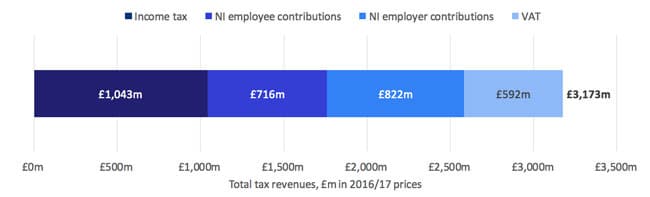
The report assesses this contribution to be £3.2 billion over the first ten years following graduation, with £1.2 billion stemming from EU students and £2 billion from non-EU students. The following chart breaks down this total revenue by category.
- “First-degree” holders contributing £1.12 billion;
- Master’s graduates contributing £1.6 billion;
- PhD graduates contributing £300 million;
- Other undergraduates contributing £163 million to the UK Treasury.
A counterpoint to the Migration Advisory Committee
Apart from demonstrating the tax and National Insurance contributions of international students to the British economy, the report was also designed to evaluate “whether international graduates are competing with UK graduates in areas with skills shortages” as well as “show the adverse impact on government revenues of restricting post study work rights for non-EU-domiciled students.” HEPI and Kaplan commissioned the research in part to counter government claims that extending post-graduate work rights for international students would not greatly impact the economy. In late-2018, a government-commissioned Migration Advisory Committee issued the following statement regarding its decision to not recommend a post-study work visa for international graduates:
“We do not recommend a separate post-study work visa though our proposals on automatic leave to remain at the end of study have some of the same effect. One reason for not recommending a longer post-study work period is that the earnings of some graduates who remain in the UK seem surprisingly low and it is likely that those who would benefit from a longer period to find a graduate level job are not the most highly skilled.”
As a result of their own commissioned research, HEPI and Kaplan note in their new report that, “we fundamentally disagree with the Migration Advisory Committee’s conclusions and recommendations.”
International graduates address skills shortages
The report counters any idea that international students who go on to work in the UK secure jobs that would have otherwise gone to British nationals, finding that international students most often end up working in sectors suffering from “acute skills shortages.” “Rather than displacing domestic graduates,” notes the report, “international graduates are plugging skills shortages.”
Current policy has removed billions from the economy
Despite the economic benefits demonstrated in the HEPI/Kaplan report as well as previous research on this question the UK government has for several years restricted international students’ post-study work rights as well as established policies aimed at reducing immigrants – including international students. Earlier this month, the government – through a new International Education Strategy announced by the Department of Education and the Department for International Trade – pledged to extend work rights for international graduates to six months (12 months for doctoral students). The extension is relatively minor in scale, as previously international students studying at the undergraduate and master’s level had been able to remain in the country to work for four months. The country’s university sector had been advocating for a new two-year work rights provision. Decisions around post-study work rights carry significant implications for the UK economy, argues the report. Since 2012, it says, the Home Office’s decision to limit post-study work rights has cost the UK just over £1 billion, broken down over £150 million per year or £750 million every five years in “foregone receipts” for the British government. Speaking about the report’s findings, Nick Hillman, director of The Higher Education Policy Institute, said: “Universities firmly believe the Government’s biggest mistake in higher education has been to discourage international students from coming here. A hostile environment has been in place for nearly a decade. It is a testament to the strengths of our higher education sector that the number of international students has not fallen, but it is an absolute tragedy that we have been unable to keep up with the pace of growth in other countries.” “The Home Office used to say there is insufficient evidence to show international students bring benefits to the UK. We proved this to be false last year, when we showed international students contribute £20 billion a year net to the UK. But, afterwards, the Migration Advisory Committee claimed there was still a lack of evidence to show international students who stay in the UK to work make a positive contribution.” “We can now disprove this too. Just one cohort of international students who stay in the UK to work contribute over £3 billion to the UK Exchequer – and it would be even more if policymakers had not reduced post-study work rights in 2012. The hard evidence shows a new approach is overdue.”







