
Survey highlights motivations for foreign students in Germany

More than half (57%) of international students in Germany said that Germany was their first choice of destination, and another 20% said that it was their second choice. This is according to a 2016 survey recently reported by DAAD in .
The international students surveyed are known as Bildungsauslaender, a term used to describe foreign students who obtain their higher education entrance qualifications outside Germany. Bildungsinlaender, a smaller proportion of the overall student population than Bildungsauslaender and one comprising students who obtain their higher education qualifications within Germany, were not surveyed. Bildungsauslaender are considered to correlate more closely to the way enrolment trends are reported in other countries.
Germany was recently ranked first in a study that included 30 European study destinations. The performance was attributed to the country’s “remarkable mix of world-class education at no or almost no fees,” as well as the fact that Germany has made “a considerable improvement in the number of courses offered in English” and boasts the lowest unemployment rate for university graduates in Europe.
More popular in certain sending markets
According to the DAAD report, Latin American students were the most likely to consider Germany a top destination (71%), followed by students from the Asia-Pacific region (63%), and then Sub-Saharan Africa (60%). North Americans were the least likely (49%).
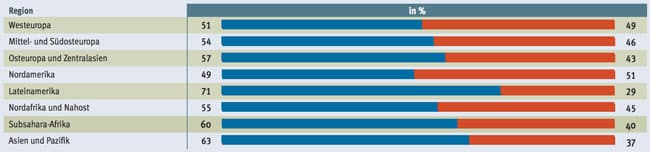
Looking at individual sending markets, more than three-quarters of Indians (78%) preferred Germany above other destinations, and more than half of South Koreans (62%) and Ukrainians (58%) did as well. Fewer than half of students from Syria, the US, Iran, Austria, and Turkey considered Germany a top choice.
Among Bildungsauslaender who chose Germany above other destinations in 2016, 61% were enrolled inengineering and 59% were enrolled in mathematics and natural sciences (59%). The survey report notes that Asian students in particular are drawn to Germany’s engineering programmes, and that:
“One argument for pursuing an engineering degree at a German university is the fact that Germany has a high level of technology.”
Motivations for studying in Germany
The report distinguished between “study-related reasons” for students to choose Germany and “destination-related reasons.”
In terms of study-specific motivations, students who came to Germany in 2016 were motivated most of all by an expectation that their programme will lead to good professional opportunities (83%). High proportions also considered Germany to offer a high quality of higher education (76%) and German universities to enjoy a good reputation (71%).
Less important to Bildungsauslaender was the fact that they would not have to pay tuition fees in Germany (56%). The availability of specialised training and education emerged as an important competitive strength for Germany, with 72% citing this factor as a motivation.
A smaller but significant proportion (38%) said that the ability to be taught in English influenced their decision to study in Germany. However, there are differences to be observed between students studying at different levels of higher education:
“While half of the students pursuing a master’s degree or doctoral studies consider studying in English to be important or very important for studying in Germany, among those bachelor’s programmes, it is only a small minority.”
More than half (56%) came to Germany with an interest in improving their German-language skills.
In terms of destination-related reasons, quality of life (63%), Germany’s reputation as a high-tech nation (58%), and the opportunity to work in Germany after graduation (57%) were the most important motivators.
Looking at regional variations, students from outside of Europe were more likely to be motivated by Germany’s reputation for offering a high quality of education and the availability of courses taught in English than students from Europe. For students from Latin America, Eastern Europe, and Central Asia, Germany’s cultural aspects were particularly appealing. Sub-Saharan African students placed a high priority on personal connections with friends and families in Germany.
Challenges foreign students have encountered in Germany
Two of the most pressing issues for the foreign students surveyed were difficulty finding accommodation (47%) and difficulty financing their studies (38%). These challenges are common across leading destinations, and it is worthwhile to consider the great extent to which they affect the quality of experience that international students have while studying. Easing students’ challenges in these areas would likely have a beneficial effect on word-of-mouth and thus future enrolment trends.
Integration issues are fairly pronounced in Germany’s international educational landscape, with 33% of Bildungsauslaender reporting “great difficulties” communicating in German. Another 30% had trouble connecting with the German population and 28% cited issues with contacts with German students. The report theorises that,
“Reasons for this may include the substantial increase in rent prices of the last ten years, as well as the growing number of degree programmes taught in English, which encourage Bildungsauslaender with limited German skills to study in Germany.”
The research found that students from North Africa and Middle East, Sub-Saharan Africa, Asia and Pacific, and Latin America tend to deal with the various issues more often, above all with integration problems, especially when it comes to communicating in German.”
In addition, students studying in higher levels of German education (master’s and doctoral programmes) reported more problems integrating than did students in bachelor’s programmes. The report notes that “these types of degrees are in particular demand among students from Asia and Pacific countries and are often taught in English,” thus it makes sense that these students might encounter more difficulty speaking in German than other students more exposed to the language in their study experience.
Those students who did not consider Germany a top choice reported more challenges in their study experience than did students who preferred Germany above all other destinations.
Those students who took advantage of support services offered to international students at German universities (e.g., psychological help, counselling on obtaining a work permit, help understanding residency law or on health insurance) reported high levels of satisfaction with these programmes. Unfortunately, only small percentages of Bildungsauslaender reported using these services.
Of all the services foreign students could use while studying, these emerged as the most relevant:
- Study counselling (74%)
- German courses (73%)
- Introduction to learning and work techniques (72%)
- Information on study financing (71%)
- Tutoring parallel to studies (71%)
- Accommodation placement services (71%)
- Assistance in dealing with the authorities (70%)
Satisfaction with study in Germany
More than eight in ten Bildungsauslaender (83%) said they would recommend studying in Germany to their friends, with half (51%) saying they would recommend the country without reservation and one-third (32%) saying they would have some slight reservations. Only 5% would advise against studying in Germany. Satisfaction was highest among Latin Americans (90%) and Europeans and Central Asians.
And, the survey found:
“The proportion of students whose opinion of Germany as a study destination has evidently improved during the schedule of their studies is more than five times as high as the proportion of students whose opinion of Germany has deteriorated.”
For additional background, please see:







