
Canada’s K-12 schools building protocols for safe arrivals this year

- Canadian schools and school boards are developing detailed protocols for incoming students this year
- The goal is to provide concrete guidance for pre-departure planning, safe travel, and mandatory post-arrival quarantine
Earlier this year, the Canadian government established an exemption to the otherwise strict border closures currently in place for international travellers. Under this exemption, international students are permitted to enter Canada so long as they held a valid study permit, or had been approved for a study permit, at the time that the current travel restrictions took effect on 18 March.
More recently, Immigration, Refugees and Citizenship Canada (IRCC) announced the resumption of some . More specifically, as of 1 July IRCC began to again process online applications for visitor visas and electronic travel authorisations (eTAs).
IRCC has also resumed processing of study permit applications submitted online “to the extent possible”. In practice, this means that, while processing has restarted, some significant issues remain, including the ability of applicants to complete biometric requirements and that processing delays can otherwise be expected.
IRCC cautions as well that, “Due to current travel restrictions, applicants should keep in mind that, even if they apply and get a visitor visa or eTA, most people will not be able to travel to Canada at this time.”
Where flights are available and travel restrictions permit, IRCC adds that, “Those who are eligible to travel to Canada at this time must have a plan to quarantine for 14 days when they arrive in Canada. This is mandatory, even if they have no symptoms. Those who don’t have a plan should not travel to Canada.”
While educators and all other stakeholders continue to watch closely for further guidance from IRCC and public health authorities, those current directives from Canadian immigration officials provide an important part of the context for student mobility to Canada over the balance of 2020.
And, importantly, they also provide a foundation for educators to establish more concrete plans for bringing students to Canada in the coming months.
This planning process is well advanced among a number of Canadian K-12 schools and school boards this summer. The peak body for K-12 in the country, the Canadian Association of Public Schools - International (CAPS-I), has provided its members with broad protocols for travel, arrival, and quarantine for incoming foreign students.
The protocols reinforce the commitment of CAPS-I members to welcoming students in “a safe manner that greatly reduces the risk of transmission of COVID-19.”
This includes ensuring that students:
- are provided with clear instructions and are knowledgeable about and committed to complying with pre-departure and travel requirements;
- are aware of the need to comply with Government of Canada requirements for international visitors;
- have completed registration and reporting as well as any forms required by provincial authorities;
- have appropriate medical insurance which covers COVID-19 during the quarantine period and after;
- are provided with appropriate care and accommodation options for the 14-day quarantine period after arrival; and
- are monitored and supported throughout the duration of their mandatory quarantine period.
Schools and school boards have in turn used those protocols as a basis for developing more specific plans for their incoming students. The Ottawa Catholic School Board () is one example of a board with very detailed plans in place to support students arriving for the 2020/21 school year.
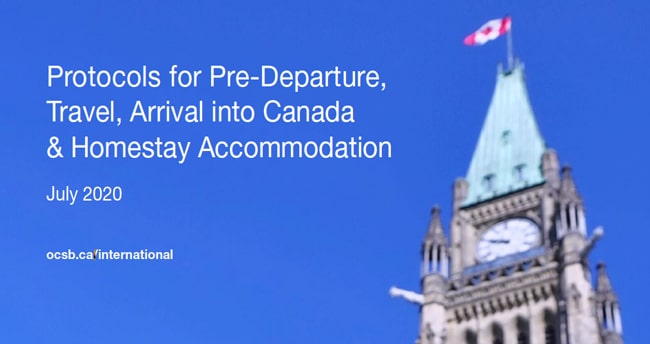
The OCSB’s guidance gives concrete instructions to students for pre-departure preparation (including quarantine planning and pre-flight medical checks), safe travel, arrival in Canada and quarantine, and post-quarantine transfer to homestay families.
That guidance includes that all students should have detailed quarantine plans and other documentation to present on arrival in Canada so that Canadian border officials can see clearly that there is a sound plan in place with good supports and oversight. “The student can have everything in order, including a valid study permit,” says Jenny Perla Leon, the board’s international education manager, “but if the [Canadian Border Services Agency] officer isn’t convinced you have everything you need to self-isolate they can still [deny entry to Canada and] turn you around.”
The board is mostly expecting students this fall that already had study visas in hand before March 18. Most students who did not have study permits by that point are deferring to February 2021 but the OCSB will apply the same travel and arrival protocols for incoming students in the first months of 2021.
This includes a highly structured programme for the mandatory 14-day quarantine that all arriving students will undertake. In cooperation with its homestay provider, MLI Homestay, the OCSB is arranging for quarantine sites at cottage resorts or hotels outside of the city, where each student can be assured of his/her own room, kitchen, bathroom and with all supplies that they will need readily available.
The OCSB is also framing the quarantine period as an extended orientation process for newly arrived students that will include socially distanced activities, such as outdoor yoga classes, as well as online counselling and advising sessions with board staff.
“We don’t want to just isolate them in a room for 14 days. We’re looking at their mental health as well,” says Ms Perla Leon. She adds that, by way of tools such as Zoom and Google Meet, that, “We’re still going to be connecting them with the school they will be attending and, for those in grades 11 and 12, with universities that they are planning to attend.”
The quarantine programme will be offered in specific windows for cohorts arriving in Canada on 2 September and 14 September. The Ottawa Catholic School Board anticipates better international flight availability for incoming students as of September and points out that the more structured cohort approach can help create a sense of community for students even during the quarantine period. “They are self-isolating,” adds Ms Perla Leon, “but they’re doing it together.”
The OCSB, along with other boards where plans are similarly advanced, are actively sharing those protocols with colleagues across Canada. The goal is to ensure that all schools are following the same processes and practices, and to parents and communities that foreign students can be warmly and safely welcomed to continue their studies this year. “During these times, we all have to work together to keep everyone safe,” says Ms Perla Leon.
For additional background, please see:







