
Students relying more on education agents for assistance with study abroad decisions

- QS data shows that education agents represent an increasingly important marketing channel in the pandemic as international travel is not possible and face-to-face student fairs aren’t happening
- QS reports a 33% increase in conversions “when agent-managed students are engaged with directly throughout their decision-making journey
- More than 1 in 5 students responding to this year’s QS International Student Survey have worked with an agent
A new report from QS shows that international students are relying more than ever on agents in their decision-making about study abroad. The report, , notes that the entire recruitment landscape going into next year is much different than it ever has been. Students are increasingly influenced by agents’ recommendations, and educators who know how to integrate agents into their international marketing plans stand to gain an important edge in target countries. A main takeaway from the QS data is that agents can provide a major boost to universities’ efforts to move students – who are navigating the uncertainties of the pandemic – through the enrolment funnel:
“Up-to-date information about intake start dates, course offerings, fees, scholarships, or policy changes are critical to student decision making, particularly in a year where there is so much movement and so many unknowns. QSES data demonstrated that there was a 33% increase in conversions when agent-managed students are engaged with directly throughout their decision-making journey.”
Because several other marketing channels will remain unavailable to universities and schools for at least part of 2021, including face-to-face student fairs and the opportunity to travel to target markets, agents may be a central element of international recruitment for many universities for the foreseeable future.
Agent usage increasing
There has been a big jump in the number of students saying they are working with agents. In 2014, only 14% of prospective international university students responding to that year’s QS International Student Survey said they had worked with an agent; in 2020, this proportion rose to 22%.
As we reported recently, agents typically account for roughly half of international student referrals for leading study destinations. Taking that as a jumping off point, some observers have pointed out that agents are expected to play an even greater role in recruitment for most destinations going forward, and especially during the COVID recovery.
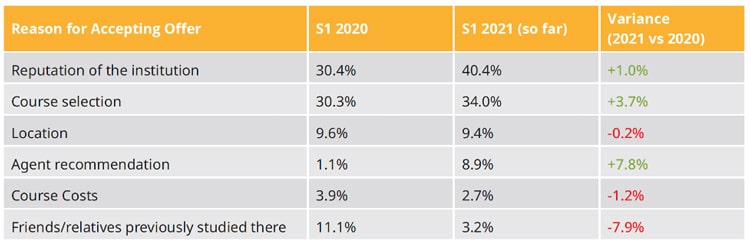
Those universities and schools who are not yet working with agents might well want to look at the following chart, which shows the dramatic year-over-year increase in agents’ influence (+7.8%) on student acceptance of offers from Australian universities.
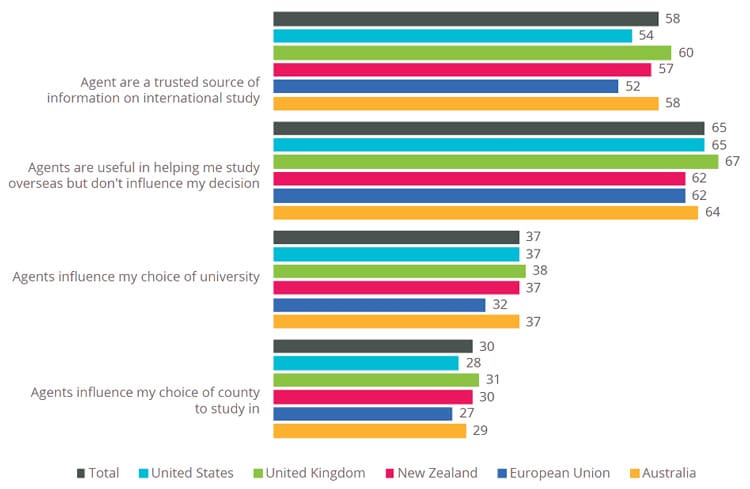
Another chart, pulled from QS’s 2020 International Student Survey, Volume 2 (compiled from more than 80,000 responses), shows that 65% of prospective students said that they found agents to be useful in helping them study overseas.
Lower proportions said agents had a direct influence on the country and institution they chose to study at, indicating that a broader range of factors is at play in students’ ultimate decision. The QS report authors note that while universities’ strategic use of agents can be helpful, it’s also important for admissions staff to find ways to communicate with students directly, as information that comes right from the institution is viewed as the most authoritative by students.
For additional background, please see:







