
Spanish language travel sector calls for government support

- The Spanish government has introduced an €11 billion support programme for the country’s tourism industry
- However, the language travel sector is not included in the relief package, despite a projected year-over-year 82% decline in language programme enrolments and an estimated loss of more than €216 million
A recent statement from the Federation of Associations of Schools of Spanish as a Foreign Language (FEDELE) illustrates .
FEDELE estimates that enrolment in the country's language schools fell by just over 82% in 2020 compared to the year before. The association notes that the sector "attracts hundreds of thousands of students every year…with 138,000 students in 2019 [in just FEDELE member schools]. The losses in the sector are estimated at €216,230,000 (US$253,000,000) in 2020 alone and, despite this, they are not part of the direct aid from the central government."
At issue is the sector's exclusion from a large-scale government relief package for Spain's tourism industry. On 24 February 2021, Spanish Prime Minister Pedro Sánchez introduced an designed to help the country's tourism operators recover from the COVID crisis. Tourism, notes the country's Ministry of Industry, Trade, and Tourism, is "a strategic sector for Spain, providing 12.3% of GDP and 12.7% of employment."
However, Spanish language schools, FEDELE reports, have been excluded from the relief package, "despite being part of TURESPAÑA's activities, belonging to the Tourism Board and having the explicit support of Fernando Valdés, Secretary State of Tourism." (TURESPAÑA, formally the Spanish Tourism Institute, is the lead national body for destination marketing in Spain.) FEDELE adds that its own COVID impact reports "show the fragility of a sector that depends entirely on the entry of international students" with an estimated 85% of the enrolment base of member schools composed of foreign students travelling from outside of Spain.
An annual report from industry consultancy Spain Education Programs (SEP) provides a more complete overview of the scale of the language travel sector in Spain. The was published in December 2020 in collaboration with EDUESPAÑA and other peak bodies, and with data and funding from the Spanish Institute for Foreign Trade (ICEX, an agency of the Ministry of Industry, Trade and Tourism).
The following table outlines estimated student numbers and student weeks for 2019 across all categories of language schools in Spain (including FEDELE member-schools). As the authors note, "There is not an official registry listing how many language schools operate in Spain and how many students attend these, a fact that complicates data gathering. To determine the number of institutions and their enrolment, we collect and triangulate data from three sources: EDUESPAÑA, FEDELE, and Instituto Cervantes (IC)." As such, the paper's analysis relies heavily on extrapolating average enrolment values for different categories of language training centres to estimate a total pre-pandemic enrolment of nearly 490,000 language students and roughly 1.7 million student weeks across the sector.
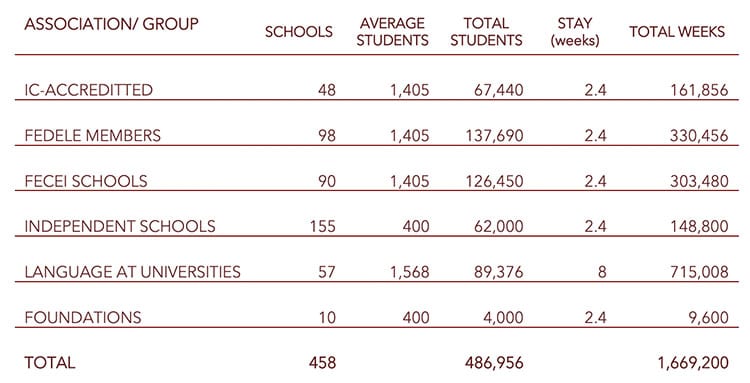
In a related projection, the authors estimate total 2019 student spending at just under €317,000,000 (US$372,000,000). This figure reflects tuition spending on language courses only so the total economic impact of the sector, after factoring in accommodation and other spending, rises to nearly €669,000,000 (US$786,000,000). SEP observes as well that the language travel sector accounts for nearly half (47%) of all foreign enrolments in Spain.
To say the least, that scale of economic activity throws the projected losses from 2020 into sharp relief. "The sector asks [the government] to reconsider which companies are eligible to receive direct aid," says FEDELE, "taking into account the logic of a sector that relies on the teaching of Spanish to foreigners who, at the moment, are not visiting our country."
For additional background, please see:







