
US opens travel exemption for students from China, Iran, Brazil, and South Africa; extends earlier guidance for online studies

- As of 1 August 2021, visa-holding students from China, Iran, Brazil, and South Africa will be able to enter the US under a special travel exception
- Similar exceptions have been extended to students from European Union and the UK
The US Department of State announced this week that students from China, Iran, Brazil, and South Africa will once again be permitted to enter the United States.
They will do so under a newly expanded National Interest Exception (NIE), which applies for students with valid F-1 and M-1 visas intending to begin or continue a programme of study commencing 1 August 2021 or after.
The announcement effectively expands an earlier easing of restrictions for European students with this week's notice affirming exemptions remain in place for travellers from the 26 European countries of as well as those from the United Kingdom and Ireland.
While Iran and Brazil are significant growth markets that have sent growing numbers of students throughout the past decade, the inclusion of China is of particular significance for US educators. China remains the largest source of international students in the US, and accounts for just over a third of total foreign enrolment in the country.
The Department of State guidance provides two additional key points for students planning to begin or resume studies after 1 August:
- Students are permitted to enter the country no earlier than 30 days before the start of their academic programmes.
- "Students seeking to apply for new F-1 or M-1 visas should check the status of visa services at the nearest embassy or consulate; those applicants who are found to be otherwise qualified for an F-1 or M-1 visa will automatically be considered for an NIE to travel."
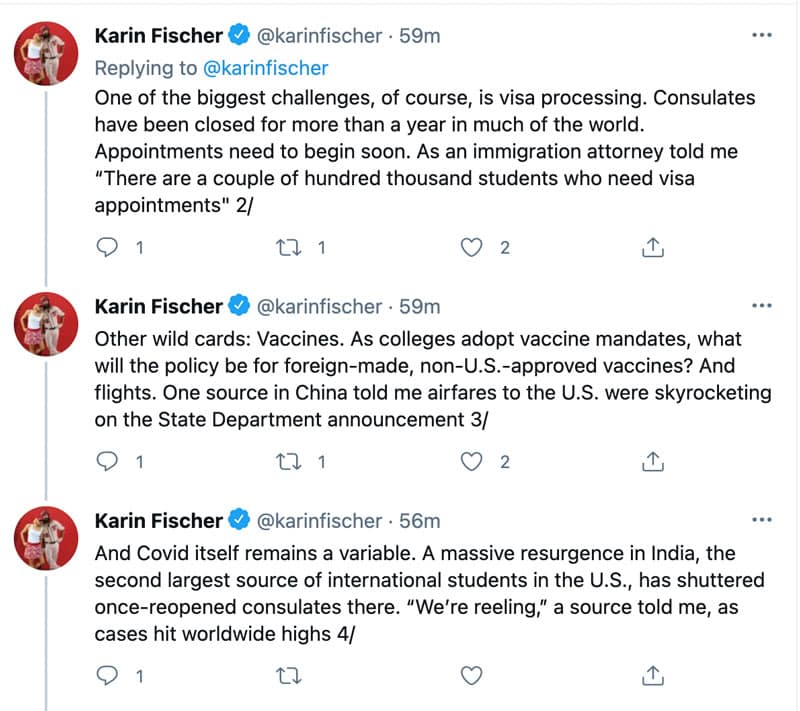
This last point draws a sharp line under a pressing concern for many students, agents, and educators this year. Visa services have been slow to resume in most US diplomatic posts abroad, and there is a tremendous processing backlog in the system. One recent analysis found that roughly three out of four US consulates remained closed, or were operating on a limited or emergency basis, as of mid-April. This includes diplomatic posts in the top two sending markets for the US – China and India – which are currently only handling visa files on an emergency basis.
Aside from visa services, there are many other details to be worked out for students planning to be in the US for the coming academic year, including availability and costs of international flights, vaccine requirements, and COVID itself. As illustrated in the following Twitter thread from the Chronicle of Higher Education's Karin Fischer, all of these factors mean that students, agents, and educators alike will still be actively contingency planning in the months ahead.
Guidance for online studies extended
In a related development, US Immigration and Customs Enforcement (ICE) also announced this week that its earlier guidance around online studies .
This harks back to departmental guidance initially issued in March 2020 that allowed foreign students who were forced to study online because of the pandemic to count their remote studies toward a full course of study in the US. Under this order, students will continue to be temporarily exempted from cap limits on online studies and will be able to preserve their visa status in the US during their remote studies.
The updated guidance for this week also affirms that new students engaged in remote studies because of the pandemic are not permitted to enter the US until their programmes, at least in part, resume in-person instruction.
As the ICE directive explains, "New or Initial F and M students who were not previously enrolled in a program of study on 9 March 2020, will not be able to enter the United States as a nonimmigrant student for the 2021/22 academic year if their course of study is 100% online. A new student should be allowed to enter the United States if they are engaged in a hybrid program, with some requirement for in-person learning. Consistent with this restriction, [US institutions] should not issue a Form I-20, 'Certificate of Eligibility for Nonimmigrant Student Status,' for a student in new or initial status who is outside of the United States and plans to take classes at an SEVP-certified educational institution that is operating fully online."
For additional background, please see:
- "Majority of US consulates remain closed with only limited visa services available"
- "US ends suspension of working visa programmes amid calls for restoration of visa processing services"
- "Will more colleges require vaccinations for students returning to campus in September 2021?"
- "International student enrolment in the US fell by nearly 18% in 2020"







