Ϲ

Market intelligence for international student recruitment from Ϲ

Ϲ

9th Jun 2021

International enrolments in US ELT fell by 50% in 2020

Short on time? Here are the highlights:
  • The number of international students studying in Intensive English Programmes (IEPs) in the US fell by 50% in 2020 compared with 2019
  • The degree of the decline is on par with that observed in Australia and less steep than decreases experienced in the UK, Irish, and Maltese ELT sectors – all declines set in the context of COVID
  • 54% of students enrolled in US IEPs intend to go on to other types of study in the US

International enrolment in Intensive English Programmes (IEPs) in the US fell by 50% in 2020 compared with 2019, and student weeks by 51%, according to the new data from the Institute of International Education (IIE) released as part of its . The data was collected via a survey conducted of 362 IEPs – both those within higher education institutions as well as independent centres – throughout the United States.

In total, the survey finds that 37,365 international students studied in US IEPs for a total of 514,685 student-weeks during the 2020 calendar year.

The IIE notes that the decline in the US, while steep, was not as severe in other leading source markets including the UK (-84%), Malta (-80%), and Ireland (-73%). Australia’s 2020 enrolments fell off by -47%, about the same percentage as in the US, while Canada’s were down by 56%. The COVID-related damage to ELT sectors across the major destinations also follows a downward trend in enrolments observed in 2019, pre-COVID.
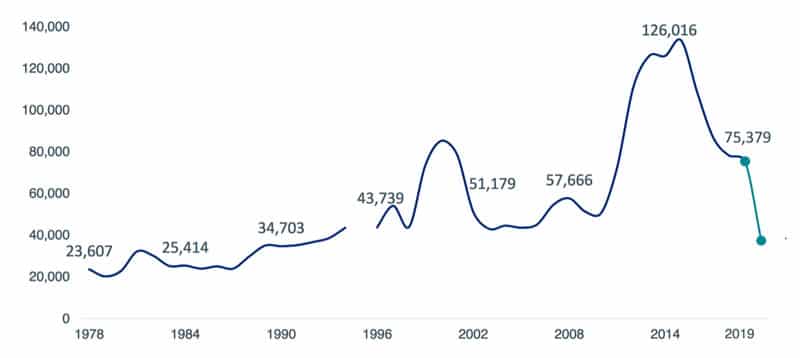
Enrolment in US IEPs from 1978 through 2020. The final figure given in the chart (75,379) is for 2019. The green downward line reflects 2020’s COVID-related drop to 37,365 students. Source: IIE

Business disruption but also innovation

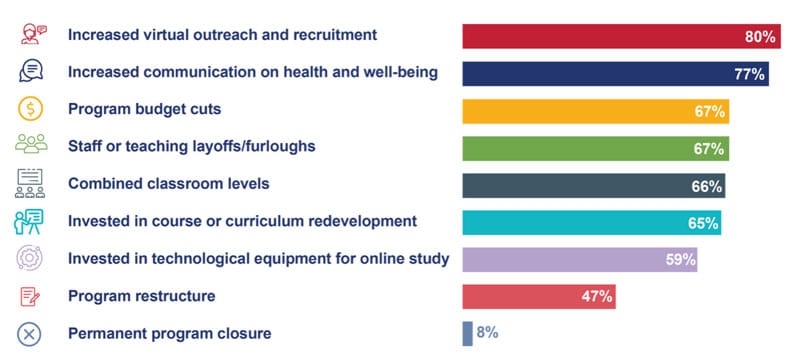
While 90% of reporting IEPs said that COVID had negatively impacted their business (including 8% who permanently closed down programmes), the same proportion said that the crisis had led to innovation, as shown below.
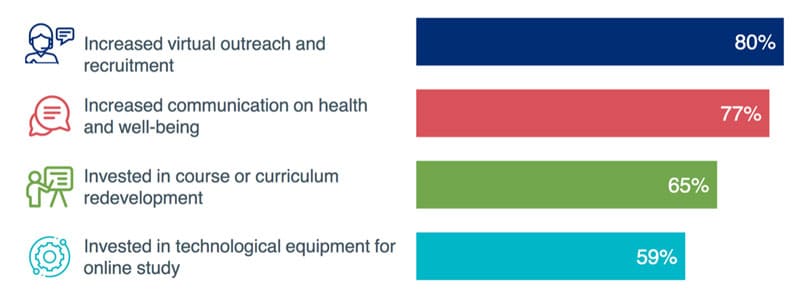
Altogether, the following chart shows the most common business impacts reported by responding IEPs.
While most IEPs pivoted in the summer of 2020 to offer primarily online instruction (89%), by fall of 2020, their offerings were more balanced and included more hybrid and in-person options.
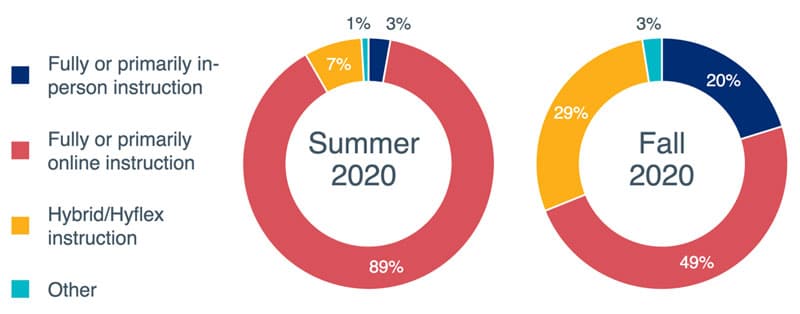
US IEPs began shifting to more in-person and hybrid delivery by fall 2020. Source: IIE

Top sending markets

The share of students in the top cluster of source markets grew in 2020 to 71%: China (9,136), Saudi Arabia (6,880), Japan, (5,285) Brazil (2,637), and South Korea (2,628). In 2019, the top five markets accounted for 66% of the total. Chinese students alone made up 25% of all US IEP enrolments in 2020, up slightly from 23% in 2018. Saudi Arabia’s 18% share moved up significantly from 12%, and Japan’s was down a bit from 16% in 2018.
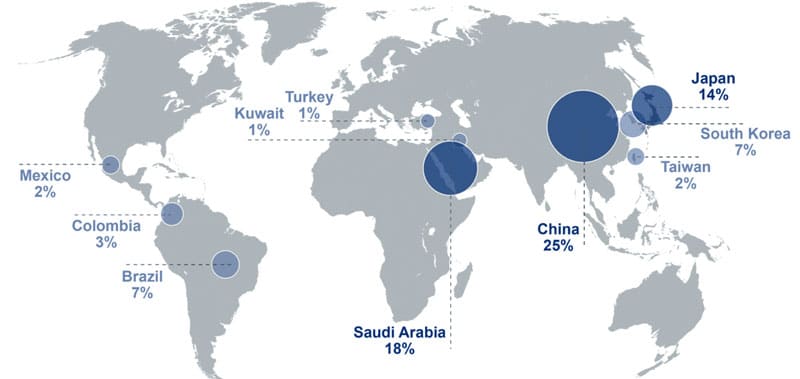
Top ten places of origin for international students in US IEPs, 2020. Source: IIE

Reflecting the importance of ELT to overall international education systems and programme levels in the major destinations, 54% of US IEP students say they are going to continue into other, non-IEP levels of study in the country.

For additional background, please see:

Most Recent

  • A common challenge: Strengthening student confidence in the ROI of study abroad Read More
  • New international student permit approvals for Canada fell below COVID levels in 2025 Read More
  • UK Home Office publishes updated visa sponsor guidance for “agents and third parties” Read More

Most Popular

  • Which countries will contribute the most to global student mobility in 2030? Read More
  • Research shows link between study abroad and poverty alleviation  Read More
  • Beyond the Big Four: How demand for study abroad is shifting to destinations in Asia and Europe Read More

Because you found this article interesting

New international student permit approvals for Canada fell below COVID levels in 2025 Canada approved only 75,372 new study permits in 2025. This represents a -64% drop year-over-year, and an -18%...
Read more
UK Home Office publishes updated visa sponsor guidance for “agents and third parties” The UK government has expanded its regulatory oversight for British institutions’ engagement with education agents. The existing structure...
Read more
Visa rejections climb in the US for international students from key markets including India A new report from Shorelight called Beyond the Interview: A Decade of Student Visa Denials
and What Comes Next,...
Read more
Supply and demand for international higher education increasingly aligned in Asia A new report from Studyportals and the British Council, “Asia, Latin America, and MENA in global education,” demonstrates...
Read more
Canadian immigration officials move to ease rules around student work permits Immigration, Refugees and Citizenship Canada (IRCC) has introduced a package of amendments to the current rules around student...
Read more
Australia: Student visa refusal rates reach record high amid weakening demand from China Australian universities have so far faced fewer challenges than English-language training (ELICOS) and vocational education providers in the...
Read more
What international students need to know about study and work visas in the United States The current political climate in the United State has spurred a flurry of proposals and rules affecting the...
Read more
Study finds strong agent interest in partnering with Japanese universities For many years, institutions in the Big Four (Australia, Canada, UK, and US) have partnered with educational agents...
Read more
What are you looking for?
Quick Links


