
Australia further eases work rights and offers visa fee refunds for returning students

- For the time being, international students have no caps on how many hours they can work in any sector of the Australian economy
- This policy will be reviewed in April 2022
- Students coming to the country until 19 March will have their visa application fee of AUD$630
- Reaction is mixed regarding potential impact of policies
Australia announced earlier this month that international students employed in some sectors would be permitted to work more than 40 hours per fortnight given skills shortages and a need to reinvigorate the national economy. , the government has taken those measures a step further and is temporarily removing the cap on working hours for all student visa holders, including secondary students, working in any sector, effective immediately.
In addition, the government is providing a significant financial incentive for international students, as well as working holiday visa holders, to come to Australia now that borders are open. Any student visa holder who is currently offshore and travels to Australia between 19 January 2022 and 22 March 2022 will be eligible for a refund of their visa application charge (VAC) of AUS$630. Similarly, anyone currently offshore with a working holiday maker visa who travels to Australia up to 22 March will be eligible for a refund of their VAC of AUS$495.
The initiatives are considered temporary and the extended working hours rule will be reviewed in April 2022.
In a press briefing, Prime Minister Scott Morrison framed the measures as a “thank you” to international students who have been patient through Australia’s long period of closed borders in 2020 and 2021:
“There are around 150,000 students who have visas who we are encouraging to come back to be there for the start of their university or college year, and that is a thank you to them for coming back and continuing to choose Australia. But we also want them to come here and be able to be filling some of these critical workforce shortages, particularly those who are working and being trained in health care, aged care, those types of sectors. That will be incredibly helpful.”
While some work and immigration policies may be temporary and COVID-specific, there also appears to be a long-term rethinking of Australian immigration strategies as they relate to international students. Australia’s strongly emphasises coordination between international student recruitment, programmes on offer, and skills gaps in economic sectors. Currently, almost half of all international enrolments in Australian universities are concentrated in business and management, a proportion the government would like to see shift in favour of areas such as engineering, healthcare, and data and digital industries.
Some concerns as well
The news about international students being offered more working hours and financial incentives is receiving mixed reviews. Immigration policy analyst Dr Abul Rizv told that such changes are jeopardising Australia’s reputation as a quality destination for academic studies:
“Everybody else still says student visas are about studying. We seem to be saying student visas are about working.”
Dr Rizv is also concerned that Australia’s extends the COVID-related policy of allowing students whose entire programmes are delivered offshore to obtain post-study work rights in Australia. He said, “The risk is that a large number of providers will do cheap, low-quality courses” and that many students will happily trade off the chance to study in Australia with the ability to pay lower tuition fees and obtain “a subclass 485 visa at the end.”
The opportunity of transnational
This much is clear for the moment: Australia intends to put a greater emphasis on offshore delivery going forward. The introduction for the new international education strategy states,
“There is an opportunity for further growth of our student market by expanding our high-quality education offerings to online and offshore markets. This could be in different delivery models at different price points to reach a much broader range of students.”
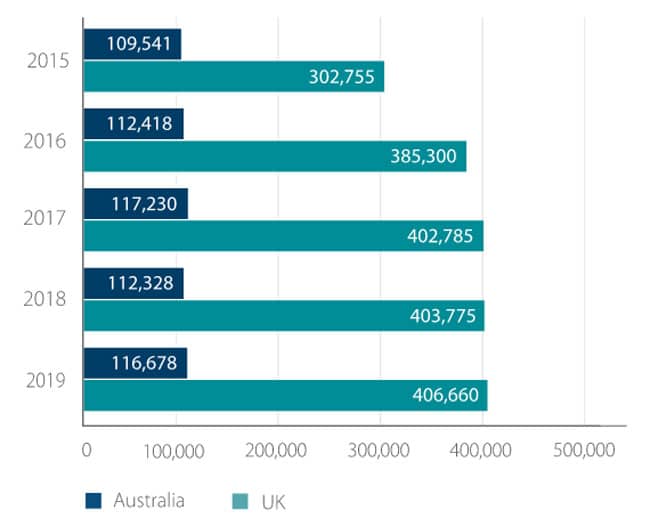
The document positions Australia’s current offshore enrolments against those of the UK as a way to illustrate how much untapped potential there is for Australian educators to deliver programmes overseas. There is a similar push towards offshore education for educators in New Zealand.
For additional background, please see:
Most Recent
-
Canadian immigration officials have made several updates to compliance guidance for study permits and post-graduate work permits Read More

-
Italy announces its “biggest language training and international mobility programme ever� Read More
-
Why sharper English-language guidance is becoming an agent’s sharpest tool for student success Read More







