
The Indian rupee has lost a lot of value this year – how will this impact planning for study abroad?

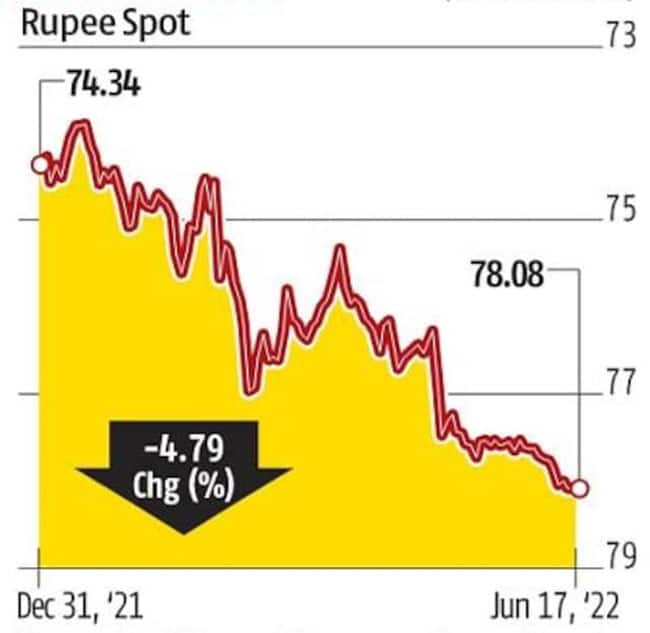
- The Indian currency has recently fallen to its lowest valuation ever against the US dollar
- The net effect is to increase the cost of study abroad for Indian students and families
- Observers so far expect that the demand for study abroad is so strong that most students will follow through on their plans this year
Indian students with plans to study abroad are currently facing significant challenges in following through on these plans. The value of their currency, the rupee, is declining against a strong US dollar, forcing some families to dig deeper into their savings or take out more loans to fund their studies.
In mid-July, the Indian rupee fell to its lowest point ever against the dollar: 80 rupees against the US currency.
Nancy Tiwari, an Indian master’s student, told that,
“Everything, including tuition fees, living expenses and travel tickets, has become costlier because of exchange-rate volatility. We have taken a loan from a bank to meet the cost of my studies in America. But with the dip in the rupee, we shall have to take an additional loan now.”
The higher cost of studying abroad for Indian students now is well-illustrated in from Ashish Fernando, CEO of iSchoolConnect: “An Indian student who always paid a fee at an exchange rate of around 65 rupees per dollar in 2017 might end up paying 78.20 rupees per dollar in 2022.”
Many won’t be deterred from following their dream
Some experts believe that the drive to study abroad is so strong in India that financial challenges are unlikely to stem the flow of Indian students to the US for education. Rohan Ganeriwala, co-founder of Collegify, told that,
“Despite the fact that the rupee has been falling, students are flocking to quality institutions. Foreign education is something that students and their parents plan for over two to three years’ time. It is the quality of education and the return on investment that are the driving factors, and people will make that investment despite the rupee falling.”
The Times notes that Indian families have “multiple finance options available from private banks, state-owned banks and non-banking financial companies” that they can turn to if needed.
Another expert told the Times that favourable economic conditions in the US, where about 60% of international mobile Indian students go, outweigh any immediate financial pressures facing families who want their children to study there. Vibha Kagzi, CEO of ReachIvy.com, said the declining rupee will have a “short-term impact” and that, “As long as the US job market continues to be robust amid the trend of Great Resignation, salaries increase amid continued talent war and work visa regime is liberal along with two-three years’ work permit post study, the US will continue to be the topmost destination for Indian students.”
Though many Indian families may accept the higher cost of sending their children abroad, it doesn’t mean it will be easy to adopt a long-term view of the return on investment. Pushpender Kumar, an Indian student planning to study in the US, told PTI that, “[he feels that] the ultimate cost will further shoot up till I land there and ultimately graduate.”
It’s the thought of working abroad after studies that Indian students will cling to as they assume the financial hit entailed by their devalued currency right now – the promise of earning foreign currency rather than rupees.
Possible scenarios for the next couple of academic cycles
It is likely there will be a few new segments of Indian students that emerge specifically as a result of the rupee’s fall against the dollar:
- Indian students who will reach deeper into their pockets to go to their preferred destination and institution.
- Those who will consider an alternate destination and institution based on factors such as affordability, ability to work during studies, and post-graduation opportunities.
- Students who will not be able to study abroad unless they receive a scholarship somewhere.
These segments are worth thinking about for institutions competing for Indian students from various positions – high rankings, cost of living, scholarships, etc. Educators who are able to show Indian students they offer a high quality of education that is also relatively affordable may have a stronger position right now than they may have in 2021.
For additional background, please see:







