Ghana: Steady gains in outbound student numbers suggest further growth ahead

- The number of students from Ghana is increasing significantly in a number of leading study destinations including Canada, the UK, Germany, and the US
- The country’s large youth population, stable democracy, and English-language proficiency are factors that make it an attractive source market
Ghana is now sending significant – if still relatively small – numbers of students abroad to leading destinations. Recent growth in Ghanaian student numbers in Canada, Germany, the UK, and the US suggests that educators in those countries are now recruiting more intensively in Ghana than in the past. They are often doing so with the help of agents, in-country offices staffed by local experts, or virtual student fairs organised by several student placement platforms.
The following graph from Statista shows the impressive upward trend in Ghanaian student mobility from 2010–2020.
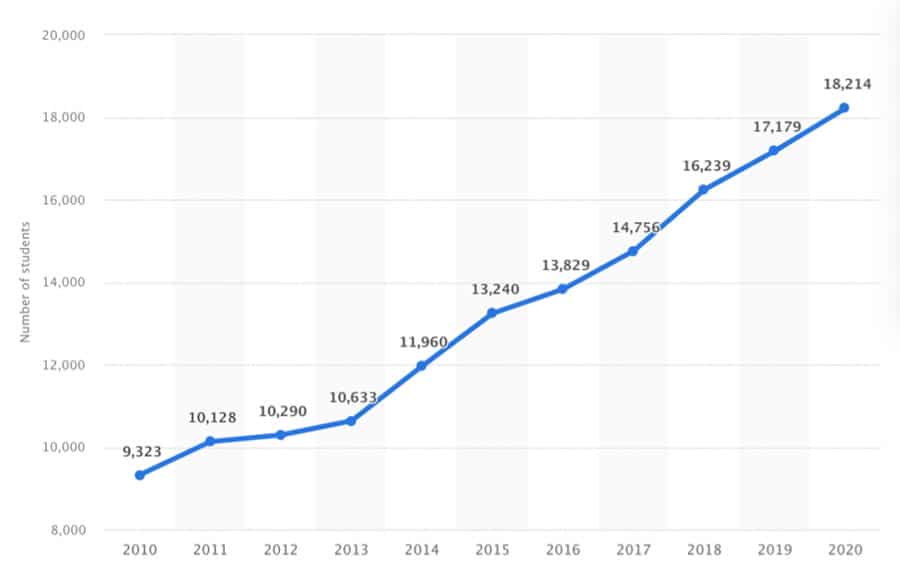
Here's a more detailed look at the growth we’re seeing from this market:
In Canada, according to IRCC data, the number of enrolled Ghanaian students was 1,235 in 2021, up from 880 in 2017 – a 40% increase.
- UK educators enrolled 21.9% more Ghanaian students in 2020/21 than in 2019/20 for , and Universities UK and UCAS are for market development, along with Nigeria and Vietnam.
- Ghana is the second-largest Sub-Saharan African source market for US educators after Nigeria. According to IIE data, a total of 4,230 Ghanaian students were enrolled in the US in 2020/21, compared with 3,215 in 2017/18 – .
- In Germany, according to , Ghana is one of the fastest developing markets, with 70% more Ghanaian students enrolled in 2019/20 than in 2017.
Currently, Ghanaian outbound is not large relative to other major source markets in Africa (e.g., Nigeria or Morocco). However, it is significant enough to form a critical mass of Ghanaian students in top destinations who, if they have a positive study experience, may recommend the destination/institution to their peers back home.
Further growth projected
We can expect more growth from Ghana given much more active recruiting overall in Sub-Saharan Africa on the part of educators in leading study abroad destinations. For example, Universities UK states that “Africa was the fastest-growing market for student recruitment, sending 29.8% more students in 2020/21 compared to 2019/20.” Africa is also on the radar in the US: University World News reports that, “According to the US Bureau of Educational and Cultural Affairs, the spotlight is on Angola, Cameroon, Democratic Republic of the Congo, Ethiopia, Ghana, Kenya, Nigeria, Rwanda, South Africa and Zimbabwe.”
Characteristics of the market
A key market fundamental making Ghana so promising for international educators is that 57% of the country’s total population of roughly 32 million is . Statista reports that “the number of people who were between the ages of 15 and 24 years in Ghana added up to ."
High school completion rates are uneven across the country and across income levels. Youth from the Ashanti, Eastern, and Greater Accra regions of Ghana are the most likely to have secondary and tertiary education, according to a 2020 report compiled by UNºÚÁϹÙÍø.
The primary language of instruction – and official language – in Ghana is English, meaning that Ghanaian students are more prepared for English-language studies abroad than many international students.
Ghana has been one of Africa’s most stable and safe countries for years, and its economy was growing robustly until very recently. Russia’s invasion of Ukraine has exerted a major downward pressure on the economy, in particular the agricultural sector, which is highly dependent on Russian fertiliser. Otherwise, the government blames weaker than predicted economic expansion on a combination of factors “including the COVID-19 pandemic ... as well as US and Chinese economic slumps (Reuters).” The economy expanded by 3.3% in the first quarter of 2022 and 4.8% in the second quarter, compared to average growth of 7% between 2017-19.
The country’s currency, the Ghanaian cedi, has depreciated this year – joining the currency devaluation trend affecting many other emerging markets. This, along with slower economic growth, means that educators recruiting in the region will need to be sensitive to affordability issues among students and their families.
Most Ghanaian students are interested in degree studies abroad, particularly at the graduate level. The Accra Information Office of the United States of America (USA) that in 2019/20, “nearly half of the Ghanaian students in the United States were studying at the graduate level, and that the number increased by 22% over last year, from 1,860 to 2,270.” The organisation notes that, “As a result, Ghana moved from the ranking of 25 to 21 in terms of the highest sending countries worldwide for graduate studies in the United States.”
For additional background, please see: