
France hosted 412,000 foreign students in 2022/23

- France hosted 412,000 international students in 2022/23, up 3% from the previous year
- 21 of 25 top markets increased, with especially strong growth from Italy, Spain, Lebanon, Congo, and India
Campus France has released its international student enrolment data for 2022/23, and in contrast to the double-digit percentage upticks recorded for that year in Canada (+30%) and the UK (+16%), the year-over-year increase in France was +3% for a total of 412,000. That increment adds to a total increase of 17% in the country's international student base over the past five years.
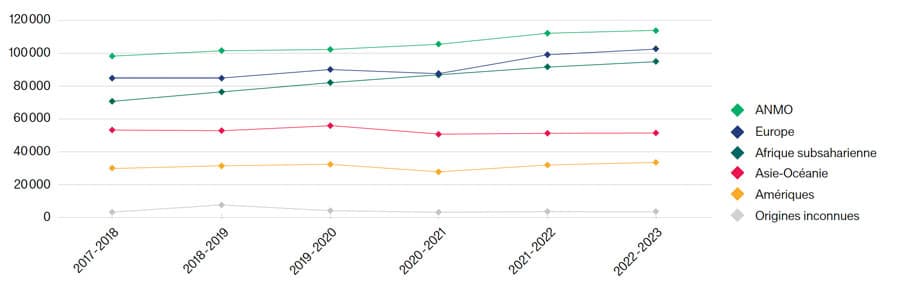
The main sending regions for French higher education institutions were Europe, sub-Saharan Africa, and North Africa. Between 2017 and 2022, these were the regional trends:
- Sub-Saharan Africa: +34% for a total of 95,285
- North Africa: +10 for a total of 91,865
- EU: +24 for a total of 73,310
- Asia/Oceania: -3% for a total of 51,992
- Europe (non-EU): +12% for a total of 29,605
- Middle East: +50% for a total of 22,445
- South America: +1% for a total of 15,220
- Central America/Caribbean: +40% for a total of 9,875
- North America: +8% for a total of 8,965
As those values reflect, and as we see illustrated in the chart below, the Middle East/North Africa and Sub-Saharan African regions have been the main growth drivers in recent years.
In terms of top sending countries, African countries once again took the top two spots, with China, Italy, and Senegal rounding out the Top 5. China is the only Top 10 market sending fewer students to France in 2022 than in 2017. In more detail, here are the trends by country (percentage increases are for 2017-22):
- Morocco +13% for a total of 45,160
- Algeria: +5% for a total of 32,145
- China: -15% for a total of 25,605
- Italy: +50% for a total of 20,030
- Senegal: +39% for a total of 15,250
- Tunisia: +11% for a total of 14,290
- Spain: +48% for a total of 11,595
- Lebanon: +103% for a total of 11,530
- Cote d’Ivoire: +32% for a total of 10,690
- Cameroon: +42% for a total of 9,765
Otherwise, Campus France notes:
“21 of the top 25 contingents of international students are increasing in 2022-2023, with a particularly strong rise in the number of Italian, Spanish, Lebanese, Congolese, and Indian students. The number of Ukrainian students has also doubled in one year (+111%), an increase linked to the continuing war.”
A more sustainable increase?
France’s 17% increase in international enrolments from 2017–22 compares with Canada’s expansion of +63% and the UK’s growth of +43% in the same time frame. Suffice to say, France has recorded a relatively gradual expansion of its international student population. Its more moderate growth curve may allow it to avoid the boomerang-type policies imposed in 2023 and 2024 by Australia, Canada, and the UK – policies aimed at rapidly curbing the surge of foreign students to lower net migration and to ease pressure on public infrastructure that has not kept up with population growth.
Those policies have sent shockwaves across student markets around the world and have caused students to reconsider where they want to study. Particularly in that context, France’s more modest record of year-over-year growth may well be a more sustainable pattern, for the medium term at least.
For additional background, please see:
- “Study estimates economic impact of foreign students in France at 5 billion”
- Agents interested in building a strong foundation for counselling students on study in France are encouraged to register for ºÚÁϹÙÍø Academy's self-paced, online course







