
Taiwan is close to reaching its pre-pandemic benchmark for international enrolment

- Taiwan’s foreign enrolment came close to 125,000 in 2024, up more than 7% over 2023
- This compares to 130,000 in 2019
- The country’s goal is to reach a foreign enrolment 320,000 by 2030
Taiwan is steadily increasing the number of international students it hosts in its colleges and universities. In 2024, a total of 123,190 students came from abroad for a degree in Taiwan, representing a five-year high and year-over-year growth of over 7%.
The island nation boasts about 160 colleges and universities, three-quarters of which are private. QS put eight Taiwanese public universities into its .
One of those eight, National Taiwan Normal University (NNTU) – which is ranked 452nd globally by QS and which is world-renowned for its education programmes – hosted the most international students in 2024 (7,650). Next (with 6,250) was National Taiwan University, the highest ranked Taiwanese university and the only one placing in QS’s Top 100 in 2025 (#68).
China is still a priority market, but diversification is happening
Chinese students have traditionally been a key source of international students for Taiwan, but Taiwan’s universities are hosting ever-greater numbers of students from other Asian countries as well, including Vietnam, Indonesia, and Malaysia. Taiwan offers a unique mix of benefits that are prioritised by Asian families:
• Lower cost of living than the Big Four
• Proximity
• Safety
• Strong university-industry linkages
• Education influenced by Western and Japanese academic models
reports that:
“Based on 2024 statistics, among the international students who studied in Taiwan and obtained valid employment permits, the top three nationalities are Malaysia, Indonesia, and Vietnam, with students from these three countries accounting for 76% of the total, and this figure shows rapid growth compared to previous years.”
However, Taiwan is losing some market share in Malaysia to China, as China intensifies its reach and investment in Belt and Road countries. By 2024, 150 countries had participated in some way in China’s Belt and Road infrastructure and development projects, and for the first time, trade with those countries made up more than half of China’s total trade volume last year. Analysts see the massive initiative as a serious threat to Western influence around the world. The Belt and Road Initiative is especially significant at a time when the US, under President Trump, is rapidly pursuing an isolationist position with respect to foreign affairs.
A goal of attracting more international students
The government strategy most influential in guiding Taiwan’s internationalisation is the (NSP) established in 2016, which prioritises close ties with other Southeast Asian nations, Australia, and New Zealand.
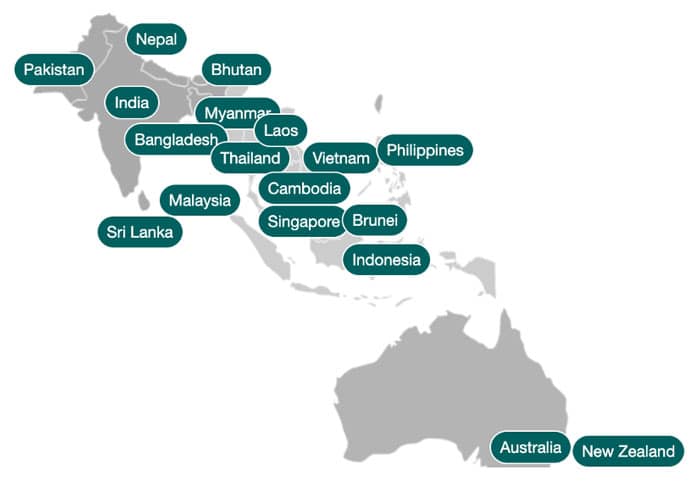
As well as student exchange programmes and cooperation agreements between Taiwan and NSP countries, scholarships are a key part of the programme. The largest scholarship initiative is the offered by the Ministry of Education (MOE). These are available to international students pursuing undergraduate, graduate, and doctoral studies. They cover most tuition and living fees, as well as airfare.
The most pressing reason that Taiwanese government wants to attract more international students is the country’s rapidly ageing population. Taiwan has one of the lowest fertility rates in the world, and demographers expect that by 2025, Taiwan will be a "super-aged" society, with those aged 65 and older composing more than 20% of the population. This is, of course, high on the government’s radar already and it is going to be a major societal and economic challenge going forward.
The official government target for 2030 is to attract 320,000 international students to Taiwan. There is also a goal – with associated investment and visa policies – of seeing roughly two-thirds of foreign graduates (210,000) staying on in the country to work after graduation. The over 7% growth in foreign enrolments registered in 2024 is certainly a sign that there is momentum towards these goals.
For additional background, please see:







