
US ELT numbers moving toward pre-pandemic norms

- Enrolment in Intensive English Programmes in the United States reached 92% of pre-pandemic levels in 2024
- The recovery in softer when measured in student weeks, which amounted to 74% of 2019 levels last year
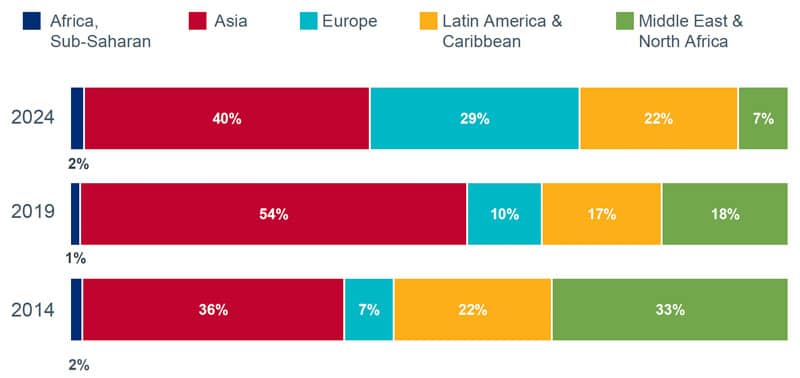
- Europe has emerged over the last five years as a much more significant sending destination and is helping to offset softening numbers from other regions
If you look at English Language Teaching (ELT) numbers in the United States year-over-year, it is easy to draw very different conclusions due to the significant fluctuations in student numbers leading up to – and of course during – the COVID-19 pandemic.
It is more instructive, however, to take a longer view and to consider those enrolment trends in five or even ten-year blocks going back over the last couple of decades. Presenting the 2024 numbers at the annual NAFSA conference last week, the Institute of International Education's Research and Learning Lead, Julie Baer, illustrated those trends with the following chart.
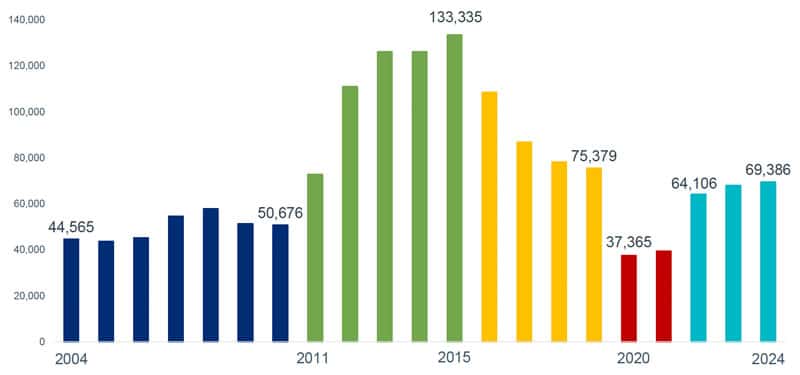
The chart describes a pattern of very stable enrolment in the several years leading up to and including 2010. And then a period of rapid growth through 2015 that was fuelled by the emergence of major scholarship programmes that provided funding for extended language studies for Saudi Arabian and Brazilian students. When those scholarship supports began to wind down in 2016, so too did ELT numbers in the US. They were in the process of returning to something like historical norms through the latter part of the decade when the pandemic took hold in 2020. And then, finally, over the last three years, we see those enrolments coming up again to surpass the pre-scholarship levels of 2010 and draw within reach of pre-pandemic student numbers.
IIE surveys Intensive English Programmes (IEPs) in the United States every year and tells us that there were just under 70,000 students at 347 IEPs in 2024, representing a 2% increase over 2023. That amounts to 92% of the pre-pandemic enrolment from 2019. Student-weeks, however, are rebounding more slowly – the nearly 769,000 weeks in 2024 represents about 74% of 2019's volume – due to a continuing decline in average stay length for language students in the US.
When viewed through student-weeks, which is perhaps the best comparative when relating enrolment in one ELT destination to that of another, what those 2024 figures tell us is that the US ELT sector is lagging behind other major destinations in terms of its progress toward pre-pandemic programme volumes.
Where do students come from?
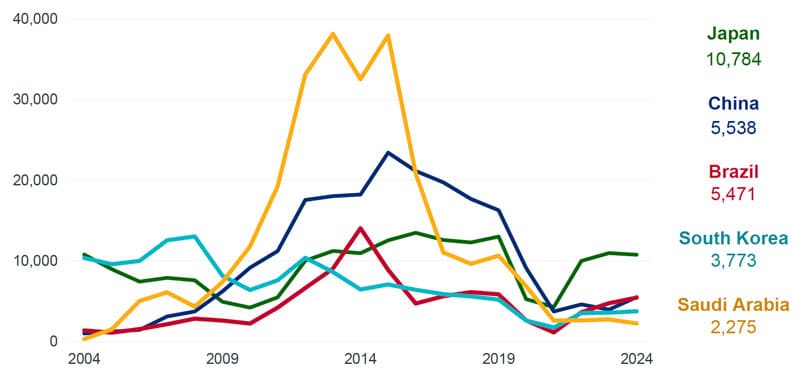
The top ten sending markets for US IEPs in 2024 were Japan (16% of enrolments for the year), China (8%), Brazil (8%), France (8%), Italy (6%), South Korea (5%), Colombia (4%), Taiwan (3%), Saudi Arabia (3%), and Germany (3%). The following chart shows the demand trends for five of those leading markets over the past two decades, illustrating in particular the rapid rise and decline of Saudi and Brazilian enrolments over that period. The chart indicates as well strengthening numbers from some key markets – notably Brazil and Japan – over the last three years.
The next chart below provides us with another view of how the composition of IEP enrolment in the US has changed since 2014, in particular to reflect a much greater role for European markets which has helped to offset declines from Asia and the Middle East.
While the average length of ELT study in US IEPs has declined over the last decade – from an average of 15 weeks in 2014 to 11 last year – there is still a significant aspect of academic preparation in US language centres. In 2024, nearly three in ten students (28%) said that they plan to go on to further study in the United States after their language programmes. As with the increasing participation of European students that has helped to offset falling student numbers from other regions, that strong cohort of academically oriented IEP students is likely helping to buffer the softening trend for average study length as well.
For additional background, please see:







