
Australia passes integrity legislation; sharpens definition of agents and agent commissions

- The Australian government has passed a package of legislative amendments that includes new provisions for the Education Services for Overseas Students Act 2000 (ESOS Act) and the Tertiary Education Quality and Standards Agency Act 2011 (TEQSA Act)
- The amendments extend new oversight and regulatory powers to government ministries and agencies, and set the stage for additional regulation of the sector via the National Code of Practice for Providers of Education and Training to Overseas Students
On 28 November 2025, the Australian House of Representatives passed the Education Legislation Amendment (Integrity and Other Measures) Bill 2025. The bill includes amendments to the (ESOS) with the goal, the government says, of strengthening “the integrity of the international education [to] ensure it maintains its social licence.”
“Australia’s future success requires a focus on quality, integrity and a great student experience,” said Assistant Minister for International Education Julian Hill. "That’s why we’re cracking down on exploitation, increasing transparency, and safeguarding the reputation of our sector. These changes will protect genuine students and support our high-quality providers.”
Amendments for international education
The legislation steers clear of hard caps on new international student commencements and instead focuses on other mechanisms to control the quantity and quality of students coming into the country.
The amendments will also impact the delivery of offshore education by Australian educators, requiring that providers be authorised by the Tertiary Education Quality and Standards Agency (TEQSA) to operate overseas. Along with the UK and US, Australia accounts for a high share of all transnational education delivered across the world. The quality of Australian educators’ overseas courses and partnerships are thus integral to the reputation of the Australian education brand.
Another feature of Australian international education is the significant role of agents in recruiting students for universities, vocational education institutes (VET), and language schools (ELICOS). According to a recent student experience survey cited by the government, 88% of international students surveyed in 2024 used an education agent to help them study in Australia.
The legislative amendments explicitly sharpen the definitions for both making it clear that any party not in the permanent employ of an institution that engages in overseas recruitment can be classed as an agent. Similarly, the amendments spell out that agent commissions include any benefits given on behalf of an institution – monetary or otherwise – to an agent in connection with international recruitment.
The importance of those refined definitions is made clear both in the amendments themselves – which confer new powers on the Department of Education to collect and share data on agents and agent commissions – and in government communications that make it clear that some type of ban or restriction on onshore commissions is forthcoming.
It is generally expected that any such regulations will be grounded in the new legislation and detailed in upcoming changes to Australia’s National Code of Practice for Providers of Education and Training to Overseas Students.
A government communique adds that, “The new definition [of education agent] supports transparency of provider/education agent relationships and integrity in the international education sector… The new definition will enable the Secretary of the Department of Education (the department) to request information on education agent commissions paid to education agents. [It] also allows the regulators greater powers to examine cross-ownership arrangements between providers and other entities in the sector under the new fit and proper provider requirements.”
Meanwhile, the Department of Education explains that the updated definition of agent commissions, “responds to sector concerns about substantial increases in education agent commissions and the types of monetary and non-monetary payments made to agents. This has highlighted the need for greater transparency regarding agent and provider activities and interactions for the sector and for students. Introducing a definition of ‘education agent commission’ will identify the range of payment and incentive arrangements providers have with their education agents in relation to overseas or intending overseas students. This change will have complementary benefits in facilitating the sharing of accurate agent information with providers, to help providers make informed decisions in choosing ethical, high quality education agents. Greater transparency around education agent commissions will support stronger integrity in the sector.”
Finally, the legislative amendments also extend new powers to government ministries and agencies to restrict provider programming for international students, including that:
- Most prospective VET providers will now need to enrol and teach domestic students for two years before being allowed to enrol international students. This is to ensure the primary motivation for VET providers is to deliver a high quality of education and student experience – not to gain revenue from international student tuition fees. An exception is made for TAFE institutions that are government-funded.
- The Department of Education may now cancel the registration of providers that, for 12 consecutive months, do not deliver courses to overseas students. This is aimed at providers who shut down their existing business to avoid debts or regulatory penalties, then open the same kind of business without those liabilities.
- The government is also empowered to cancel entire courses due to concerns around quality or relevance to Australia’s skills needs.
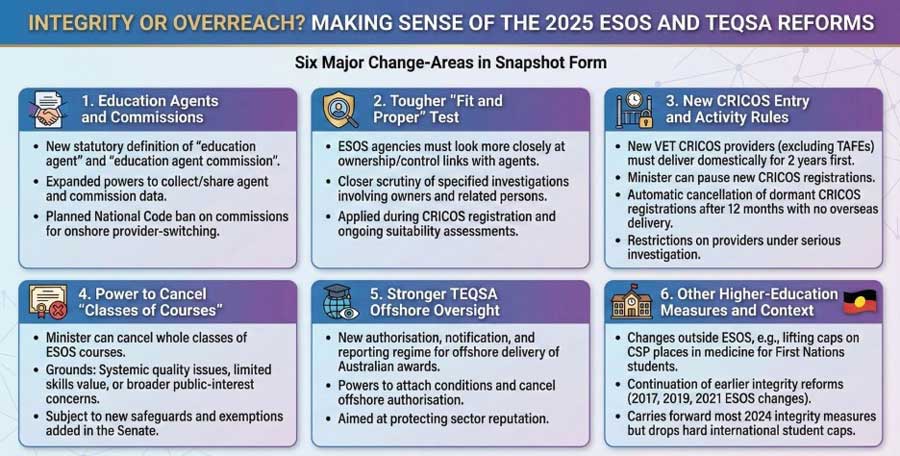
The major amendments for the ESOS Act and the TEQSA Act are summarised in the following table.
Industry reaction
Australia’s international education sector generally approves of efforts to strengthen integrity in the system and to better protect students. But some believe that the provisions of the newly passed amendments are vague and really intended to obscure the real goal of constraining new international enrolments. Some industry stakeholders also decry the government’s response to . Ian Pratt, Managing Director at Lexis English, wrote on :
“After numerous Senate hearings (ignored), industry consultation (ignored, but Julian got some nice photos for his socials), peak body negotiations (largely ignored), one failed attempt in the Senate then last minute amendments by the Greens (ignored) and LNP (token, but welcome), Hill and Jason Clare MP will finally have the chance to claim some kind of victory [with Bill 2025].”
Also writing online, Sukh Sandhu, the Director, Compliance, Risk Management, and Strategic Planning at CAQA Australian Higher Education Group, offered of the legislative package and said: “At its heart, the Education Legislation Amendment (Integrity and Other Measures) Bill 2025 is trying to answer a simple public question: can Australians trust that our international education system is genuine, high quality and not being used as a back door to migration abuse?
For too long, a small but damaging minority of providers and agents have made that question harder to answer. In that sense, many of the integrity measures in this Bill are not only understandable but overdue.
Yet integrity cannot come at any cost. A regulatory system that treats every provider as a potential suspect, concentrates power without transparent safeguards, or discourages new high-quality entrants would ultimately damage the sector it is meant to protect.”
For additional background, please see:
Most Recent
-
Canadian immigration officials have made several updates to compliance guidance for study permits and post-graduate work permits Read More

-
Italy announces its “biggest language training and international mobility programme ever� Read More
-
Why sharper English-language guidance is becoming an agent’s sharpest tool for student success Read More







