
US will allow entry for fully vaccinated travellers beginning in November

- Relaxed border restrictions will open the door to international student recruitment in an expanded list of countries
- Students pursuing shorter programmes, as well as those needing F and M visas, will soon be able to travel to the US if fully vaccinated
- The US government is also dropping the in-person interview requirement for some F, M, and J visa applicants in an effort to clear the visa processing backlog that has developed as a result of COVID-related embassy closures around the world
In early November, fully vaccinated travellers will be able to enter the US, representing an end to a broad travel ban that has been in place for months. The Biden administration’s decision to relax travel restrictions was prompted by the success of vaccine rollouts in various parts of the world. It comes as welcome relief for those working in industries including airlines, hospitality, and international education, and it will especially appease UK and EU governments who have been frustrated at continued travel bans affecting their citizens.
To be eligible to enter the US, travellers must:
- Be fully vaccinated with vaccines approved by the Centers for Disease Control (CDC);
- Show proof of vaccination before boarding a US-bound airline;
- Provide a negative COVID test taken no more than 72 hours prior to flying.
In addition, travellers will be required to provide their phone numbers and email addresses to border officials in order to facilitate enhanced contact tracing.
Explaining the decision, White House coronavirus response coordinator Jeffrey Zients said,
“Today nearly 6 billion shots have been administered globally and dozens of countries have strong vaccination rates. Vaccines continue to show that they're highly effective, including against the Delta variant.”
At this time, land borders with Mexico and Canada remain closed.
Impact on US educators
Universities and schools in the US have in recent months been able to recruit and accept students from several countries under the “National Interest Exception” (NIE) which applies to students with F-1 and M-1 visas beginning or continuing programmes with start dates in August 2021 or after. Students from China, Iran, Brazil, and South Africa – as well as from the UK, Ireland, and the 26 European countries of the Schengen area – had been covered by this exception.
But the NIE did not extend to other important student sending markets for the US – including Asian countries other than China and India (e.g., South Korea, Japan, Vietnam, Pakistan, Taiwan), Latin American countries other than Brazil (e.g., Mexico, Colombia), and African countries other than South Africa (e.g., Nigeria). As you can see from the table below, that left thousands of students from top source countries unable to come to the US, and so the news that all fully vaccinated travellers can enter the US will come as welcome news to both educators and prospective international students.
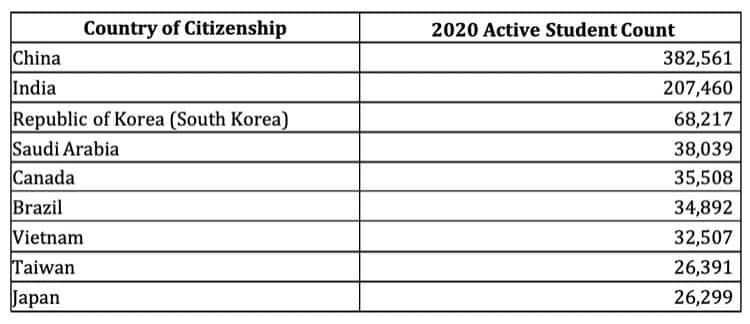
The new travel rules also mean that students wanting to come to the US for shorter programmes – i.e., those not on M-1 or F-1 visas but rather on visitors’ visas – can now enter the country if they are fully vaccinated, as can the vaccinated parents of all international students who have so far not been able to visit their children in the US.
Will the news affect vaccine uptake?
The US travel restrictions may also improve vaccine uptake among international students in several markets who will only be able to come to the US if they are vaccinated. This will be more difficult for students in some markets, however: IDP research conducted in the summer of 2021 found that less than half of students in Vietnam, Bangladesh, Nepal, Taiwan, and the Philippines said they were confident they could receive a vaccine in their home countries to be able to comply with a potential vaccine requirement.
In-person interviews to be waived for some visa applicants
The US is still working through a massive visa applicant backlog as a result of COVID-related embassy and consulate closures around the world over the past year. The requirement that F and M visa applicants undertake an interview at an embassy/consulate in their home country has obviously created a further bottleneck in the processing backlog, since such interviews have literally been impossible for many students.
Now, the US Department of State has announced that it will drop the in-person interview component of visa applications for many students for the rest of the year to help clear that backlog:
“The Deputy Secretary for Management and Resources, under the authority delegated to him by the Secretary of State, in consultation with the Department of Homeland Security, has authorised consular officers through the end of 2021 expand the categories of F, M, and “academic J visa applicants” (students, professors, research scholars, short-term scholars, or specialists) whose applications can be adjudicated without an in-person interview in their consular district of residence, with certain exceptions.”
The Department of State links the new exception to the government’s commitment to supporting international students and US educators:
“International students are now and always have been among the Department of State’s highest priorities. The Department recognises the important contributions these students make to our college and university campuses; the positive impact they have on US communities; and the rich benefits of academic cooperation in increasing cultural understanding, furthering research, knowledge, and supporting US diplomacy. The Department is committed to supporting the US academic community, while administering US law. The Department also recognises this is a critical period of time for students seeking to begin their studies at academic institutions across the United States.”
Building momentum for US education
The new rules allowing fully vaccinated students from around the world to come to the US as well as the decision to drop in-person interviews for many visa applicants can only increase the ability of thousands of students to come to the US for studies, and the ability of US educators to recruit overseas. Surveys have shown that student demand for the US has risen under the Biden administration, and other leading destinations – Canada in particular – face a growing competitive challenge as a result.
In July 2021, the US Department of State and Department of Education, with the additional support of the Departments of Commerce and Homeland Security issued a joint statement saying that welcoming international students is now a national foreign policy priority. The joint statement marks the first time in 20 years that the US government has taken such steps towards more coordinated action in support of the sector.
The Departments of State and Education have committed themselves to a number of action items in support of international education, including:
- Encouraging more international students to come to the United States (and more American students to study abroad);
- Ensuring that a strong focus on international education is part of America’s recovery from the pandemic;
- Implementing “policies, procedures, and protocols so as to facilitate international
education and authorised practical experiences while promoting program integrity and protecting national security;” - Clearly communicating “policy guidance and [implementing] fair, efficient and transparent support processes” for student visas and related services;
- Fostering increased cooperation between the federal government, US higher education institutions, and the private sector around research and intellectual property protections.
For additional background, please see:







