
Survey findings underscore the link between English proficiency and career success

- The majority of interview subjects in a recent study believe that English skills are directly related to career opportunities and income
- The research shows a clear link between English mastery and career satisfaction
- However, many English language learners struggle with confidence in their use of the language, and are looking for additional learning and practice opportunities
New research from Pearson shows that English language learners see mastery of English as vital to their career prospects and earning potential.
Pearson interviewed more than 5,000 speakers of English as a second or additional language from Japan, Saudi Arabia, Brazil, Italy, and Florida (United States). Across all countries in the sample, the vast majority of respondents (80%) believe English proficiency is directly related to income potential, and expect that strong English skills will lead to as much as an 80% salary increase.
That expectation is borne out in part by the career satisfaction reported by survey participants. Pearson explains: "Those with the highest English proficiency are more satisfied with their existing income and jobs. According to the research, three quarters (75%) of advanced English speakers are satisfied with their income, compared with less than half (47%) of beginner English speakers. Nearly 9 in 10 (88%) advanced speakers are satisfied with their job, but this number goes down to fewer than two thirds (64%) amongst beginners."
Survey respondents were also clear in their belief that learning English would open the door to new and better career opportunities. Just over half (51%) said that learning English would give them access to a wide range of career options while two in five (40%) said that better English skills would help them advance more quickly in their chosen fields.
The confidence gap
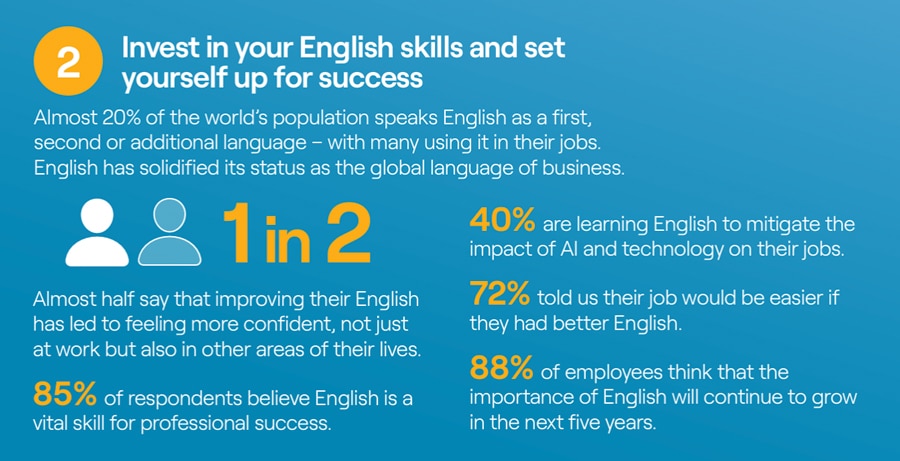
Only about a quarter of the interview participants said they feel confident of their English across all four skills areas (reading, listening, speaking, writing) in the workplace – this even though 85% said they felt English was critical for their work and 60% said they use English on a weekly basis. Pearson adds that, "Nearly three quarters (72%) went as far as to say their jobs would be easier if they knew better English, and only a quarter (27%) of respondents felt they could fully express themselves when using the language to do their jobs."
Nearly nine in ten interview subjects (88%) felt that their employers should offer additional training in English (but only a third reported any employer-supported training). Overall, more than half (54%) felt that they had not received sufficient training in English. A similar proportion (56%) reported that a challenge was that their previous English instruction had most often emphasised grammar and vocabulary, as opposed to the use of English in everyday situations. About half of respondents also expressed the concern that they did not have enough opportunity to practice English outside of the classroom.
Please consult the Pearson website for .
For additional background, please see:







