Ϲ

Market intelligence for international student recruitment from Ϲ

Ϲ

12th Apr 2016

2.28 million abroad for language study in 2014

New research indicates that nearly 2.3 million people travelled abroad for a language course in 2014. This is the top-level finding from the IALC Study Travel Research Report 2016: , and it sets the tone for an interesting new view of the global market for language travel. The report provides a very wide frame indeed with its focus on nine major languages: Chinese, English, French, German, Italian, Japanese, Portuguese, Russian, and Spanish. It draws on extensive desk research paired with a global survey of 466 education agents from 74 countries (which was in turn supplemented with a small interview panel of 21 leading agents). Starting, for example, with the estimate that a “minimum” of 2.28 million students studied a language abroad in 2014, the report quickly sets this total in a larger context. It represents about .25% of all second language learners worldwide, meaning that even though that global movement of language learners is significant in absolute terms it represents only the smallest fraction of those learning a second language around the world. English is not the most widely spoken language in terms of native speakers - that distinction goes to Chinese - but it is the most popular second language choice. English language travel accounts for an estimated 61% of the global population of mobile language students, or about 1.4 million English language travel students in 2014.

The agents’ view

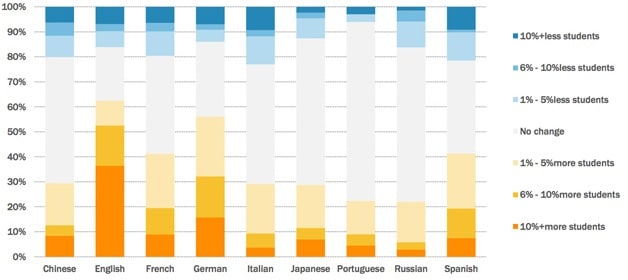
Nearly all (97%) of the responding agents currently promote English language courses. French and German courses - both at 62% - are the next most-commonly represented, followed by Spanish at 51%. The report’s authors suggest that this indicates a certain saturation of English courses within the agent channel, with each agent representing on average 60 English schools. They also note that this may point to new areas of opportunity for agents to expand by adding courses in other languages to their programme options for students. Most respondents reported strong growth over the past three years, as reflected in the following chart. As it reflects, 63% reported an increase in demand for English language study, followed by German (56%) and then French and Spanish, each at 41%. In the same period, growth in demand for Chinese study outpaced the demand for Italian and Russian. More immediately, "The majority of agents marked 2015 as a year of growth for their businesses - 59% of respondents reported an increase in the number of students sent abroad, with 27% achieving double-digit growth in the number of language students served. However, 26% of agents experienced a downturn from 2014 to 2015. The highest ratios of agents reporting growth were predominantly from Argentina, China, Colombia, India, Mexico, Pakistan and Vietnam. Conversely, the majority of agents experiencing a decline in student numbers were based in Russia." change-in-demand-for-language-study-abroad Change in demand for language study abroad as reported by agents, 2012 compared to 2015. Source: IALC Looking ahead, nearly 80% of responding agents believe that demand for English courses abroad will continue to grow over the next three years. The report adds, "Even though the structure of demand may change due to recent developments in the market (lower demand for adult courses, more demand for junior courses), education agents repeatedly stressed that English proficiency is a compulsory criterion required by any prospective employer and represents almost a necessary skill for professional success - especially in the home country." Agents also anticipated continuing growth in demand for Chinese, German, French, and Spanish in the years to come.
Why study?

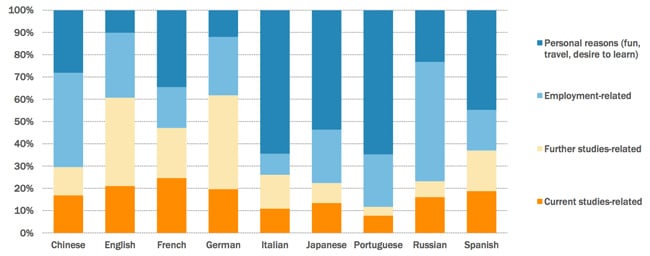
The report describes a shifting landscape in which the reasons for learning a foreign language abroad continue to become more practical, with a pronounced shift away from study for personal reasons (e.g., cultural interest, desire to learn or have fun) toward career reasons (i.e., related to employment goals or plans for academic study abroad). As the following chart reflects, German and English skills are now mainly sought in connection with current or future studies. At the other end of the spectrum, "personal reasons" remain key drivers of demand for Portuguese and Italian whereas motivations for French study are more balanced across personal interest and academic or career goals. students-reasons-to-learn-a-particular-language-abroad Students’ reasons to learn a particular language abroad as reported by agents. Source: IALC The stronger links to academic and career goals that we see here leads the report to conclude, "Language travel is becoming increasingly interconnected with other sectors and preferences - international higher education segments, school trips with language tuition, internships + language programmes, etc."
Learning earlier

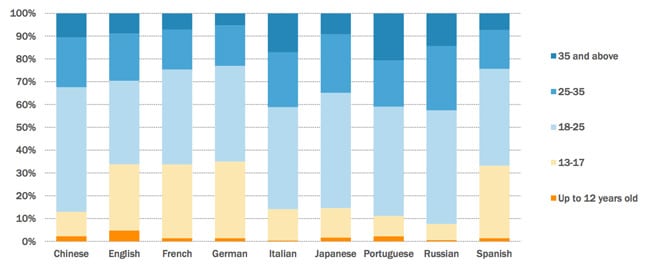
The key target group for language travel remains 18-to-25-year-olds, which comprises on average 46% of all bookings. Even so, the report finds that people are learning languages at an earlier age, calling this, "A driver that will also shape the future of the global language travel market." The following chart reflects this emerging reality, where we see a much greater role for the "junior market" (the 13-to-17-year-old segment) and particularly so for English, French, German, and Spanish. student-age-as-reported-by-agents Student age as reported by agents. Source: IALC The report concludes that, "Structural changes in product offering can be expected - aimed more towards junior age groups. The under 18 age group is already more noticeable in English and overall, the number of juniors is predicted to grow for other European languages as well. Therefore, language schools catering for these languages need to be prepared for a change in product." For additional background, please see our recent coverage on global language travel trends and a separate item on the size of the language travel market. In keeping with one of the important themes from this year's report, please also see our earlier interview with IALC Executive Director Jan Capper on marketing languages other than English.
Most Recent

  • A common challenge: Strengthening student confidence in the ROI of study abroad Read More
  • New international student permit approvals for Canada fell below COVID levels in 2025 Read More
  • UK Home Office publishes updated visa sponsor guidance for “agents and third parties” Read More

Most Popular

  • Which countries will contribute the most to global student mobility in 2030? Read More
  • Research shows link between study abroad and poverty alleviation  Read More
  • Beyond the Big Four: How demand for study abroad is shifting to destinations in Asia and Europe Read More

Because you found this article interesting

New international student permit approvals for Canada fell below COVID levels in 2025 Canada approved only 75,372 new study permits in 2025. This represents a -64% drop year-over-year, and an -18%...
Read more
UK Home Office publishes updated visa sponsor guidance for “agents and third parties” The UK government has expanded its regulatory oversight for British institutions’ engagement with education agents. The existing structure...
Read more
Visa rejections climb in the US for international students from key markets including India A new report from Shorelight called Beyond the Interview: A Decade of Student Visa Denials
and What Comes Next,...
Read more
Supply and demand for international higher education increasingly aligned in Asia A new report from Studyportals and the British Council, “Asia, Latin America, and MENA in global education,” demonstrates...
Read more
Canadian immigration officials move to ease rules around student work permits Immigration, Refugees and Citizenship Canada (IRCC) has introduced a package of amendments to the current rules around student...
Read more
Australia: Student visa refusal rates reach record high amid weakening demand from China Australian universities have so far faced fewer challenges than English-language training (ELICOS) and vocational education providers in the...
Read more
What international students need to know about study and work visas in the United States The current political climate in the United State has spurred a flurry of proposals and rules affecting the...
Read more
Study finds strong agent interest in partnering with Japanese universities For many years, institutions in the Big Four (Australia, Canada, UK, and US) have partnered with educational agents...
Read more
What are you looking for?
Quick Links