
Taiwan ties new international recruitment goals to labour shortages

- Faced with a shrinking workforce and, if current forecasts hold, a declining population by the start of the next decade, Taiwan has launched an ambitious plan to attract up to 400,000 foreign workers
- As part of that plan, the island nation also has a goal to recruit 200,000 degree-seeking international students by 2030, up from a pre-pandemic base of about 63,000
Taiwan's economy is facing a severe labour shortage which arises largely from a declining (and ageing) population combined with historically low birth rates. "Taiwan’s fertility rate is forecast to fall to the world’s lowest by 2035," reports the . "Although an anticipated turnaround by 2045 offers hope for the industrialised island that depends on a stable labour force for its signature hi-tech exports."
To help reverse this pattern of a shrinking workforce, Taiwan's government said last year that it aims to attract up to 400,000 foreign workers by 2030, acknowledging at the same time that it would be competing for talent with other major players in the region, including Hong Kong, Singapore, and China.
Within that larger goal is a target to attract 20,000 "special professionals" to take up roles in specific technology sectors, including semiconductors, blockchain, finance, and renewable energy development.
And the plan includes concrete targets for international students as well with the goal to build the country's foreign enrolment to 200,000 degree-seeking students. Total foreign enrolment in Taiwan reached a record high of 130,000 students in 2019, roughly half of which (63,000) were enrolled in degree studies. Throughout the 2010s, much of the growth in those student numbers came from markets in South and Southeast Asia.
This growth trend was the result of a deliberate government strategy ("The New Southbound Talent Development Program") which targets key markets in the region. The southbound plan was enacted in 2016 to encourage closer economic and cultural ties between Taiwan and 18 other Asian countries, including Malaysia, Vietnam, Indonesia, and Thailand.
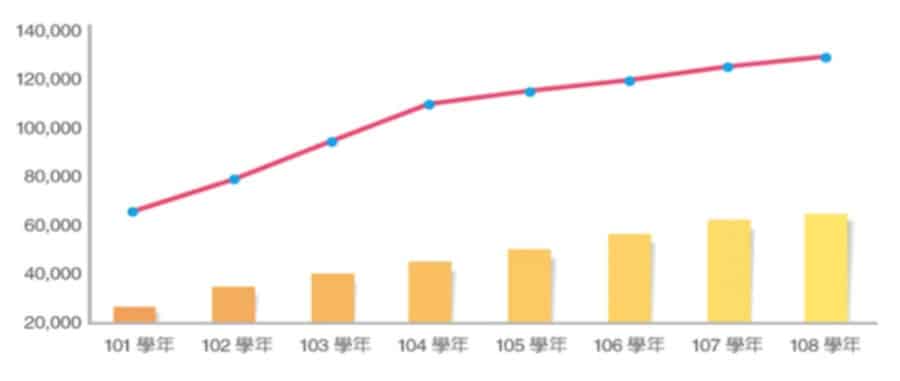
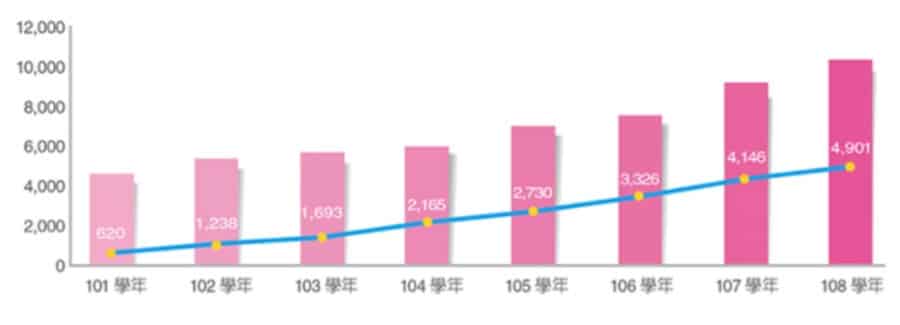
Growing labour market demand, along with an opening up of post-study work opportunities for foreign graduates, has resulted in greater numbers of international students staying on in Taiwan to work after their studies.
The following chart tracks both the number of foreign graduates each year (as shown by the pink bars) and, in the blue line, the number who stayed on to work in Taiwan.
Observers have pointed out, however, that Taiwan will need to strengthen its offer to top talent, including clear pathways to residency and work after graduation, in order to compete with neighbouring destinations.
Some of those important points of reference include Hong Kong which, in October 2022, extended the work period for foreign graduates to two years. It also opened a new two-year visa track for high-income earners (US$318,000+ per year) as well as graduates of the world's top 100 universities with at least three years' work experience.
Singapore has a similar programme to attract foreign professionals earning at least US$22,800 per month.
Speaking to the , Alicia Garcia-Herrero, the Asia-Pacific chief economist for Natixis Corporate & Investment Banking in Hong Kong, explained that Taiwan has not yet dropped all of its barriers for foreign talent, in part due to pressure from local parents and job seekers. “Taiwan needs this more than anyone else,” she said. “They will have to fight for this talent. It won’t be easy.”
For additional background, please see:







