
Australia: Multiple data indicators signal further declines ahead for international student numbers

- Several student visa trends paint a troubling picture of future international enrolments in Australia
- Aside from those enrolling in higher education, the number of new students coming into the country is not enough to replenish the number who are leaving
- Two sub-sectors are already suffering very steep declines – English-language training (ELICOS) and vocational education (VET)
- Higher education is beginning to see decreases in demand from China and high refusal rates for other top markets
A new analysis of student visa trends suggests that the next couple of years – at least – look grim for Australia’s English-language training schools (ELICOS) and vocational education providers (VET). They will also present significant challenges for Australian universities.
The context here is the past three years of new policy settings and greater government intervention to manage student inflows, as well as two successive student visa application fee hikes. As of this writing, the non-refundable fee of AU$2,000 is the highest in the world. The cost of a student visa – and the very real possibility for students from many markets that their application will be refused – is dampening demand, especially for students coming for relatively shorter programmes, such as English-language courses.
Unravelling the data
Presenting the analysis to IEAA members in April 2026, English Australia CEO Ian Aird showcased the importance of clarifying the source, time frame, and implications of often misunderstood data indicators for Australia’s international education sector. For example:
- Enrolments vs. student numbers: In Australia, course enrolments tend to be the main data point presented in international education summaries and covered by media. They are sometimes confused with international student numbers – which are something quite different. Enrolments are always far higher than student numbers because international students often enrol in multiple courses in a given year (e.g., two back-to-back English-language courses of four months each would be counted as two enrolments for a single student).
- Commencements vs. NTAs: General commencement numbers comprise both students coming for the first time to study in Australia and students already in Australia who progress from a completed course to a new course. But “New-to-Australia” (NTA) commencements describe only offshore students enrolling for the first time ever in Australia.
Each of those four indicators – course enrolments, student numbers, commencements, and NTA commencements – tell very different stories. Of the four, enrolments are the least indicative of the current and future state of affairs. Mr Aird explains:
“Both enrolment and commencement figures must be recognised as ‘lag indicators’ in terms of sector health. That is, the enrolments are students who may have started their courses months and sometimes years ago. Even commencements are students who booked, paid for, and were granted visas months before they commence. If a commencement is part of a pathway, it too could have been booked years before it is indicated in the official data.
This means that the majority of 2025 enrolments and many 2025 commencements are students who were not impacted by any of the 2024 changes to the student visa system and government policy.”
Why NTAs are more predictive of future trends
New-to-Australia commencement data offers a stronger indication of international student demand under the current settings – and relatedly, factors either easing or challenging students’ ability to come to Australia. This is because NTA counts represent new students coming into Australia within the recent past (as opposed to enrolments, for example, where data could represent demand from years prior, before the new policy settings came into force). Therefore, the latest NTA data reflects students who have relatively recently:
- Wanted to apply to an institution in Australia
- Decided to pay the fee for a visa application (currently AU$2,000)
- Had their visa approved
When NTAs fall, it suggests that fewer students now consider it worthwhile to apply for a visa and/or more students who are having their visa rejected. A recent decline suggests that the trend will continue unless current circumstances change. Right now, that context is Australia’s extraordinarily expensive visa application fee and high rate of visa refusals.
Recent increases or decreases in the volume of visa applications and in the visa approval rate provide an even better sense of the future trendline for the sector. These can also be divided into applications made in Australia (hence, re-enrolling students) and applications made outside Australia (generally, New-to-Australia students).
Have NTAs fallen?
New-to-Australia commencements have indeed fallen (see Chart 1 below), and this decline coincides with both a lower application volume (Chart 2) and a higher visa refusal rate for students from key markets.
Below, Chart 1 shows that whole-sector NTAs have dropped significantly over the past two years and are significantly lower than before the COVID-19 pandemic. Chart 2 reveals that the number of students submitting visa applications fell by 32% from the post-COVID rebound peak in 2023 to 2025.


The damage to ELICOS and VET providers is the most severe
The picture for the ELICOS and VET sectors is considerably bleaker than the all-sector aggregate: a -40% y-o-y New-to-Australia commencement decline in 2025 for ELICOS and a -49% fall for VET. Chart 3 (below) shows the pattern for ELICOS.

As English Australia notes, there is a clear connection between the timing of visa application fee hikes and plummeting applications (and NTAs) for ELICOS:
“The student visa application charge went from AU$710 to AU$1,600 from 1 July 2024. This saw the monthly average student visa applications for ELICOS study fall by 34% versus pre-COVID (2018–2019) application levels or 46% versus post-COVID (2023) application levels. The increase of the student visa application charge to AU$2,000 from 1 July 2025 saw applications for ELICOS fall a further 27%.”
What about higher education?
The higher education sector has so far fared better than other kinds of providers because (1) many of the universities have the advantage of streamlined visa processing, which means their applicants aren’t scrutinised to nearly the extent as for other sectors, and (2) students are more willing to pay the visa application fee because it is a smaller proportion of the cost of a degree. For example, from 2024 to 2025:
- Higher education course enrolments rose by +9.7%;
- Commencements also increased slightly (+0.7%);
- New-to-Australia commencements were down by only -0.5%.
However, the sector’s resilience is now being tested in multiple ways. Major challenges include a decline in demand from China and high visa refusal rates for other key markets.
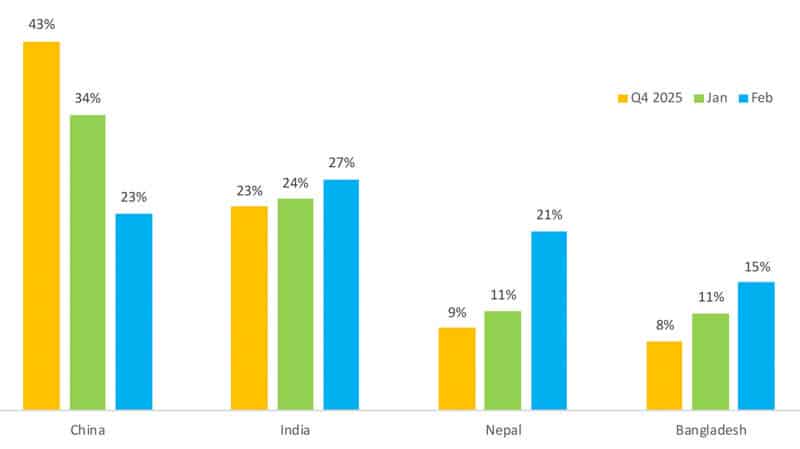
Chart 4 shows the proportion of applications from the top 10 source countries for higher education. The top 10 countries are traditionally responsible for 85% of all HE applications from offshore (that is, new students in the system). In Q4 2025, Chinese applications accounted for over 4 in 10 (43%) of these offshore applications. This fell to a third (34%) in January 2026 and to less than a quarter (23%) in February 2026.
By contrast, demand from India, Nepal, and Bangladesh has risen to the point where 65% of offshore applications from the top 10 are from these three countries. But much of this demand is being stopped at the border. In February 2026, 40% of Indians applying for a visa for study at an Australian university were rejected, as were 51% of Bangladeshis and 65% of Nepalis.
Lower interest from China – coupled with high visa rejection rates for students from other top markets –will almost certainly lead to a decline in Australian university commencements and enrolments in the coming intakes.
Are Australian government policies working?
To manage immigration, the Australian government is working to better link migrant profiles to labour force skills gaps. It wants to reduce net migration to pre-pandemic levels though policies aimed at increasing barriers for low-skilled temporary visa holders to work and immigrate.
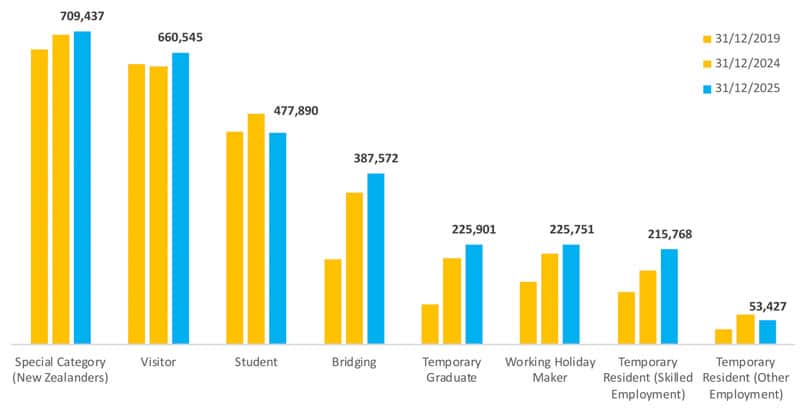
Mr Aird presented a slide (shown below) showing that of eight temporary visa categories, only one is being affected by this mission: international students. He commented:
“Where government is talking about the number of temporary visa holders, and they’re taking all sorts of actions to control and manage that, they’re actually managing only one group – student visa holders. The other groups are all increasing significantly.”
The English Australia report reminds readers: “It’s vital to remember these numbers relate to real people. Falling student numbers means lost jobs in Australia, lost livelihoods.”
For additional background, please see:
- “Australia: Student visa refusal rates reach record high amid weakening demand from China”
- "Australia: Latest enrolment data challenges the government’s assertion of stability for international education this year"
- "Australia: Full-year data for 2025 reveals impact of AUD$2,000 study visa application fee on ELICOS sector"
- "Australia passes integrity legislation; sharpens definition of agents and agent commissions"







