
New research finds global youth increasingly drawn to non-Western governance models and study destinations

- Youth are increasingly drawn to countries outside of the West on multiple metrics, including for study abroad
- For international students faced with more restrictive policies in the Big Four, there are other doors that are open, including in Asia and the Middle East
- The implications of high visa rejection rates for students from Global South will be felt not only in international education, but in soft power and economic competitiveness
Two important new global studies – the 2025 iterations of the British Council’s survey and – suggest that youth are craving certainty in an increasingly unpredictable and volatile world, and this is shaping their perceptions of countries’ attractiveness.
Of its research, the British Council notes:
“The findings from multiple metrics suggest that in an increasingly unstable, multipolar world, there is a growing preference among young people for predictability, security, and capability – qualities increasingly associated with non-Western governance models – over the perceived instability, paralysis and polarisation of many Western democracies.”
Of the study destinations becoming more attractive to youth, several are authoritarian, which dovetails with another major study that found that young people are to non-democratic governance. The Big Four remain in the lead, but they are losing ground, not least because of less welcoming immigration settings than in the past – particularly for students from the Global South.
About the research
The British Council’s 2025 Global Perceptions survey sample was over 20,000 youth aged 18–34 in G20 countries excluding Russia. A key aim was determining how the UK stacks up against other countries in terms of attractiveness, trust, perceptions of the economy and government, and as a study abroad destination.
The 2025 QS Global Student Flows report drew on responses from over 70,000 students across 191 countries. Otherwise, QS says it “maps and forecasts international student mobility using an open source framework, flow mapping technology, and scenario-based forecasting.”
Leaders and climbers
The British Council survey asked respondents about the overall attractiveness of countries based on a number of metrics. Chart 1 (below) shows Japan, Italy, and the UK are in the lead, but all have lost some ground. Japan is almost stable since 2016 (down 1 percentage point), but Italy and the UK have lost -5 and -6 percentage points, respectively. The UK leads in “trust in government,” but has fallen slightly (-1) while Japan is #2 and has gained +5 percentage points.
Meanwhile, of the five “climbers” (countries that gained the most in attractiveness since 2016), four are in Asia (South Korea, Türkiye, China, and Indonesia), with Saudi Arabia rounding out the top five.
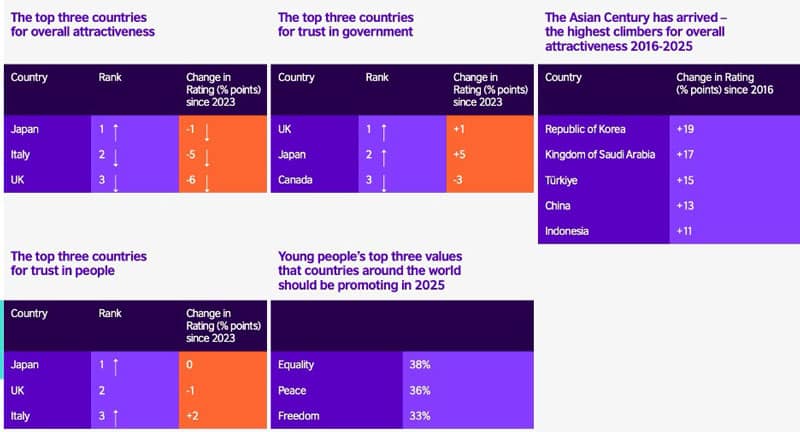
Interestingly, of the five climbers, two are non-democratic (China and Saudi Arabia), and one is increasingly authoritarian (Türkiye). All three of those countries have “strongman” leaders who have been in power for some time. China’s President Xi Jinping has held the presidency since 2013; Saudi Arabia’s Crown Prince and Prime Minister Mohammed bin Salman has led since 2017, following his father, Salman bin Abdulaziz Al Saud; and Türkiye’s President Recep Tayyip Erdoğan has held power since 2014.
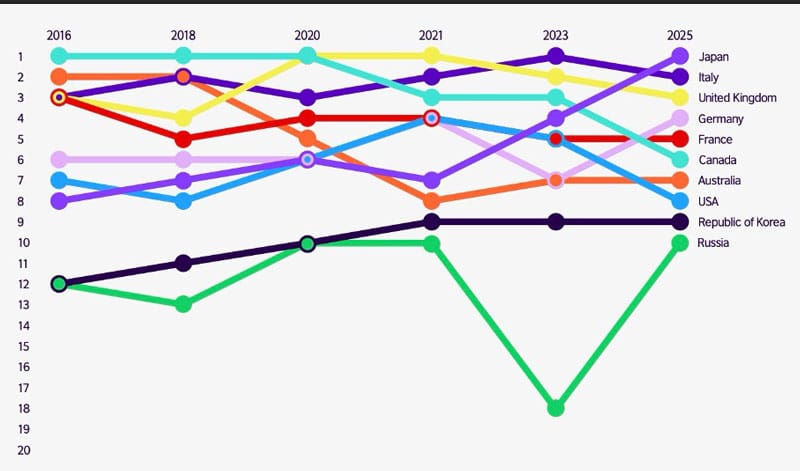
What’s more, even Russia makes the top 10 for attractiveness today (see Chart 2, below), bouncing back from its ranking of #18 when it invaded Ukraine to #10 in 2025. Russia’s President Vladimir Putin has been in place since 1999 and rules with an iron fist.
The British Council notes:
“The top ten for overall attractiveness has long been dominated by rich, liberal, democratic capitalist states. The UK, Japan, and Italy have consistently held leading positions over the past decade. But that dominance is no longer assured: Australia, Canada, and the United States have all seen their rankings decline over time, with the risk that one or more may soon fall out of the top ten.”
QS also finds a gravitation to non-Western countries
There may be a connection between these changes in attractiveness and students’ rapidly growing interest in alternative destinations. In publishing its 2025 Global Student Flows report, QS interviewed Matthew Ramsey, Director of University Affairs at the University of British Columbia, who said:
“We now live in a more uncertain global environment. This uncertainty has an impact on the younger generation, and especially those who may consider studying outside of their home country.”
The Global Student Flows report projects that by 2030, Türkiye, the United Arab Emirates, Malaysia, and Japan will gain more share of international students, while the combined market share of the Big Four is projected to drop from 40% to 35%.
High visa rejection rates will ripple outside of international education
High visa rejection rates in Australia, Canada, and the US for African and South Asian students will have a huge impact on future global student mobility – and countries’ soft power. QS interviewed Hans de Wit, a Distinguished Fellow at the Center for International Higher Education at Boston College, who said:
“We see a reduction in South-North mobility and an increase in South-South mobility … Africa is the new battlefield, with students moving within the region and to Asia and the Middle East.”
The losses incurred by traditional leaders in attractiveness such as Canada and the US coincide with their extremely high visa rejection rates of students from Global South countries. For example:
- In 2025, nearly two-thirds (64%) of all F-1 visa applications from African students were rejected. Many Asian students were even more likely to be refused: India: 61%; Pakistan: 71%; Bangladesh: 73%; Nepal: 81%; and Afghanistan: 81%.
- The latest African-only study permit rejection rate data published by the Canadian government in 2023 found that over 60% of African students were refused in Canada. And in 2025, the refusal rate for Indian students was 74%.
With rejection rates like these, the ability of the US and Canada to build soft power and partnerships with the Global South is greatly diminished. The introduction to the British Council’s Global Perceptions report states:
“[Youth perceptions] influence personal choices – like where to study, where to build a business, or which partnerships to pursue. But they also shape the choices of governments, businesses, and international organisations. Whether negotiating trade deals, collaborating on climate action, or sharing intelligence, trust is the foundation of international cooperation.”
The UK has also lost ground
The British Council found that of the top 5 study destinations, the UK has lost considerable ground (see Chart 3 below), and it notes that this trend has wide implications:
“The UK has long benefitted from a strong soft power position. But … this advantage is slipping. While the UK remains attractive and trusted, its relative standing among G20 nations is under pressure. This poses a direct challenge to its international influence, long-term security, and economic prosperity. Crucially, soft power is no longer the preserve of a few traditional powers. Emerging players are actively vying to become the next “soft power superpower.” The competition is intensifying – and the field is levelling. In this new race, complacency is costly. If the UK is to maintain its edge, it must act decisively, strategically, and with purpose.”
One finding in particular confirms the strong linkages between economic competitiveness, soft power and study abroad: youth respondents saying they studied in the UK were four times more likely to say they intend to do business or trade with the UK in the future than those who had not.

Practical rather than philosophical
For students from the Global South aiming to improve their and their families’ lives, study abroad offers the chance of earning globally recognised degrees, sending money home, and accessing often better educational systems than exist in their own countries. If they can’t get into a Big Four destination, they have increasingly attractive alternatives.
Over time, the more international students who study outside the West, the more talent, trade, and soft power will be concentrated in those regions.
For additional background, please see:
- “From the Big Four to the Big Fourteen”
- "Visa rejections climb in the US for international students from key markets including India"
- "Australia: Student visa refusal rates reach record high amid weakening demand from China"
- "Narrowing bands of compliance: How the UK’s new RAG system will impact international student recruitment"







