
Economic impact of UK ELT estimated at nearly £2 billion

- A new economic impact study estimates the value added by the UK ELT sector at nearly £2 billion, with roughly 40,000 jobs supported
- The value of the sector has risen over the past decade – even as absolute student numbers have declined post-COVID – due to increases in the average spend per student
A new study commissioned by English UK finds that the country's ELT (English Language Teaching) sector generated £996 million in revenue (US$1.3 billion) in 2024, and directly supported 14,000 in full-time equivalent jobs. , the first such analysis in the past decade, estimates that the gross added value (GVA) – a figure that estimates the total economic contribution of the sector, including both direct and indirect impacts – was closer to £2 billion (US$2.66 billion) and that the sector supported nearly 40,000 jobs across the UK.
“The ELT sector makes a widely unrecognised contribution to the UK’s economy and wider global influence,” says the report. “The headline figure of around £2 billion of gross value added to the UK economy is a substantial contribution but one that ignores the long-term downstream effects on the economy of previous students (or their connections) investing in the UK following a positive experience as a language student. The total contribution to the long-term fiscal health of the UK, therefore, is far greater than we have calculated and needs to be recognised.”
The paper notes that the ten-year interval between this new economic impact study and the previous analysis from 2015 marks a period of substantial change for both the sector and the country:
"The ELT sector, like many others, has had to move from a relatively stable economic and geopolitical environment to one fraught with uncertainty. Since the last report was written in 2015, the UK has left the European Union, faced an unprecedented global pandemic, and seen an energy price shock and a subsequent cost of living crisis following Russia's invasion of Ukraine. Rapid increases in migration (both legal and illegal) within Europe and the United States…have contributed to a rise in populist politics and a change in the world order away from globalisation and towards protectionist-focused economic blocs."
That context has contributed to a decline in student numbers between 2014 and 2024. In total, the sector taught nearly 150,000 fewer students last year than it did a decade ago. Those students are now skewing younger, with juniors accounting for a much larger share of enrolment, and, as a result, the average length of stay has also declined (from 4.6 weeks in 2014 to 3.4 weeks last year).
"This shift can partly be explained by the growth in online language learning methods," explains the report. "[They] offer a cheaper and easier alternative for professionals looking to gain basic language skills for work. A stay in a language centre in the UK offers language advancement, but also a cultural experience, and it is often junior markets where this is most evident."
In spite of the decline in student numbers, the sector's overall employment impact has increased over time (+3% compared to 2014) and the overall value aded by ELT teaching in the country has increased by 15% over the past decade due to corresponding growth in the average spend per student.
The research team conducted interviews with senior staff at ELT centres across the UK, and there were important takeaways from those conversations. For example:
"Many spoke about the need to innovate in the light of increasing competition within the sector and from digitally enabled language learning options. For some, this was about providing a more diversified offer that, for example, embedded learning English within a subject-based course. For others, it was providing a more blended experience in terms of how AI and other emerging technologies could be used to supplement and complement the face-to-face learning experience. Others have simply concentrated on providing high quality language learning courses to a known market that is underpinned by strong, long-term relationships."
Enrolment trends in 2024
The resilience and far-reaching impacts of the ELT sector in the UK is reinforced by released this week by English UK. The sector "held steady" during a period of profound uncertainty last year. Comparing year-over-year, overall student numbers were down marginally (-0.5%) as were student weeks (-0.9%).
All told, English UK's 309 member centres taught 349,679 students in 2024. Nearly all – 333,440 – were enrolled in full-time, face-to-face programmes that amounted to a total of 1,150,255 student weeks, and an average stay of 3.4 weeks. That volume of student weeks is roughly three-quarters (72%) of the pre-pandemic high point recorded in 2019.
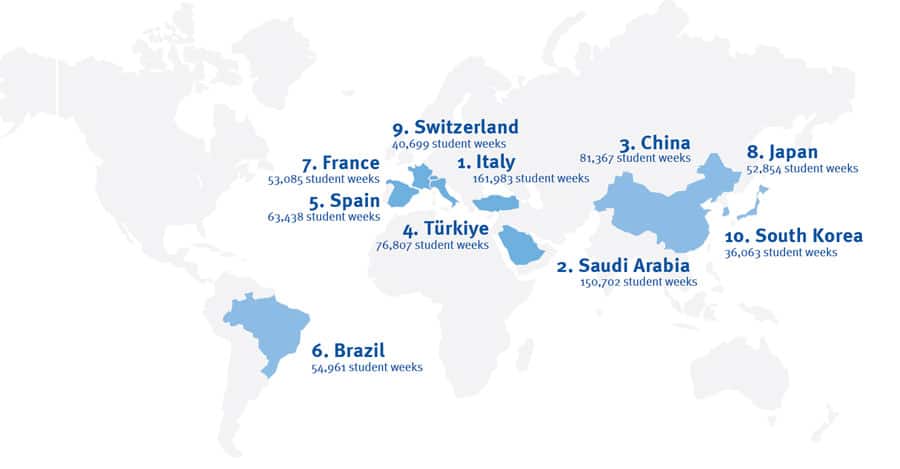
Nearly two-thirds (62%) of 2024's enrolment were juniors, which continues the longer-term shift toward younger students that has been unfolding over the past several years. Notable growth markets included China (+20,129 weeks), Türkiye (+18,782 weeks), and Colombia (+6,309 weeks). The following illustration highlights the top sending markets for UK ELT in 2024. Together, they accounted for more than 770,000 student weeks, or about just over two-thirds of the total volume of ELT programming last year.
For additional background, please see:







