
France directs universities to charge higher tuition fees to non-EU students starting September 2026

- New students from outside the EU now must pay differentiated tuition fees that are about 16 times higher than what they were previously
- The cost of study in France will remain much lower than in Big Four countries, but higher than in Germany
- The fee announcement dovetails with France’s new “Choose France for Higher Education� strategy,� which is focused on attracting international students to priority sectors
French Higher Education, Research and Space Minister Philippe Baptiste announced on 21 April that almost all non-EU students coming to France for the 2026/27 academic year will be required to pay annual tuition of €2,895 (US$3,391) for a bachelor’s programme and €3,941 (US$4,617) for a master’s degree.
Since 2019, French universities have been encouraged – but not obliged – to set non-EU tuition fees higher than for other students. The majority have continued to charge the base rate of €178 (US$195) and €254 (US$280) per year at the bachelor’s and master’s level, respectively. Their decision to opt out has been based on a belief in equal access to higher education regardless of where a student is from.
As of the announcement, universities no longer have a say in whether or not they choose to differentiate non-EU fees.
When do the fees take effect?
The fee hike does not affect current non-EU students, but it does come in the middle of the application cycle for the start of the 2026/27 academic year in September, which critics say will introduce uncertainty and confusion for both applicants and institutions alike.
Are there exceptions?
No more than 10% of students will be exempted, with most exceptions for scholarship holders and those facing personal hardship. Sixty percent of grants will be reserved for students choosing priority disciplines: health, digital – including artificial intelligence (AI) – quantum science, biotechnology, the environment, energy, space, food, information technology (IT), and communications.
The context for the hike
The mandatory tuition levels are part of a new international education strategy, “,” the ambition of which is to attract more students to sectors within which France needs more skilled workers. The country’s working‑age population is expected to contract over the coming decades, which could stem innovation and economic competitiveness if not mitigated by incoming talent.
The government says the higher fees for non-EU students will position French higher education as more prestigious. It also notes that affected students will still pay less than a third of the total cost of training them (with the rest paid by the state), and that study in France will remain less expensive for them than in most other top destinations.
In Canada, the UK, the US, and Australia, international student tuition is least US$15,000 and more often US$20,000+ per year, with tuition rates for some specialised STEM programmes and selective institutions running considerably higher.
A strategic gamble
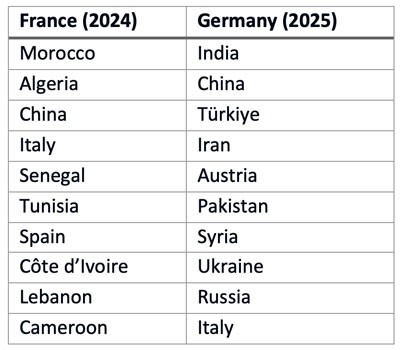
The new fee requirements in France may well increase competitiveness of another major European destination – Germany – especially in price-sensitive markets in Africa and South Asia.
Most public universities in Germany do not charge differentiated tuition fees. Rather, non-EU students are asked to pay between €100–400 (roughly US$140–$270) per semester in service fees. Germany’s private universities do charge higher fees, but account for only about 14% of system enrolment.
In 2025/26, Germany attracted 420,000 foreign students (+4% y-o-y), while in 2024/25, France hosted 443,500 international students (+3% y-o-y). Both countries have prioritised diversity in their recruitment, which has helped them to cope with slowing Chinese outbound numbers. While France dominates in Africa, Germany’s popularity is growing. Africans now compose a quarter of all international students in Germany.
What is the rationale for the fee increase?
The government does not think higher fees will depress overall international student demand. Minister Baptiste pointed out that the number of foreign master’s students in the UK has gone up by +60% in the past 10 years despite tuition fees in the tens of thousands of euros. (However, -19% fewer international master’s students enrolled in the UK between 2023 and 2025 after a rule was enacted in 2024 that prevents most students from bringing their families with them on dependant visas.)
The other reason the government cites for imposing differentiated fees is that France’s public higher education system . Most French public universities currently work within deficit budgets, mostly because wage, energy, and other costs are outpacing government funding.
Reaction from higher education stakeholders
, the association of French rectors, considers the new fees for non-EU students to be:
- In opposition to the “humanistic values of hospitality and openness that universities extend to students from around the world”;
- Likely to produce a pronounced deterrence effect (students opting not to enrol) on students from disadvantaged countries;
- Insufficient for addressing universities’ profound financial woes (revenue from the higher fees is projected at €250 million).
The association states: “In this context, France Universités opposes the particularly sharp and abrupt reduction in the latitude previously available to each institution.”
Unions – which are already upset with the government’s approach to higher education – also condemn the new fees. In March, 20 unions representing professors, researchers, and students coordinated rallies across France to protest state underfunding, chanting slogans such as “Universities in ruins, science in peril.” New protests are scheduled for May 1, and the student unions will that the differentiated fees are:
- “Dangerous, discriminatory, and incoherent (FAGE)”
- “Xenophobic,” poised to “exacerbate poverty among international students,” and “not aimed at better welcoming international students, but at selecting those who can pay (UNEF).”
Association and union activism will likely focus on persuading the government to extend exemptions to more students, allow for payment plans, and protect current students from being expelled when they cannot meet a payment deadline.
University of Strasbourg expels 47 students
This year marked the first instance of a university expelling students because of their inability to pay differentiated fees. Unlike most other French universities, the University of Strasbourg exercised its option to charge non-EU students more before this became mandatory, and in April it notified 47 students that they would be “disenrolled” because of missed payments. Most of the students were in good academic standing.
As reported in , university faculty have launched a petition condemning the “financial harassment” of students “selected on academic criteria.” Some barged in on a university board meeting on 16 April, demanding a breakdown of exempted nationalities, and data on university enrolments by country of origin.”
Disproportionate impact
Whether French student and faculty resistance will end up softening the implementation and impact of differentiated fees remains to be seen. Time will also tell whether the higher cost of studying in France for non-EU students will have a notable impact on enrolments and demand.
Pascal Maillard, a professor at the University of Strasbourg and secretary of SNESUP-FSU, a higher education union, believes that the increased fees will have a significant and disproportionate impact on poorer students:
“Ninety percent of [non-EU students] come from some of the world's poorest countries: For students from Senegal, Togo, Chad, Morocco or Algeria, €15,000 [of tuition plus other financial requirements in France] is an astronomical sum that represents the equivalent of €45,000 to €50,000 for us."
Professor Maillard’s comment underscores how massive an investment study abroad is for many students from Africa and from other regions where per capita wealth is low.
For additional background, please see:







